
Vandaag of morgen in huis

Kwaliteit gegarandeerd

Welkomstaanbiedingen ontgrendelen: GRATIS bezorging | Tot 80% korting | Gratis 30 dagen JoyPlus-proefperiode
Download de app
Car LED lighting can give your interior a different look, replace an existing bulb or modernise certain parts of your car. However, not every LED strip or replacement bulb is suitable for every vehicle. The wrong fitting, insufficient space behind the lamp or a warning message from the CANbus system can quickly make a purchase less appealing.
This guide will help you compare car LED lighting based on verifiable specifications, installation and use. That way, you can better judge when a compact T10 bulb is sufficient and when a complete set of RGB ambient lighting for cars makes more sense.
A product description may say that a product is suitable for many cars, but that does not automatically mean that the fitting, available space and connection match those of your vehicle. Always check:
With an LED strip, the main considerations are not the fitting but the length, positioning and power connection.
Brands sometimes quote a much higher light output than that of a halogen bulb. According to the brands’ own tests, these figures may be measured under specific conditions. In practice, the reflector, light distribution, colour temperature and headlight alignment also make a difference.
Do not use random H7 H11 H1 LED headlights without checking whether the bulb and application are permitted for your car. Interior, parking and number plate lighting have different requirements from headlights.
A CANbus error-free LED bulb is designed to reduce the likelihood of a warning message or flickering light. This is not a universal guarantee. Some vehicles, including certain BMW, Mercedes-Benz and Volkswagen models, may still require an additional decoder or resistor. For example, the Bullvision product description states that Volkswagen, Mercedes-Benz, BMW and similar vehicles may need an additional CANbus decoder.
T10 W5W LED bulbs are commonly used for interior and number plate lighting. T10, W5W, 501, 168, 194 and 2825 are related designations, but you should still check the original bulb or your car’s handbook. A bulb that fits electrically may be too long or too wide physically.
For headlights, you must follow the exact specified fitting. Do not simply replace an H1 bulb with an H7 or H11.
Most sets for car LED interior lighting operate at 12 volts. A vehicle or connection with a different voltage could cause damage. Heat dissipation is particularly important for headlights. Look for an aluminium housing, fan or another cooling solution where this is listed in the specifications.
With LED strips, keep cables away from pedals, the steering mechanism and moving seats. Test the lighting before securing everything permanently.
“Plug-and-play car lighting” usually means that no major modifications are needed, but it does not mean that every installation can be completed without preparation. Clean surfaces before applying tape and do not bend acrylic or fibre-optic strips sharply. Some sets may only be cut at designated points.
A complete set for car interior LED strips may include several controllers, extension cables and separate lamps. This gives you more options, but it also requires tidy cable routing.
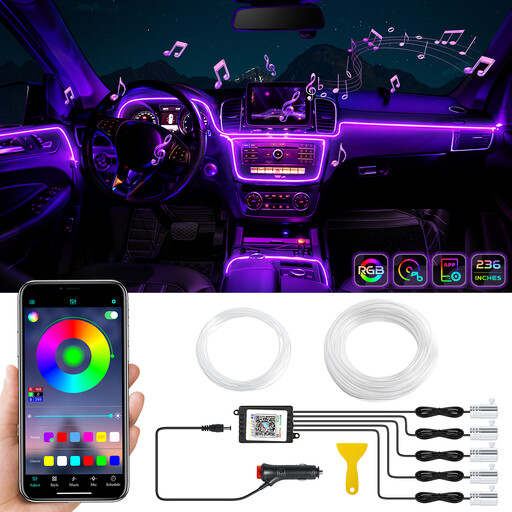
Why it suits this profile: This set is designed for drivers who want an easy way to add RGB ambient lighting to the dashboard or door panels. The included car charger minimises the need to modify the wiring.
The specifications state an operating voltage of 10–16 volts. The fibre can be cut into 3 to 5 sections; check the required length in advance and do not bend the line more sharply than necessary.
Bluetooth app control, 29 pre-programmed modes according to the product description, music-reactive LED lighting and approximately 6 metres of fibre.
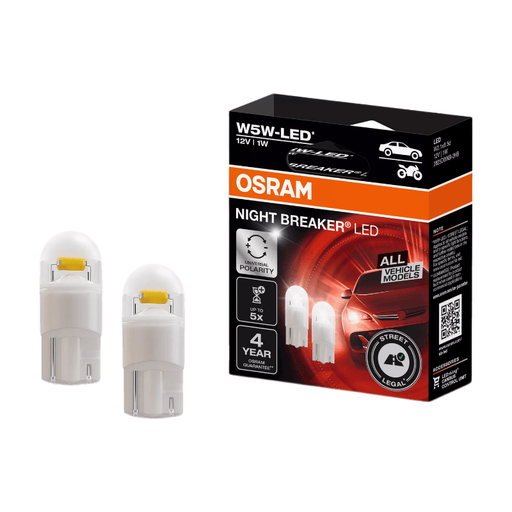
Why it suits this profile: Ideal for anyone looking for a compact W5W solution for parking lights, position lights, number plate lighting or interior lighting, while also valuing clear application information.
The product information limits use to the stated 12V applications and warns that some CANbus systems may still require a decoder.
W5W fitting, 12 volts, 5700 kelvin, 50 lumens according to the product information, and universal polarity for installation.

Why it suits this profile: This comprehensive set is ideal for tuning enthusiasts who want to combine dashboard, door and footwell lighting with multiple controllers and separate lighting zones.
The set clearly states that it uses a 12V power supply and includes four footwell lamps and separate door lighting. The strips may only be shortened at suitable points.
Six acrylic strips, four footwell lamps, door and storage-compartment lighting, Bluetooth app, static colours, and chase or music modes according to the product description.
We have put together a complete, up-to-date list of products that fully meet these strict selection criteria and the applicable European safety regulations.
That depends on its positioning, colour and light intensity. Lighting must not obstruct your view or confuse other road users. Position RGB ambient lighting indirectly in dashboard or door gaps, and check the Dutch traffic rules for use while driving.
Lifespan varies according to the product and conditions of use. For some T10 W5W LED bulbs, manufacturers quote figures of up to 60,000 hours, while certain headlights are stated to last for more than 50,000 hours. According to the brands’ own claims, these are product estimates; heat, vibration, moisture and the quality of the connection all affect the actual lifespan.
LEDs often use less power for a comparable application, but the exact consumption varies by bulb or strip. Always check the stated wattage. With RGB sets, consumption may also change depending on the number of active light points and the brightness setting.
