
Vandaag of morgen in huis

Kwaliteit gegarandeerd

Welkomstaanbiedingen ontgrendelen: GRATIS bezorging | Tot 80% korting | Gratis 30 dagen JoyPlus-proefperiode
Download de app
A flat car battery often strikes at the worst possible time: in a dark car park, on a camping trip or just before you leave for work. With a car jump starter, you can try to start a 12V vehicle yourself, without needing another car or jump leads.
However, not every portable jump starter is automatically suitable for your vehicle. High amp ratings, large battery capacities and extra features may sound appealing, but they don’t tell the whole story. Read on to find out what to look for and which models suit different needs.
A figure such as 3000A or 7000A tells you the stated peak current, but not whether the device is suitable for your car. Check the engine size, fuel type and voltage too. A jump starter for 12V vehicles isn’t designed for the 24V systems found in some lorries and buses.
Also bear in mind the difference between petrol and diesel. Diesel engines often need more power to start. A model listed as suitable for petrol engines up to 9,0 litres may have a different limit for diesel engines.
The battery capacity, such as 12.800 or 20.000mAh, gives an indication of the available energy. The starting current and the way the manufacturer measures capacity are just as relevant. So don’t compare mAh ratings alone; also look at:
A smaller portable jump starter may be enough for a compact petrol car, while an SUV, campervan or van may need a more powerful model.
Incorrectly connected clamps can cause damage. Choose a device with clear polarity indicators, short-circuit protection, and protection against overheating or overloading. According to the product descriptions, several models below have eight to ten protection features. These are specifications provided by the brands; always read the manual to check exactly how the safety features work.
A jump starter isn’t something you buy once and then forget about. Fully charge it before first use and check the battery regularly. Some manufacturers recommend recharging every two to three months, while others advise doing so every three to six months. Store the device somewhere dry and don’t leave it in direct sunlight or extreme heat for long periods.
Most of the cars, motorbikes, campervans and boats in this selection use a 12V battery system. Check your vehicle’s manual to be sure. Also check the maximum engine size:
A portable battery charger or power bank for your car can charge devices, but it won’t always replace a suitable car battery booster.
A higher stated peak current gives you more headroom, but the model still needs to be suitable for your engine. Look for sturdy clamps, a suitable cable length and clear connection instructions too. Usually, you’ll connect the red clamp to the positive terminal and the black clamp to a suitable negative terminal or unpainted metal earth point, depending on the instructions.
Try starting the car briefly, and let the device cool down if you need to make several attempts. Don’t use an emergency jump starter with a damaged, leaking or frozen battery.
A jump starter with a compressor is handy if you need to adjust your tyre pressure while out and about. Check the maximum pressure, the nozzles supplied, the units of measurement and whether it switches off automatically. A 150 PSI compressor won’t inflate every car tyre at the same speed. The actual inflation time depends on factors such as tyre size and starting pressure.
An LED light with an SOS or flashing mode can be useful if you break down in the dark. The power bank function can charge phones, tablets and other USB devices, but check the output ratings before connecting a device.

Why it suits this type of user: At around 330 grams, its compact casing is easy to store in your car. According to the product listing, this model is suitable for 12V petrol and diesel vehicles, motorbikes and boats.
The product specifications state both a peak current of 1200A and a starting current of 600A, so you get more than just one marketing figure.
Stated capacity of 12800mAh, LCD display, USB output and LED light with three modes.
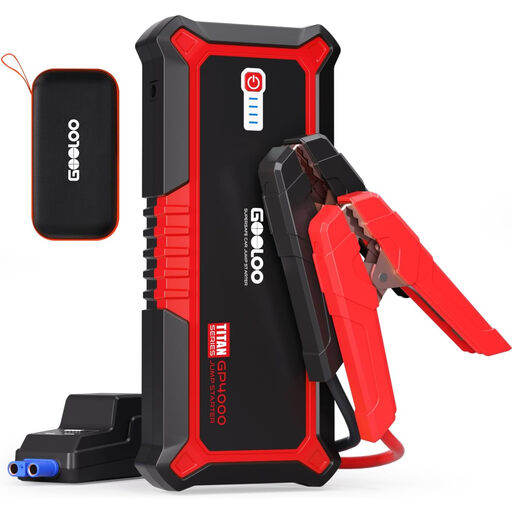
Why it suits this type of user: This model is designed for larger 12V vehicles. According to the product description, it supports petrol engines up to 10,0 litres and diesel engines up to 10,0 litres; always check this against your vehicle’s manual.
The manufacturer lists ten protection features, including protection against reverse polarity, short circuits and overheating.
Stated peak current of 4000A, metal clamps, USB outputs and a sturdy casing.

Why it suits this type of user: For drivers of SUVs, lorries and campervans, or those who regularly make long journeys, this model combines jump-starting assistance with a car tyre inflator and power bank.
The listing gives a maximum compressor pressure of 150 PSI, five inflation modes, four nozzles and automatic shut-off.
Stated peak current of 4500A, suitable for petrol engines up to 9,0 litres and diesel engines up to 8,0 litres, plus an LCD screen and LED light.
We’ve put together a full, up-to-date list of products that meet these strict selection criteria and the applicable European safety regulations.
A jump starter is intended as emergency starting assistance, not as a permanent fix for a worn-out battery. If the problem keeps happening, have the car’s battery and charging system checked.
No. First check that your vehicle has a 12V system, then compare its fuel type and maximum engine size with the product specifications. A 12V battery booster isn’t suitable for a 24V system or an electric car’s high-voltage system.
Its lifespan depends on storage, temperature, charging habits and how often you use it. Recharge the device regularly according to the manual, even if you don’t use it. Store it somewhere dry and avoid prolonged exposure to heat, frost and direct sunlight.
Charging it usually takes little energy, but the built-in battery slowly loses charge while in storage. So check it every few months. A model with an LCD display or charge indicator makes it easier to check the remaining capacity before you set off.
