
Vandaag of morgen in huis

Kwaliteit gegarandeerd

Welkomstaanbiedingen ontgrendelen: GRATIS bezorging | Tot 80% korting | Gratis 30 dagen JoyPlus-proefperiode
Download de app
A flat car battery always seems to happen at the worst possible moment: before you leave for work, in a dark car park or while you’re away on holiday with a caravan. A car jump starter can be a handy emergency solution. However, not every model is suitable for every car. High amp ratings, large battery capacities and extra features may sound impressive, but they don’t tell the whole story.
In this guide, you’ll find out what to look for in a portable jump starter, which marketing claims to treat with caution and which type is right for your needs.
A figure such as 2000A, 4000A or even 8000A is the stated maximum peak current. It isn’t the same as a continuous starting current. What’s more, measurement methods vary between brands. So use peak current as one point of comparison, not as a guarantee that it will start every car.
Check the stated engine compatibility too. A model rated for, say, up to 6.0-litre petrol and 4.0-litre diesel engines won’t necessarily be suitable for a large van or motorhome.
A jump starter rated at 20,000mAh may seem more powerful than one rated at 10,000mAh, but manufacturers don’t always state capacity in the same way. For example, the Porbi S901 lists 20,000mAh, with a stated nominal capacity of 10,000mAh. So check the dimensions, charging time and whether it’s intended to be used as a car power bank too.
Higher capacity can mean extra weight. If you mainly want a compact emergency starter to keep in the glove compartment, a lightweight model may be more practical.
A jump starter with a compressor can be useful if your tyre is low on air, but 150 PSI is the maximum pressure and tells you little about how quickly it can inflate a tyre. Check the airflow, hose, supplied valve adaptors and maximum running time too. Some models shouldn’t run for more than around 10 minutes at a time. Let the device cool down afterwards.
A car tyre inflator also won’t repair a puncture. Use the compressor to get the tyre up to the correct pressure temporarily, then drive to a garage or tyre specialist if needed.
Most models in this category are 12V jump starters for cars, SUVs, motorbikes and light commercial vehicles. Check your vehicle’s manual to make sure the battery is 12V. A 12V jump starter isn’t designed for a 24V system, such as those found in some heavy goods vehicles.
Also check whether the model is suitable for petrol or diesel engines. Diesel engines generally need more starting power. A product whose specifications state ‘up to 8.0-litre petrol and 6.0-litre diesel engines’ gives you a clearer indication than a vague claim such as ‘suitable for all cars’.
It’s best to choose a car emergency starter with clear connection checks. Useful features include:
According to the product specifications of various brands, these types of safety features are built in. That doesn’t mean you can skip the manual. Never use a jump starter with a visibly damaged, leaking or frozen battery.
A display showing the battery percentage makes it easier to check whether your car jump starter is ready to use. Fully charge the device before using it for the first time, and store it somewhere cool and dry, away from direct sunlight.
The battery will slowly lose charge even when the jump starter isn’t in use. Check the charge every few months and recharge it according to the manual. A jump starter left unchecked in the boot for years may not have enough power when you need it.
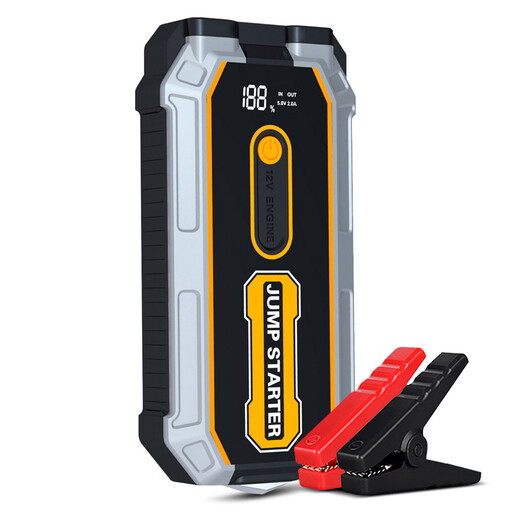
Why it suits this profile: At around 330 grams, this compact model is ideal for drivers who want to carry a simple emergency car starter without taking up much space in the car.
The product specifications list the battery capacity of 12.800mAh and the nominal capacity of 7.200mAh separately. The supported 12V petrol and diesel vehicles are also clearly stated.
1200A peak current, LCD display, USB output and an LED light with three modes. Stated weight: approximately 330 grams.
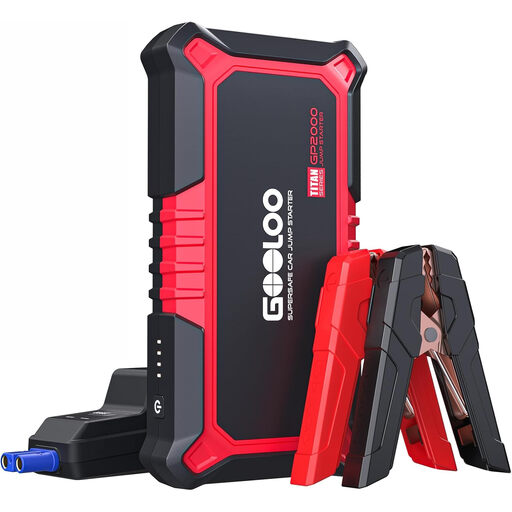
Why it suits this profile: This model is aimed at drivers who value safety features and sturdy clamps, as well as starting power and the option to use it as a power bank.
The stated compatibility is specified for engines up to 8.0-litre petrol and 6.0-litre diesel. The description also lists ten safety features, including reverse polarity and spark protection.
2000A peak current, two USB outputs and a 400-lumen LED light with normal, strobe and SOS modes.
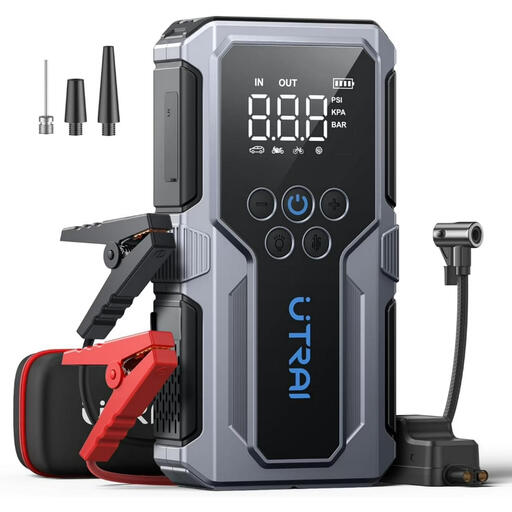
Why it suits this profile: For SUV drivers, motorhome owners and people who are often on the road, this model combines jump starting with tyre inflation and device charging.
According to the product specifications, the compressor has adjustable pressure, an LCD display and an automatic stop function. The instructions also state a maximum continuous running time of 10 minutes.
3000A peak current, compressor up to 150 PSI, 2-inch LCD screen, ten listed safety features and 18W fast charging.
We’ve put together a complete, up-to-date list of products that meet these strict selection criteria and the applicable European safety regulations.
Use a car battery charger if the battery keeps going flat. A jump starter can help in an emergency, but it won’t provide a lasting charge for a worn or faulty battery.
It can, but only if the model is suitable. Check the stated maximum diesel engine capacity and the required starting power. A diesel engine often needs more current than a comparable petrol engine.
That depends on storage, temperature, charging cycles and battery type. Recharge the device regularly, even when you’re not using it. Don’t leave it in a hot car or somewhere damp for long periods.
There are no fuel or subscription costs for using it. You will need electricity to recharge the internal battery. Ongoing costs mainly come from potential wear to the lithium battery and replacing it if its capacity decreases over time. Check the warranty and maintenance instructions before you buy.
