
Vandaag of morgen in huis

Kwaliteit gegarandeerd

Welkomstaanbiedingen ontgrendelen: GRATIS bezorging | Tot 80% korting | Gratis 30 dagen JoyPlus-proefperiode
Download de app
A flat car battery often happens at the worst possible moment: on a cold morning, during a motorhome holiday or after the car has been left unused for a few weeks. A car jump starter can get you moving again without needing a second car. However, not every compact device is suitable for every engine.
As a Joybuy Product Recommendation Officer, I focus mainly on verifiable specifications and practical use. Pay particular attention to these three common pitfalls:
Most portable jump starters are designed for 12V vehicles with a lead-acid battery. This generally includes cars, motorbikes, SUVs, vans, motorhomes and some boats. Always check your vehicle’s handbook and the product information.
Next, look at the maximum engine capacity:
The stated peak current, such as 1200A, 2000A or 4000A, is a manufacturer’s product specification. Therefore, compare this figure alongside the stated engine compatibility, starting current and instructions for use.
A safe car jump starter should preferably have smart jump leads with clear status indicators and protection against, among other things:
According to GOOLOO’s product description, the GE1500 and GP2000 models have ten safety features. The number of protections may vary between other models. Treat this as a point to check rather than a guarantee that incorrect use cannot cause damage.
Read the manual before first use. In the usual sequence, connect the red clamp to the positive terminal and the black clamp to a suitable, unpainted metal earthing point. Start the engine briefly and, once it has started, remove the black clamp first, followed by the red clamp. The exact procedure may vary by model.
A car battery starter needs to have enough charge when you need it. A display showing the charge level helps prevent surprises. Some models recommend charging the jump starter every two to three months when it is not being used.
Also note the difference between:
A compact emergency jump starter weighing 330 grams is easy to store, while a heavier model may offer more features or a higher stated current. Store a lithium jump starter in a dry place, away from direct sunlight and not for extended periods in an extremely hot car.
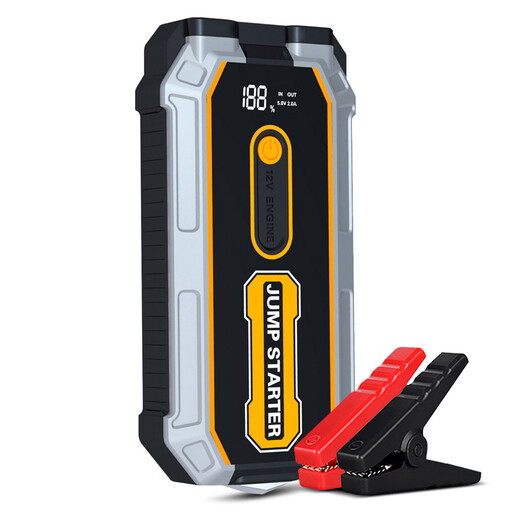
Why it suits this profile: The compact housing weighs approximately 330 grams, making it practical for drivers who want to keep a simple portable jump starter in the glove compartment.
The LCD display shows the remaining charge level. This means you can see when charging is needed sooner than with a model without a charge indicator.
1200A peak current, suitable for 12V petrol and diesel vehicles according to the product description, plus a USB output and three-mode LED light.
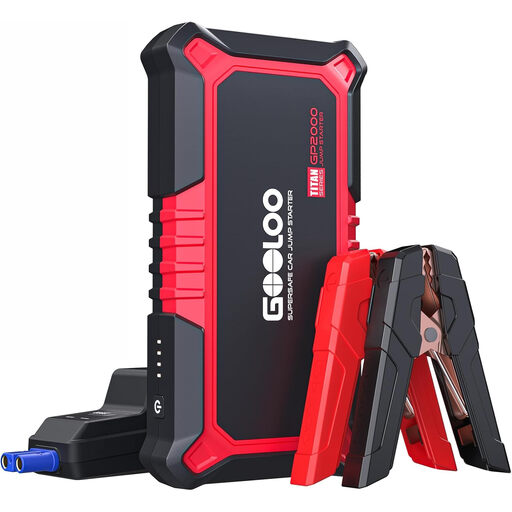
Why it suits this profile: This model combines a higher stated peak current with smart leads, a storage case and several charging options for regular use.
The manufacturer lists ten safety features, including protection against reverse polarity, short circuits and overheating. Check the manual for exact operation.
2000A peak current, stated support for up to 8.0-litre petrol and 6.0-litre diesel engines, two USB outputs and a 400-lumen torch.
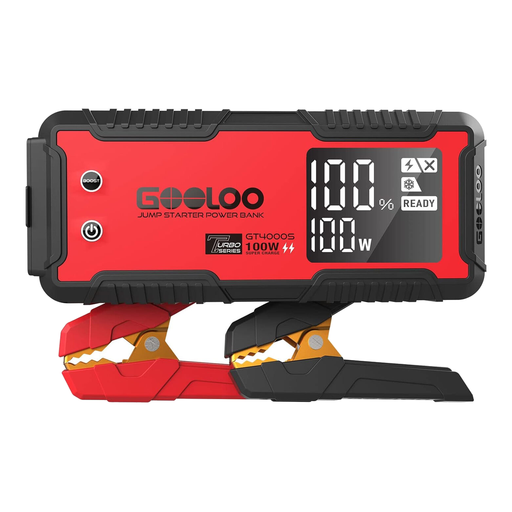
Why it suits this profile: The stated capacity and connections are suited to drivers of motorhomes, pick-ups, boats or larger vehicles who want extra reserve power.
The screen shows the product status and the product description lists several safety features. The stated operating temperature range is -20 °C to 60 °C.
4000A peak current, stated in the product information as suitable for up to 12.0-litre petrol and 10.0-litre diesel engines, plus 100W charging and a 12V/15V connection.
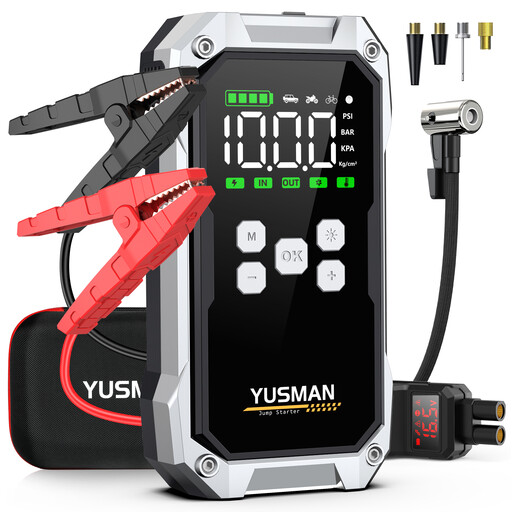
Why it suits this profile: Ideal for motorists who want a tyre inflator and warning light in the same device as a car battery booster.
The LCD display shows the status and tyre pressure. The manufacturer lists protection against short circuits, overheating and reverse polarity, among other features.
5000A peak current, a compressor up to 150 PSI, USB ports and four light modes according to the product description.
We have put together a complete, up-to-date list of products that fully meet these strict selection criteria and the applicable European safety regulations.
Never use a jump lead with booster on a vehicle whose voltage or battery type is not supported. Stop if the cables are damaged, the battery is leaking, there is smoke or significant heat, and have the vehicle inspected.
This depends on the battery’s condition, the engine and the model. Some products have a boost function for very low voltage, but this is not guaranteed to work with every vehicle. Check the stated compatibility and fully charge the jump starter beforehand.
Its service life depends on storage conditions, temperature, charge level and the number of jump starts. Store the device in a dry place and recharge it periodically according to the manual. Manufacturers may state a standby time or warranty; this is product-specific information, not a general lifespan for all lithium batteries.
Yes, various models have USB outputs for phones, tablets, cameras or GPS devices. The charging function does not replace a full-size inverter for 230V appliances. Before buying, check the number of ports, the output voltage and the maximum power.
