
Vandaag of morgen in huis

Kwaliteit gegarandeerd

Welkomstaanbiedingen ontgrendelen: GRATIS bezorging | Tot 80% korting | Gratis 30 dagen JoyPlus-proefperiode
Download de app
A flat battery often happens at an inconvenient time: on a cold morning, after a weekend parked up or when your car is in a remote car park. A car jump starter can get you moving again without a second vehicle or traditional jump leads. However, not every model is suitable for every car, motorbike or campervan.
Manufacturers’ product descriptions often quote high peak currents and large capacities. These figures are useful, but they do not tell the whole story. As a Joybuy Product Recommendation Officer, I therefore focus primarily on verifiable specifications, connection safety and the practical situation in which you intend to use the portable jump starter.
A peak current, such as 2,000A or 5,500A, is not the same as a continuous starting current. According to a brand’s product description, it is a maximum short-term value under certain conditions. You should therefore also check:
A car jump starter for a small petrol car is not automatically suitable as a diesel jump starter, or for a campervan or van.
Many models feature protection against reverse polarity, short circuits, overheating and overcurrent. This reduces the risk of incorrect connection, but it does not make careless use safe. Always check the positive and negative terminals, use the supplied cables and follow the instructions.
A jump starter must not be used with a visibly damaged, leaking or frozen battery. If in doubt, calling a breakdown service or visiting a garage is the safer option.
A portable booster that has been sitting flat in the boot for months will not help when you break down. Lithium batteries gradually lose charge during storage. The product information for various models recommends recharging them approximately every two to three months. Check the charge before a long journey and especially before winter.
Choose a 12V jump starter that is suitable for your vehicle. Do not look only at the car’s make or model; engine size and fuel type are more important. For example, a product may be described as suitable for petrol engines up to 6.0 litres and diesel engines up to 4.0 litres. This is a product specification, not a guarantee that every flat or faulty battery will start.
A compact model is often sufficient for a motorbike or quad. For an SUV, lorry, boat or campervan, having extra scope in the stated engine compatibility is practical. Also check that the vehicle actually uses a 12V system. A 24V system, used in some lorries, requires a different type of solution.
Capacity is often stated in mAh, but the usable amount of energy also depends on the internal battery and output power. A higher capacity can be useful for several starting attempts or if you want a jump starter with power bank functionality. Also look at:
A lightweight model of around 330 grams is easy to store in the glove compartment. A more powerful model with a compressor can weigh around 900 grams and needs more storage space.
Look for a smart cable with a clear status indicator, spark protection, reverse-polarity protection and overheating protection. An LCD screen can display the remaining charge or temperature. This makes operation easier to understand, but you should still check manually that the clamps are connected correctly.
The stated temperature range is based on the brand’s product information. Do not store a lithium jump starter in direct sunlight or in a very hot car for long periods. Allow the device to cool down between several starting attempts.
A jump starter with compressor can be useful when a car tyre is soft. Pay attention to the maximum pressure, air flow rate, hose length and automatic shut-off function. A rating of 150 PSI indicates a maximum value; it is not the recommended tyre pressure for your car. Use the sticker on the door pillar or the vehicle handbook for that.
An LED light with an SOS or flashing function is practical if you break down in the dark. A power bank is useful for a phone, but check the charging protocol if you also want to charge a tablet or laptop.
A car battery tester is not a starting aid, but it can help you assess the cause of starting problems. According to the product description, the VDIAGTOOL BT500 supports 6V, 9V, 12V and 24V lead-acid batteries, including AGM, GEL and EFB. The device displays information including voltage, resistance, charge status, and the starting and charging system. According to the same description, lithium and deep-cycle batteries are not supported.
A car battery charger is designed to charge or maintain a battery gradually. A jump starter provides short-term starting power; a battery charger does not replace that function.

Why it suits this profile: According to the product information, this compact model weighs around 330 grams and is designed for 12V petrol and diesel vehicles, motorbikes and boats. It is therefore easy to keep in a car for occasional breakdown assistance.
The stated peak current of 1200A is shown alongside a starting current of 600A, allowing you to compare both figures. The LCD display also helps you check the charge before setting off.
12800mAh capacity according to the product description, USB output, three light modes and dimensions of 165 × 84 × 30 mm.
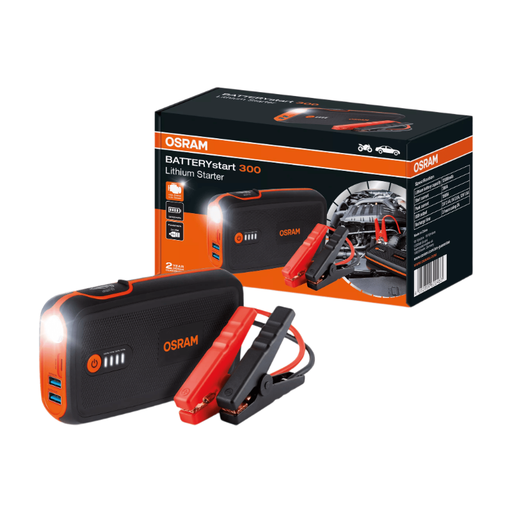
Why it suits this profile: According to the product information, this 12V battery booster is suitable for petrol engines up to 8 litres and diesel engines up to 4 litres. The additional 12V output can power a compatible car accessory.
The vehicle limits are clearly stated. The manufacturer also provides instructions for fully charging the unit, connecting the terminals correctly and removing the clamps immediately after starting.
2000A peak power, 16800mAh lithium-ion capacity, dual USB output, LED light and a stated two-year warranty.
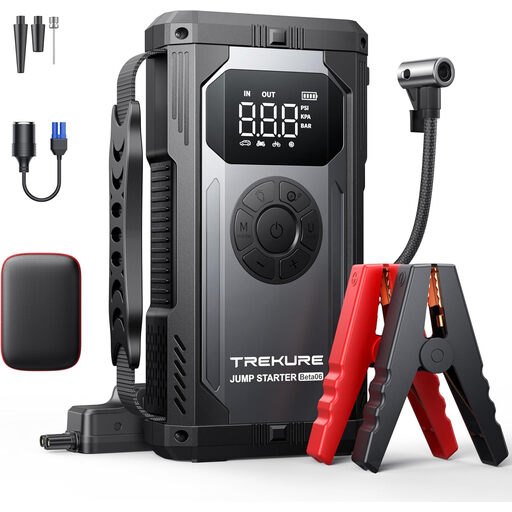
Why it suits this profile: According to the product description, this model combines starting assistance for 12V vehicles with a 150 PSI compressor, USB outputs and a 12V connection. This makes it suitable for campervans, SUVs, boats and people who spend more time on the road.
The product information mentions automatic shut-off at the set tyre pressure and provides a temperature range. However, use the compressor according to the recommended tyre pressure, not based on the maximum PSI.
5500A peak current, support for up to 10.0 litres of diesel according to the product description, 23800mAh lithium-polymer battery and three light modes.
We have put together a complete, up-to-date list of products that fully meet these strict selection criteria and the applicable European safety regulations.
Do not use damaged cables and never connect the red and black clamps directly to each other. Jump leads with protection are an alternative, but you will need a second vehicle or a suitable external battery.
That depends on the condition of the battery and the jump starter model. Low voltage can sometimes be overcome using a boost function, but a faulty, frozen or leaking battery must not be started with a booster. Check the handbook and the battery first.
Its lifespan depends on usage, storage temperature and charging maintenance. Recharge the device regularly according to the product instructions, even if it has not been used. Do not store it in direct sunlight or extreme heat for long periods.
No. A jump starter supplies high current for a short time to start a vehicle. A car battery charger gradually charges the battery from the mains and some models can also provide maintenance charging. If you regularly make short journeys, you may want to consider a suitable battery charger or car battery tester alongside an emergency car starter.
