
Vandaag of morgen in huis

Kwaliteit gegarandeerd

Welkomstaanbiedingen ontgrendelen: GRATIS bezorging | Tot 80% korting | Gratis 30 dagen JoyPlus-proefperiode
Download de app
A flat car battery often happens at the worst possible time: on a cold morning, by the motorway or at a campsite without a power socket. With a car jump starter, you can sometimes provide support to a 12V battery yourself, without relying on jump leads or breakdown assistance.
However, not every portable car jump starter is suitable for every vehicle. Marketing claims about high peak currents mean little if the cables, safety features or vehicle compatibility do not match your needs. Below, you’ll find out which specifications to check and which models suit different situations.
A high peak current sounds appealing, but it is not the only factor that matters. Also check whether the car jump booster is suitable for your petrol or diesel engine, for example based on engine capacity. A device described as suitable for a petrol engine up to 9.0 litres is not automatically suitable for every diesel vehicle.
Also pay attention to the nominal voltage. Most cars, SUVs, motorbikes and vans require a 12V jump starter. Using the wrong voltage could cause damage.
Incorrectly connected clamps can be dangerous. Look for features such as reverse-polarity protection, short-circuit protection, overheat protection and overcurrent protection. A smart cable with an indicator light showing whether the connection is correct makes the device easier to use.
These features do not replace careful operation. Do not use a battery booster if the battery is visibly leaking, damaged or frozen.
A car emergency starter only works when its internal battery has enough charge. Lithium products discharge slowly, but they still require maintenance. Many models recommend charging the device every three to six months. Store it in a dry place and avoid prolonged exposure to heat, frost or direct sunlight.
Compare the stated peak current with your vehicle’s requirements. A compact model may be sufficient for a small petrol car. For an SUV, van, motorhome or diesel engine, having more capacity to spare is useful.
Always check these three points:
Claims such as “starts in seconds” or “thousands of starts” come from the brand’s product information. Do not regard them as guaranteed results in every situation, as the condition of the battery, temperature and engine all have an impact.
Thick cables and well-fitting clamps help transfer power reliably. Look for a clear connection between the smart jumper cable and the battery booster. A green signal when the connection is correct, as found on some models in the overview, is useful if you have little experience with jump leads.
Always follow the instructions: typically, you connect red to the positive terminal and black to the negative terminal or a suitable metal earthing point. Only start the engine once the device indicates that the connection is correct.
A jump starter power bank can charge phones, tablets and other USB devices. Check how many USB ports are available and whether fast charging is supported. An LED light with an SOS or flashing mode can improve visibility at the roadside, but it is not a replacement for a warning triangle or other legally required safety equipment.
A jump starter with compressor is useful for inflating tyres while you’re on the road. Check the maximum pressure, the nozzles supplied and whether it has an automatic shut-off. The product information for the UTRAI JS-9 and BuTure BC02, for example, states that the compressor reaches up to 150 PSI and stops once the set pressure is reached. Allow the compressor to cool down between uses and do not run it for longer than the stated maximum duration.
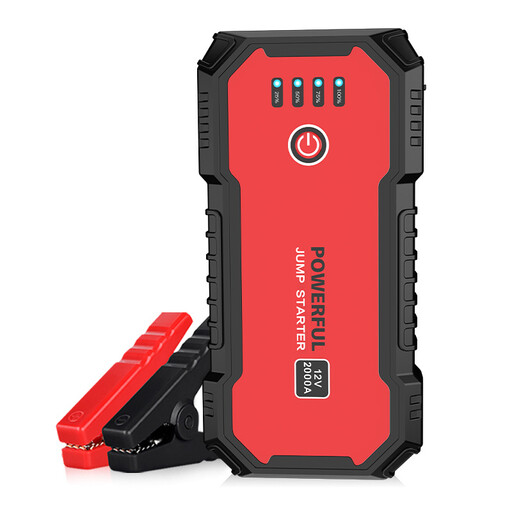
Why it suits this profile: A compact option for drivers of 12V petrol and diesel vehicles who mainly want an emergency power source and power bank. According to the product description, the model weighs approximately 430 grams.
The product information states the vehicle compatibility, a rated capacity of 10,000mAh and protection against dust and rain. However, check that the stated 1500A output and engine limits are suitable for your car.
14,000mAh battery according to the description, QC3.0 18W output and LED lighting with steady, flashing and SOS modes.
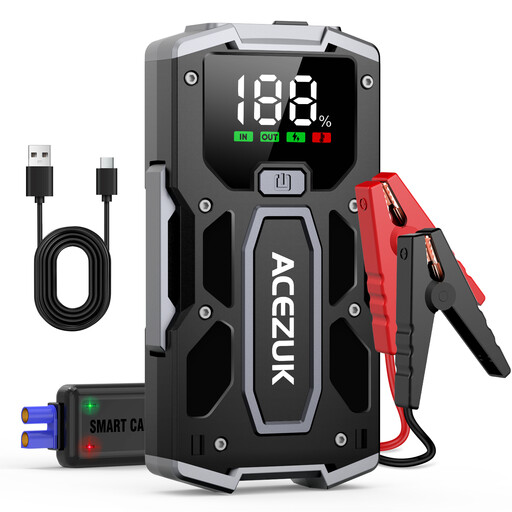
Why it suits this profile: Ideal for anyone who values extra control and wants to be able to read a display. According to the product description, the model is intended for cars, lorries, motorbikes and lawnmowers, among other vehicles.
The model lists eight safety technologies and a display showing battery and temperature information. Before buying, check the limit of 7.0 litres for petrol and 5.5 litres for diesel.
LCD display, 400-lumen LED lamp with three modes, USB output and Type-C input.
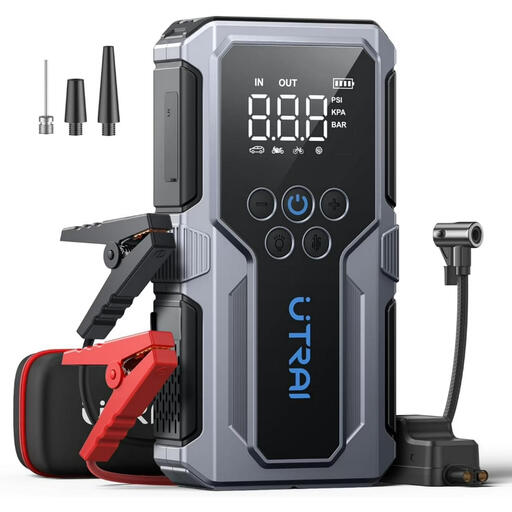
Why it suits this profile: Suitable for motorists, campers and travellers who want to inflate tyres without carrying a separate pump, as well as having a car battery starter.
According to the product description, the compressor has adjustable pressure, an LCD display and automatic shut-off. Do not use it continuously for more than ten minutes.
150 PSI compressor, 15,000mAh power bank, USB and USB-C ports and ten stated safety features.
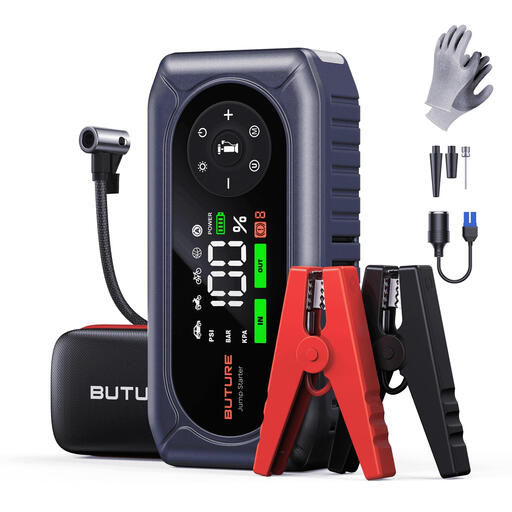
Why it suits this profile: An interesting option for drivers of larger vehicles, SUVs, boats or motorhomes who want to combine several functions in one device.
The product information states limits of up to 9.0 litres for petrol and 8.0 litres for diesel, as well as automatic compressor shut-off and ten safety features. Compare these limits with your vehicle’s specifications.
Stated peak current of 4500A, compressor up to 150 PSI, four nozzles and four LED modes.
We’ve put together a complete, up-to-date list of products that fully meet these strict selection criteria and the applicable European safety regulations.
A jump starter is intended for emergency use. A battery that regularly goes flat may need servicing or replacing.
No. Check the maximum engine capacity for petrol and diesel, the vehicle category and the manufacturer’s instructions. A model for a small petrol car may not be suitable for a diesel van, motorhome or SUV.
Its service life depends on the internal battery, storage temperature, charging frequency and number of starting attempts. Recharge the device periodically according to the instructions, for example every three to six months. Stop using it if it swells, becomes damaged or shows any other visible abnormalities.
Charging it generally uses less electricity than running a compressor for a long time or charging several devices through the power bank. The exact cost depends on the capacity and electricity price. A model with USB-C fast charging can reduce charging time, but check that the supplied cable and adapter are suitable.
