
Vandaag of morgen in huis

Kwaliteit gegarandeerd

Welkomstaanbiedingen ontgrendelen: GRATIS bezorging | Tot 80% korting | Gratis 30 dagen JoyPlus-proefperiode
Download de app
A flat car battery usually happens at the worst possible time: on a cold morning before work, at the campsite or by the motorway. With a car jump starter, you can try to start a 12V vehicle independently, without a second car and without having to lay long jump leads across the road in the rain.
However, not every portable jump starter is suitable for every car. High amp ratings on the packaging do not tell the whole story. As a Joybuy Product Recommendation Officer, I therefore focus on verifiable product specifications, ease of use and compatibility with your vehicle.
A rating such as 4000A or 7000A sounds impressive, but the required capacity also depends on the engine type, engine capacity, battery condition and ambient temperature. Always check whether the manufacturer specifies compatibility with your petrol or diesel engine.
A jump starter for a small petrol car does not have the same requirements as one for a diesel car, SUV or van. A model described as suitable for up to 3 litres of diesel is not automatically suitable for a 5- or 8-litre diesel engine.
Peak current describes the short starting impulse. Lithium battery capacity is usually stated in mAh or Wh. A higher capacity can be useful for several attempts or for using the device as a power bank in the car, but it does not by itself indicate how powerful the starting function is.
Also pay attention to the difference between the stated capacity and rated output. With some models, the usable output capacity is lower than the nominal mAh rating.
A jump starter with an air compressor can be useful when your tyres are under-inflated, but check whether the compressor has a pressure gauge, automatic shut-off and the correct connections. A high maximum pressure, such as 150 PSI, does not mean that the device will inflate every tyre equally quickly.
An LCD display, LED light and USB ports are also useful, but they are not more important than sturdy clamps, sufficient cable length and clear protection against reverse polarity.
Start by choosing according to your vehicle:
A 12V jump starter is designed for vehicles with a 12V system. Do not use the device without checking the manual on vehicles with a different electrical system.
A car battery booster only works reliably when its built-in battery has sufficient charge. Fully charge the device before using it for the first time and check the status regularly. Manufacturers often recommend recharging a jump starter every two to three months when it is not being used.
Store the device in a cool, dry place away from direct sunlight. Lithium batteries are sensitive to prolonged exposure to high temperatures. Before setting off, also check that the clamps, cables and casing show no visible damage.
Practical safety features include:
These features do not replace correct use. Connect red to the positive terminal and black to the negative terminal, follow the instructions and remove the clamps as soon as the engine is running. Do not start a vehicle with a damaged or frozen battery.
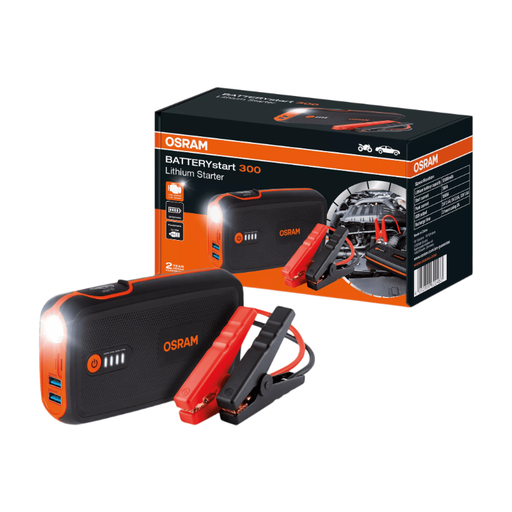
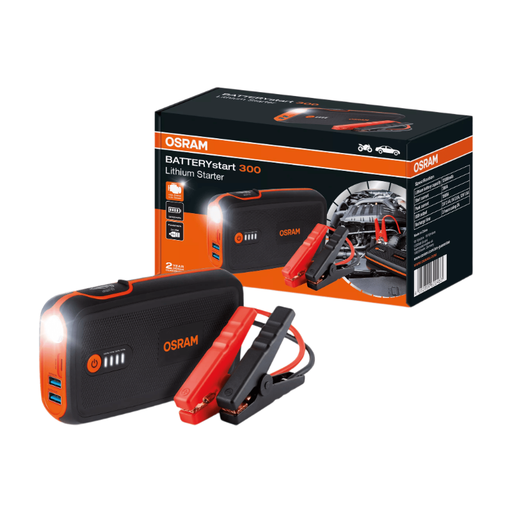
Why it suits this profile: According to the product specifications, this compact model weighs 706 grams and is designed for motorbikes, passenger cars and petrol engines up to 6 litres or diesel engines up to 3 litres.
The product description states both the peak current and engine limits, so you do not have to rely solely on the amp rating.
13000 mAh, 1500A peak current, two USB outputs and an integrated LED light.
Why it suits this profile: For drivers who want a 12V output for accessories as well as jump-starting, this model offers more features than a basic car battery booster.
The specifications state a maximum engine capacity of 8 litres for petrol and 4 litres for diesel, making the intended use clearer.
2000A peak current, 16800 mAh, dual USB and an additional 12V connection for, for example, a cool box or tyre inflator.
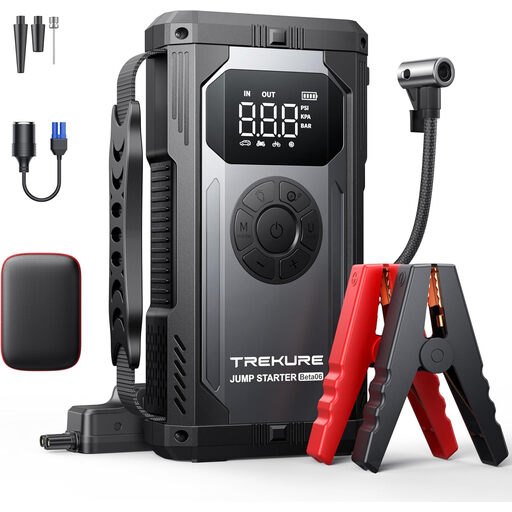
Why it suits this profile: This model is aimed at drivers of SUVs, vans, motorhomes and other 12V vehicles who also want to top up their tyres while on the road.
In addition to the starting limits, the product information states that the compressor has an LCD pressure display and automatic shut-off.
5500A peak current, compressor up to 150 PSI, dual USB, 12V output and three LED modes.
We have compiled a complete, up-to-date list of products that fully meet these strict selection criteria and the applicable European safety regulations.
A jump starter can help with a flat battery, but it will not permanently recharge a worn-out battery. Have the battery and charging system checked if the problem keeps recurring.
It can, provided that the product specifications support the diesel engine in question. Check both the voltage and the maximum engine capacity. A jump starter for a diesel car often requires more starting power than a model for a small petrol car.
Its lifespan depends on usage, storage temperature and charging maintenance. Charge the device according to the instructions, even when it is not used for long periods. Do not leave it permanently in a hot car, and do not use damaged cables or casing.
For motorists who regularly take long journeys, go camping or have a second vehicle, a battery booster with compressor can be practical. If you simply want to be able to get a flat battery going again, a compact model without an air pump may be enough. Compare the weight, dimensions, charging time and stated engine compatibility before buying.
