
Vandaag of morgen in huis

Kwaliteit gegarandeerd

Welkomstaanbiedingen ontgrendelen: GRATIS bezorging | Tot 80% korting | Gratis 30 dagen JoyPlus-proefperiode
Download de app
A flat battery usually happens at the worst possible time: on a cold morning, during a holiday or in a remote car park. With a car jump starter, you can often try to start a 12V vehicle yourself, without needing a second car or long jump leads. However, not every portable car battery booster is suitable for every vehicle.
Marketing often focuses on a high amp rating, a large battery capacity or extra features. These figures only tell you something when they match your engine, usage situation and maintenance routine. Below, you’ll discover which specifications matter, which pitfalls to avoid and which models suit different user profiles.
A rating such as 2,000 A, 4,000 A or 8,000 A sounds impressive, but this is a peak current. The stated starting current, engine size and difference between petrol and diesel are also relevant. A small petrol engine generally needs something different from the large diesel engine of a motorhome, SUV or van.
Always check:
A 12V jump starter is not automatically suitable for 24V lorries or electric vehicles with high-voltage batteries.
Lithium batteries gradually lose charge, even when the device is not being used. A jump starter left unchecked in the boot for months may therefore not have enough energy when you need it most. According to the product information for various models, regular recharging is recommended, for example every two to six months.
Also check the temperature limits. A locked car can become extremely hot in summer. Store the device according to the manual, preferably in a dry place and away from prolonged direct sunlight.
An LED torch, car power bank, LCD screen or compressor can be useful, but they do not automatically make a jump starter more suitable. A jump starter with a compressor is particularly useful if you also want to top up your tyres while out on the road. If you only need to overcome a flat battery, a more compact model may be the better choice.
Also check the included accessories. Not every product includes a mains charger; sometimes you only receive a USB-C cable or a 12V charging adapter.
Choose a car jump starter based on the stated engine capacity, not just its amp rating. For example, the product description for the GOOLOO GE1500 states support for petrol engines up to 6.0 litres and diesel engines up to 4.0 litres. The Porbi S306 mentions 12V petrol and diesel vehicles, including cars, SUVs, motorbikes, boats and snowmobiles.
For larger engines, motorhomes, tractors or heavy SUVs, models with a higher stated capacity may be more suitable. Always check that the engine capacity matches your vehicle.
A good car jump starter should provide clear connection instructions and protective features. These may include:
These features cannot prevent every mistake, but they can limit the consequences of connecting the leads incorrectly. Connect the red clamp to the positive terminal. According to the relevant manual, the black clamp should be connected to the negative terminal or a suitable, unpainted metal earth point. Use only the supplied cables and follow the manufacturer’s instructions.
Capacity is often given in mAh. When comparing products, check whether this refers to nominal capacity or rated output. For example, the Porbi S306 states a battery capacity of 12,800 mAh and a rated output of 7,200 mAh. This difference shows why a single capacity figure does not tell the whole story.
A jump starter with an air pump can be especially practical when a tyre is underinflated. Look out for:
A compressor is designed for topping up a tyre, not for repairing a damaged or punctured one.
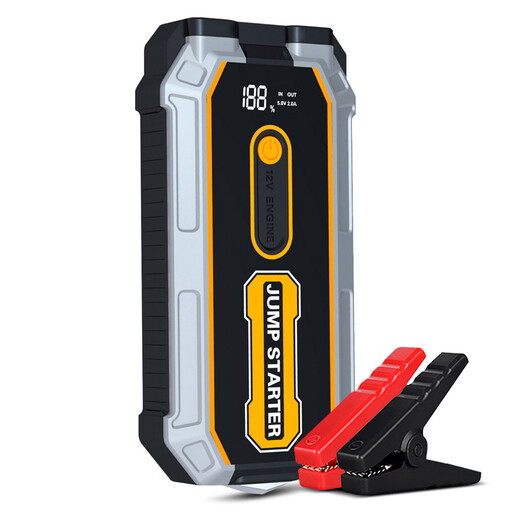
Why it suits this profile: According to the product description, this is a compact 12V jump starter with 1200A peak current, an LCD display and power bank function for cars, SUVs, motorbikes and boats.
The LCD screen shows the remaining charge, making it less likely that you’ll set off with a half-empty power bank.
330 grams, a 10 W USB output, three light modes and a stated charging time of approximately four hours.
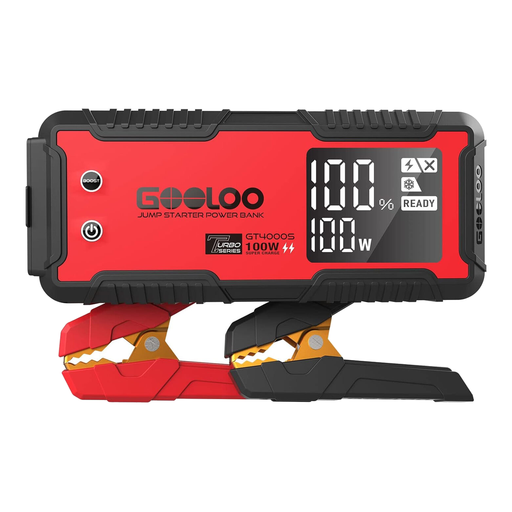
Why it suits this profile: The product information states a 4000A peak current, support for petrol engines up to 12.0 litres and diesel engines up to 10.0 litres, plus USB-C fast charging up to 100 W.
The stated engine limits and status display provide more guidance than a high amp rating alone.
Three USB ports, a 400-lumen lamp and a supplied 100W car charger according to the product description.
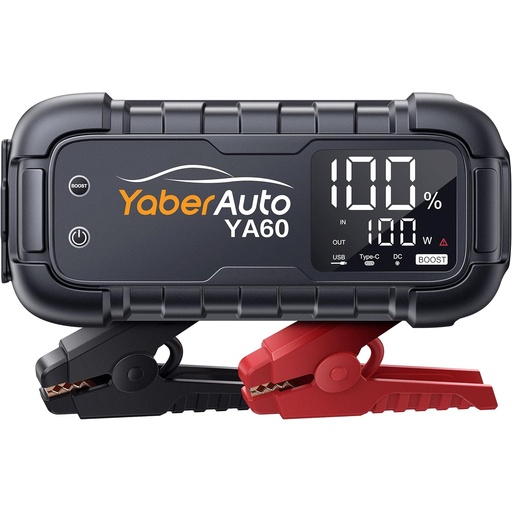
Why it suits this profile: According to the product description, this lithium jump starter is designed for larger vehicles and intensive use, supporting diesel engines up to 12.0 litres and offering a 150W DC output.
The stated charging information, connections and safety warnings make usage easier to monitor than with a model providing only basic information.
26800 mAh, 65W USB-C, two USB-A outputs and a 600-lumen lamp according to the product details.
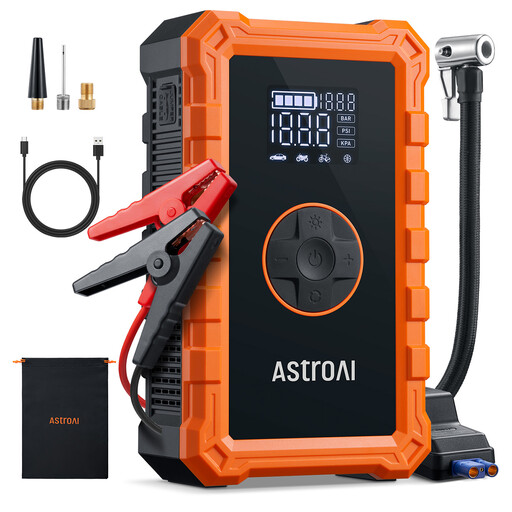
Why it suits this profile: According to the product description, this jump starter with air pump combines 1500A, support for 6.0-litre petrol and 3.0-litre diesel engines, and a 150 PSI compressor.
According to the product information, the screen shows the set and current tyre pressure, while automatic shut-off helps prevent overinflation.
Five adjustable inflation modes, three pressure units, USB ports and three light modes.
We’ve compiled a complete, up-to-date list of products that fully meet these strict selection criteria and the applicable European safety regulations.
Do not use the device with a damaged or leaking battery. If the car still will not start, the problem may lie with the battery, alternator, starter motor or wiring.
Its lifespan depends on charging cycles, storage temperature and maintenance. Recharge the device periodically according to the manual and store it in a dry place. A model stored completely flat for a prolonged period may become less usable.
Only if the product description states the correct diesel engine capacity. Diesel engines often require more starting power than petrol engines. Therefore, check the stated limit, such as 4.0, 6.0 or 10.0 litres for diesel.
Power consumption while charging is generally limited, but the actual cost depends on the battery capacity and electricity price. The main recurring cost is usually not charging, but replacement when the lithium battery loses capacity over time. Regular maintenance and correct storage can help limit unnecessary replacement.
