
Vandaag of morgen in huis

Kwaliteit gegarandeerd

Welkomstaanbiedingen ontgrendelen: GRATIS bezorging | Tot 80% korting | Gratis 30 dagen JoyPlus-proefperiode
Download de app
A flat battery rarely happens at a convenient time. You might be in a car park, on the motorway or at a campsite with a caravan that won’t start. A car jump starter can get you moving again without relying on another vehicle or roadside assistance.
However, not every portable jump starter is suitable for every vehicle. Marketing claims about thousands of amps, large battery capacities and “instant starts” don’t always tell the whole story. Before buying a car battery booster, pay particular attention to the points below.
A product might advertise a peak current of 2000A, 4000A or even 8000A. That figure is only one part of its performance. Check which engine types and capacities the jump starter is designed for, too.
A 12V jump starter for a small petrol engine has different requirements from a jump starter for a diesel SUV, motorhome or lorry. Always check the stated limits for petrol and diesel engines.
A higher capacity in mAh mainly means the device can supply power to USB devices for longer or support multiple starting attempts. It doesn’t automatically mean the car jump starter is more powerful when starting your vehicle.
As well as capacity, check the stated peak current, starting current and compatibility. Some products list these figures separately and clearly; others only show a marketing term on the packaging.
Incorrectly connected jump leads can cause damage. Choose a car battery booster with protection against reverse polarity, short circuits, overheating, overcurrent and overloading. These features don’t make a device foolproof or risk-free, but they can help you connect it correctly.
Also check that the cables, clamps and casing are sturdy. Never use a jump starter with a damaged, leaking or frozen battery.
Most portable car jump starters in this category are designed for 12V vehicles. Always check this in the manual for your car, motorbike, motorhome, tractor or boat.
For example, a model might be suitable for petrol engines up to 6.0 litres, while its limit for diesel engines is 4.0 litres. Diesel engines generally need more starting power. If you have a large SUV, van, motorhome or lorry, it’s worth choosing a model with plenty of headroom over the stated engine limit.
The peak current indicates the short burst of current the device can deliver according to its product specifications. Starting current is just as relevant when comparing models. Check the recommended operating temperature, too, especially if you keep the jump starter in your car during cold Dutch winters or hot summer days.
An LCD screen can be useful for checking the battery level, warnings or temperature. That way, you won’t discover your emergency car jump starter is flat only when you break down.
A jump starter with a compressor can also come in handy for topping up a car tyre. Check the maximum pressure in PSI, airflow and maximum operating time. Compressors often need time to cool down between uses.
A jump starter power bank with USB-C or USB-A can charge phones, tablets and other devices. This is useful when camping or on long journeys, but extra features often make the device bigger and heavier. So only choose a compressor or extensive charging functions if you’ll actually use them.

Why it suits this user: Measuring 165 × 84 × 30 mm and weighing around 330 grams, this compact portable jump starter is easy to store in a glove compartment or rucksack.
The specifications list both a 1200A peak current and a 600A starting current, and state that it can be used with 12V petrol and diesel vehicles.
12800mAh battery according to the product description, LCD status display, USB output and three-mode lighting.
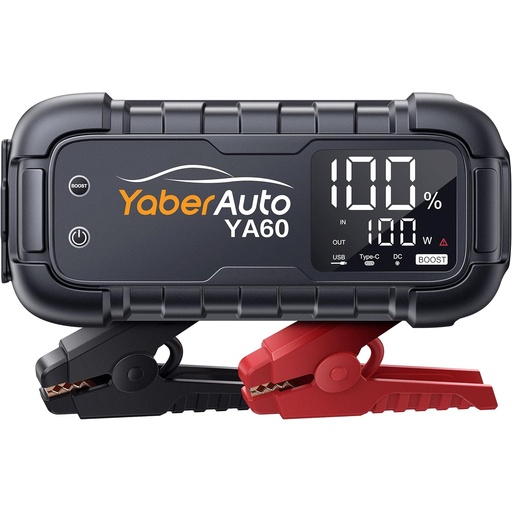
Why it suits this user: This model is designed for vehicles with larger engines and combines starting assistance with charging options for mobile devices.
The product information lists 12V compatibility, a limit of up to 12.0 litres for diesel engines, 10 intelligent safety protections and a 65W USB-C port.
26800mAh according to the product specifications, USB-C 65W, two USB-A ports, 150W DC output and 600-lumen lighting.
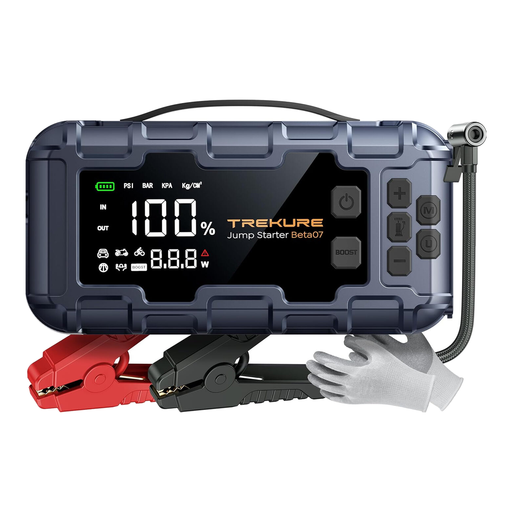
Why it suits this user: A jump starter with a compressor is a good fit for motorhome and caravan owners, as well as motorists who want to top up their tyres while on the move.
The product specifications list a 160 PSI compressor, five pressure settings, automatic shut-off and a 3.3-inch display.
According to the product information, it offers 6000A peak current, 45W USB-C PD, two USB-A ports and a four-mode LED light.
Store the car jump starter in a cool, dry place and out of children’s reach. Recharge it after use and check the battery level every few months.
We’ve put together a complete, up-to-date list of products that meet these strict selection criteria and the applicable European safety regulations.
Only if the model is suitable for both engine types. Check the separate limits for petrol and diesel. A device that’s suitable for an 8-litre petrol engine may not be suitable for a diesel engine of the same size.
This varies depending on the model, temperature and storage conditions. Manufacturers often recommend checking and recharging an unused jump starter every two to six months. Always follow the manual. Don’t leave the device in direct sunlight or in a hot car for extended periods.
It depends on how you’ll use it. If you only need to start a car with a flat battery, a compact model without a compressor is often enough. A compressor is particularly useful for motorhomes, caravans, road trips and motorists who want to adjust their tyre pressure themselves while on the move. Bear in mind the extra weight, size and cooling time.
