
Vandaag of morgen in huis

Kwaliteit gegarandeerd

Welkomstaanbiedingen ontgrendelen: GRATIS bezorging | Tot 80% korting | Gratis 30 dagen JoyPlus-proefperiode
Download de app
A flat battery usually happens at the worst possible time: on a cold morning, during a camping trip or in a remote car park. A car jump starter can get you moving again without needing a second vehicle and jump leads. However, not every model is suitable for every car.
Pay particular attention to these three common pitfalls:
Most cars, SUVs, motorbikes, motorhomes and vans use a 12V battery system. A 12V car jump starter is not automatically suitable for a 24V lorry or bus. Always check your vehicle’s manual first.
Also pay attention to the difference between petrol and diesel engines. Diesel engines generally require more starting power. For example, a model specified as suitable for petrol engines up to 6.0 litres may have a lower limit for diesel engines.
The stated engine size is a manufacturer’s guideline. Conditions such as cold weather, battery condition, cable connections and engine type can affect starting. If in doubt, choose a model with sufficient headroom, but do not automatically pay for the highest amp rating.
Peak current is the maximum short burst of current. Starting current, when stated, gives a more realistic indication of the current available while starting the engine. Battery capacity determines, among other things, how many starting attempts and USB charges are possible.
A compact portable jump starter for a small petrol car has different requirements from a car battery booster for an SUV, motorhome or diesel van. For regular use, a clear status display and sufficiently long cables are often more practical than simply having a larger number on the packaging.
Look for features such as:
These features reduce the risk of incorrect connection, but they do not replace the manual. A car jump starter should always be used according to the manufacturer’s instructions. Red goes on the positive terminal (+) and black on the negative terminal or a suitable unpainted metal earth point, where specified by the manual.
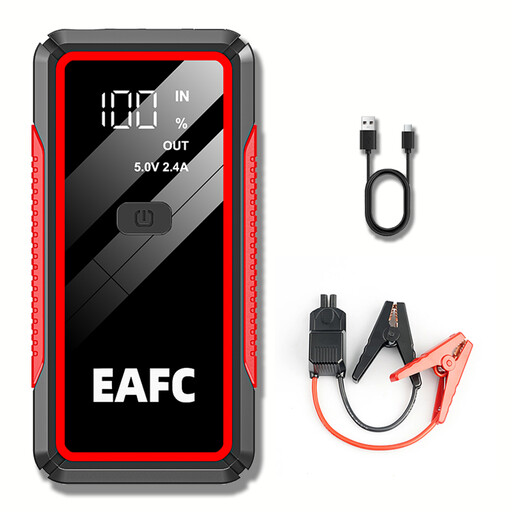
Why it suits this profile: A straightforward option for motorists looking for a compact emergency car starter with basic features for a petrol or diesel car.
The product specification separately states support for petrol engines up to 6.0 litres and diesel engines up to 4.0 litres. The status display helps you check the charge level.
2000A peak current, 10,000mAh lithium battery, USB output and three-mode LED light. Weight according to the product specification: approximately 700 grams.
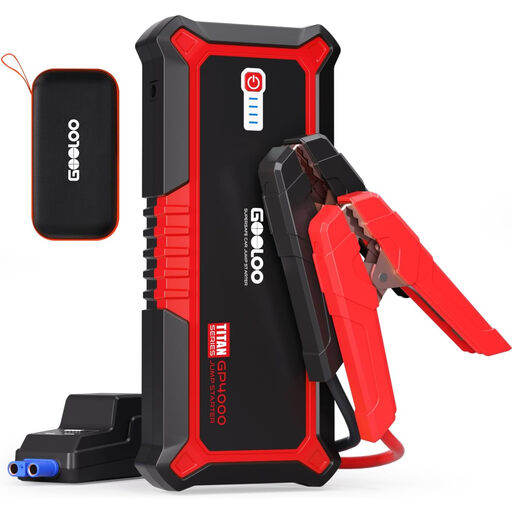
Why it suits this profile: Suitable for drivers of larger SUVs, motorhomes and vans, as well as those who want extra starting headroom and multiple charging options.
The stated compatibility covers all petrol and diesel engines up to 10.0 litres. Make sure to check this against your own vehicle’s specifications.
4000A peak current, two USB outputs, USB-C and smart jump leads with multiple safety features. The built-in torch has three modes.
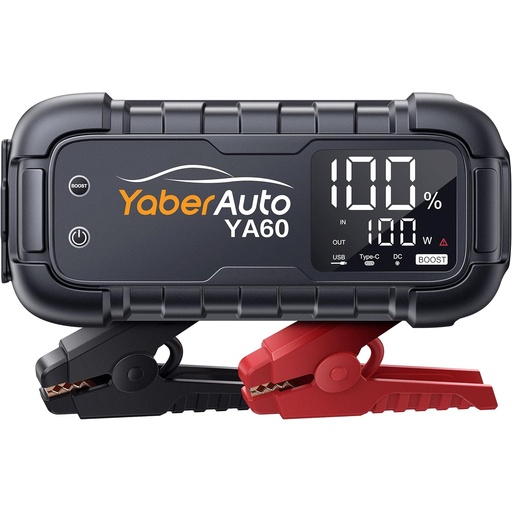
Why it suits this profile: Designed for users with larger vehicles and lots of mobile equipment, for example when travelling in a motorhome or working on the road.
Alongside the stated 8000A peak current, the specifications list a 26800mAh battery, 65W USB-C and a 150W DC output. This lets you assess the overall functionality, not just the amp rating.
Supports petrol and diesel engines up to 12.0 litres according to the product information, plus 600-lumen LED lighting and a stated operating temperature range of -20°C to 60°C.
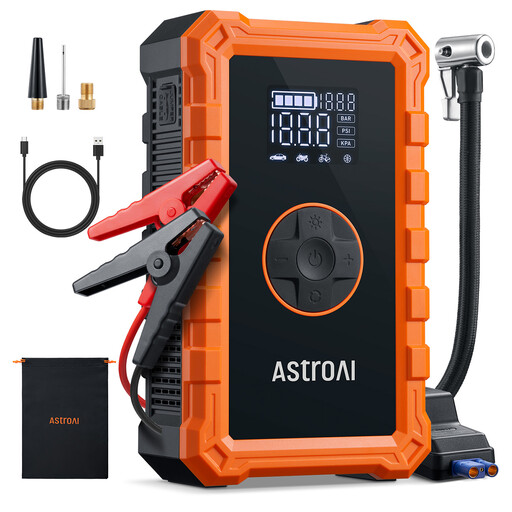
Why it suits this profile: Ideal for travellers, campers and drivers who want to carry a portable tyre compressor alongside a car battery booster.
According to the product specification, the compressor has an automatic stop function and five preset modes. The manufacturer also states that the unit should rest after prolonged pumping; follow this instruction.
1500A peak current, compressor up to 150 PSI, power bank function and a display for battery status and tyre pressure.
We’ve put together a complete, up-to-date list of products that fully meet these strict selection criteria and the applicable European safety regulations.
A jump starter only works when it has sufficient charge. Check the charge level before setting off and recharge the device after use. For longer-term storage, many manufacturers recommend topping it up periodically; the exact interval varies by model.
Do not use the booster if the casing is damaged, swollen or wet. Allow a compressor to cool down as instructed in the manual, and do not store the device for long periods in direct sunlight or extreme heat. An LED emergency light is useful for visibility, but if you break down, also place the legally required warning triangle and wear a high-visibility vest when necessary.
You can if the product specification lists both fuel types and your engine size. A diesel engine may require a higher starting load. Also check that the vehicle has a 12V system; a 12V jump starter is not designed for 24V systems.
Switch off the vehicle and follow the manual. Usually, you connect the red clamp to the positive terminal and the black clamp to the negative terminal or an unpainted earth point. Check that the indicator shows a correct connection. Start the vehicle briefly and remove the clamps in the prescribed order once the engine has started.
This varies according to the model, how it is used and how long it is stored. Recharge it after attempting to start a vehicle and check the status before a long journey. If it is rarely used, periodic charging is advisable because a lithium battery slowly loses capacity during storage.
