
Vandaag of morgen in huis

Kwaliteit gegarandeerd

Welkomstaanbiedingen ontgrendelen: GRATIS bezorging | Tot 80% korting | Gratis 30 dagen JoyPlus-proefperiode
Download de app
A flat car battery often happens at the worst possible time: just before you leave for work, during a road trip or in a dark car park. With a car jump starter, you can often try to start a vehicle with a flat 12V battery yourself. Some models also work as a jump starter power bank, compressor and LED emergency light.
However, a high amp rating does not tell you everything. If you focus only on marketing claims, you could end up with a device that is unsuitable for your engine, insufficiently charged or awkward to use.
A rating such as 2,000A, 5,000A or 7,000A sounds impressive, but you should also check the starting current, battery capacity and suitability for petrol or diesel engines. According to the product description, the EAFC 2000A delivers a peak current of 2,000A and a starting current of 1,000A. The manufacturer states that it supports petrol engines up to 6.0 litres and diesel engines up to 4.0 litres.
These figures are the brand’s product specifications and do not guarantee that every car will start in every situation. A completely defective battery, poor earth connection or engine problem cannot be resolved with a 12V jump starter.
A basic car battery booster may be sufficient for occasional use. For camping, long journeys or an emergency kit for the road, a model with a USB output, compressor and light can be more practical. Do bear the capacity in mind: a compressor uses relatively large amounts of energy and can quickly reduce the remaining charge.
A jump starter that has been left flat in the boot for months may not be ready to use when you need it. Check the charge level and follow the maintenance instructions. When connecting it, the usual arrangement is: red clamp to positive (+) and black clamp to negative (-) or a suitable earth point. Smart jump leads with reverse-polarity protection can reduce the risk of an incorrect connection, but always check the manual for the specific model.
Most portable jump starters for cars are designed for 12V systems. Check that this matches your vehicle. Then look at the engine type and capacity. A diesel engine often requires more current to start than a petrol engine. For an SUV, van or pick-up, it is sensible to choose a model with plenty of headroom.
Motorcycles and smaller petrol cars generally require less starting power, but the correct voltage, clamps and charge level remain important.
Capacity is usually stated in mAh or Wh. According to the product information, a 10,000mAh model can also charge USB devices. The EAFC 2000A has a USB output of up to 5V/2A to 2.4A, depending on the stated product specification. Always check the exact version on the product page.
A higher capacity usually means more reserve for several starting attempts or charging a phone. The trade-off is generally a larger size and greater weight.
A jump starter with compressor can be useful when a tyre has low pressure. Check that the maximum pressure in PSI meets your needs and whether the pressure display also supports Bar or kPa. The EAFC 12V version lists a compressor of up to 150 PSI, automatic shut-off and several pressure units.
For roadside breakdowns, a built-in light, SOS mode or strobe light can be useful extras. Treat an LED emergency light as a way to improve visibility and check connections, not as a replacement for a warning triangle or other legally required safety equipment.
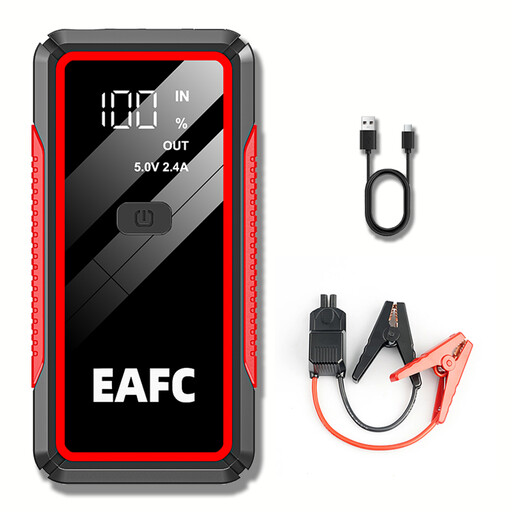
Why it suits this user profile: A compact 12V jump starter for motorists looking for a basic solution with a power bank and emergency light.
The product description states both a 2,000A peak current and a 1,000A starting current, as well as a specified range for petrol and diesel engines.
10,000mAh capacity, USB output, digital status display and LED light with three modes, according to the product information.
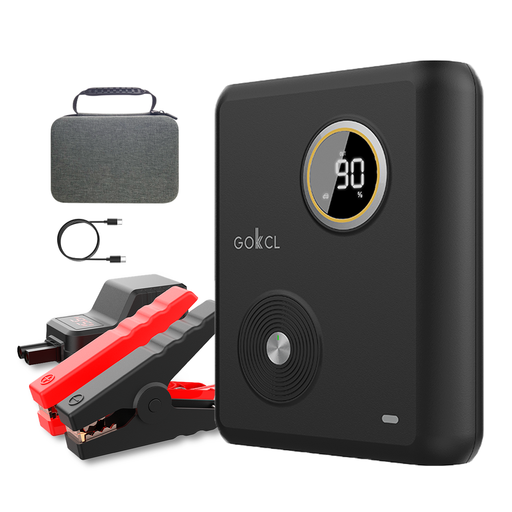
Why it suits this user profile: An interesting option for anyone who places a high value on battery capacity, charging functions and long-term storage.
The stated specifications include a 600A starting current, 1,500A peak current and a 12V system; always check these against your vehicle.
27,500mAh, PD60W input and output, 200-lumen LED light and, according to the manufacturer, approximately 1% self-discharge per month.
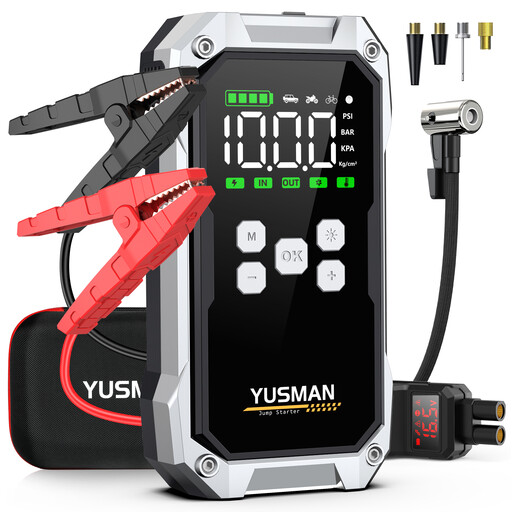
Why it suits this user profile: Suitable for drivers of larger vehicles, campers and anyone who also wants to inflate tyres.
The specifications state that it uses a 12V system, provide separate information for petrol and diesel engines, and include an LCD status display.
21,800mAh, a stated 5,000A peak current, compressor up to 150 PSI, USB ports and smart clamps with multiple protection features, according to the product description.
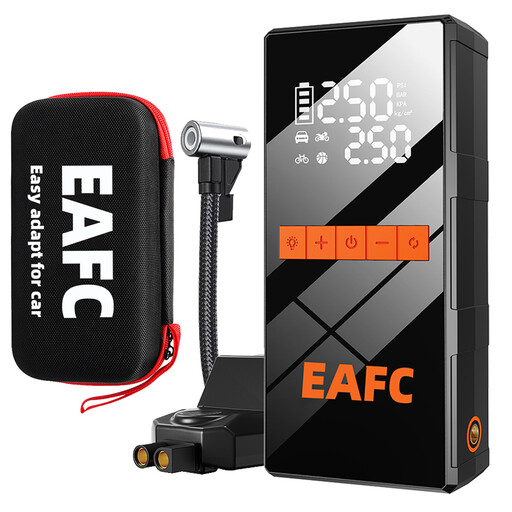
Why it suits this user profile: A multifunctional choice for the road, combining a jump starter, compressor, power bank and light in one unit.
The product information recommends charging before first use and recharging every twelve months.
8,000mAh, 1,200A peak current, 150 PSI compressor, automatic shut-off and LED modes, according to the product description.
We have put together a complete, up-to-date list of products that fully meet these strict selection criteria and the applicable European safety regulations.
Store the device in a dry place, check the cables and clamps regularly, and do not leave a jump starter in extreme heat for long periods without checking the storage instructions.
No. Check the 12V specification, engine type and maximum engine capacity. A jump starter for petrol and diesel cars may be suitable within a specific range, but the stated figures vary by model. If the battery is defective or there is an electrical problem, you may still need roadside assistance.
That depends on the battery type, usage, storage temperature and maintenance. Charge the device according to the manual. Some brands state a low self-discharge rate or a specific number of charging cycles; these are claims based on the brand’s own information and do not represent a fixed service life for every user.
That depends on how you plan to use it. If you simply want to be prepared for starting a car with a flat battery, a compact model without a compressor may be sufficient. If you frequently take long journeys, go camping or want to carry a tyre pressure gauge and pump, a 4-in-1 model could be useful. In that case, check the maximum pressure, hose length, charging time and weight.
