
Vandaag of morgen in huis

Kwaliteit gegarandeerd

Welkomstaanbiedingen ontgrendelen: GRATIS bezorging | Tot 80% korting | Gratis 30 dagen JoyPlus-proefperiode
Download de app
A flat battery rarely happens at a convenient time. You might be in a car park, on the side of the motorway or at a campsite without access to a socket. An auto jump starter can then act as a portable car jump starter, without the need for a second vehicle and long jump leads.
However, not every portable jump starter is suitable for your vehicle. Marketing often focuses on high amp ratings, large mAh figures and extra features. These figures do not always tell the whole story. Pay particular attention to the following pitfalls.
A rating such as 3000A, 4500A or even 7000A sounds impressive. However, peak power is not the only factor. Also check whether the device is intended for a 12V system and the maximum engine size stated by the manufacturer for petrol and diesel engines.
A model for a small petrol engine is not automatically suitable as a jump starter for petrol and diesel engines with a large capacity. Never use a booster on a 24V lorry system when the product is intended only for 12V.
mAh indicates the battery capacity, but it does not determine on its own whether a car will start. The battery design, cables, clamps and stated starting current also play a role. Therefore, look at the combination of peak current, starting current and stated engine size.
A jump starter with a compressor can be useful when a tyre is soft, but a built-in pump often has a maximum operating time. For example, the product information for the BuTure BC02 states that the compressor must not be used for more than 10 minutes at a time. Allow the device to cool down afterwards.
A jump starter with a power bank or LED light also needs to be charged regularly. A device that has been left unused in a hot boot for months may not be ready to use when you need it.
For most cars, motorbikes, motorhomes and smaller commercial vehicles, a 12V jump starter is relevant. Check the vehicle documentation or the battery to find out which voltage is used.
Also look out for:
A car will not start automatically just because a jump starter has a high amp rating. The vehicle’s battery and electrical system must also be in usable condition.
Where possible, choose a car jump starter with smart cables and clear notifications. Check whether the product information lists features such as:
These features reduce the risk of connecting the cables incorrectly, but they do not remove the need for careful use. Connect red to the positive terminal and black to the negative terminal or a suitable unpainted metal earth point, as instructed in the manual.
A compact model fits easily in a glove compartment, while a larger, more powerful jump starter may offer more power and features. Therefore, check the weight, dimensions and accessories.
A jump starter with compressor is practical when dealing with a slowly deflating tyre. A jump starter with power bank can charge phones, tablets or sat-nav equipment. A jump starter with LED light is useful when you break down in the dark, particularly if the light also has SOS or flashing modes.
Also consider how it is charged. Some models charge via USB-C, while others have a car adaptor or support fast charging. Follow the charging frequency recommended in the manual and store the device in a cool, dry place.
The choices below are based on the stated product specifications, features, vehicle compatibility and accessories. Performance claims come from the product information provided by the respective brands and are not presented here as guaranteed results.

Why it suits this profile: According to the product information, this compact model weighs approximately 330 grams and is intended for 12V petrol and diesel vehicles, motorbikes, boats and snowmobiles. This makes it practical for everyday use and holiday trips.
The stated 1200A peak current is combined with specific information about a 12V system and supported vehicle types. According to the product description, the LCD screen displays the remaining charge.
1200A peak current, power bank function, USB output and LED lighting with three modes. The stated dimensions are 165 × 84 × 30 mm.
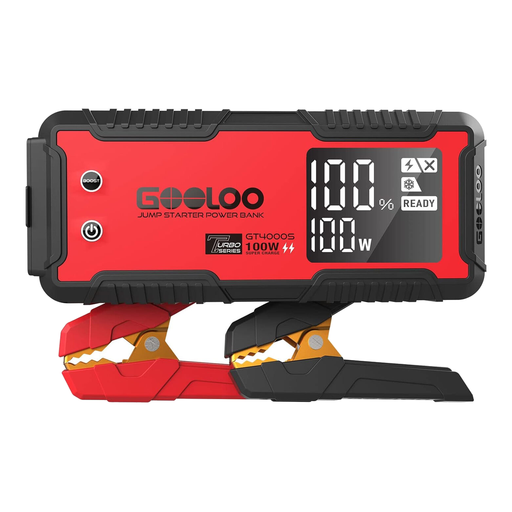
Why it suits this profile: According to the brand’s product information, this model supports petrol engines up to 12.0 litres and diesel engines up to 10.0 litres, making it suitable for drivers of larger cars, motorhomes, pick-ups or off-road vehicles.
The product information lists not only 4000A peak current, but also a 3.2-inch screen, 10 safety features and several cable and charging accessories.
4000A peak current, 100W charging via USB-C, three USB ports and an LED lamp with spotlight, strobe and SOS modes.

Why it suits this profile: This 5-in-1 model is designed for motorists who want not only to start their vehicle, but also inflate tyres, charge devices and have lighting available.
According to the product specification, the compressor has an adjustable pressure of up to 150 PSI, five modes and automatic shut-off. The stated maximum operating time of 10 minutes remains important.
4500A peak current, compressor with four nozzles, LCD screen, 500-lumen LED lamp and stated support for 12V vehicles.
We have put together a complete, up-to-date list of products that fully meet these strict selection criteria and the applicable European safety regulations.
Yes, a portable jump starter is specifically designed to act as a standalone power source. First check the vehicle voltage and connect the clamps according to the manual. Do not keep the engine turning over for an extended period if the vehicle does not start. Do not attempt to start a damaged, leaking or frozen battery with a booster.
The lifespan depends on the battery type, storage temperature, charging frequency and usage. Recharge the device after use and check it regularly if it is kept in the car. Some manufacturers state a standby time or number of charging cycles, but these are product specifications and not a guarantee for every usage situation.
Charging a jump starter generally costs less than using a garage or breakdown service, but the compressor uses a relatively large amount of energy while inflating. Use it only for as long as necessary, set the correct tyre pressure and allow the device to cool down according to the manual. A jump starter with a power bank can also use the remaining energy to charge USB devices.
