
Vandaag of morgen in huis

Kwaliteit gegarandeerd

Welkomstaanbiedingen ontgrendelen: GRATIS bezorging | Tot 80% korting | Gratis 30 dagen JoyPlus-proefperiode
Download de app
A flat car battery often happens at the worst possible time: on a cold morning, during a camping trip or while you’re travelling in a motorhome, boat or motorbike. A car jump starter can then provide a practical emergency way to start your car, without relying on another motorist.
However, not every portable jump starter is suitable for every vehicle. Manufacturers use high peak currents and large capacities as marketing claims, while important details are sometimes less clearly stated. Pay particular attention to the following pitfalls.
A peak current of 2,000A, 4,000A or even 8,000A sounds impressive. However, this figure does not tell you everything about everyday usability. Also check:
The stated peak current is a manufacturer’s product specification, not a universal measurement standard. Therefore, compare the full specifications rather than just the highest number on the packaging.
A larger battery, such as 20,000mAh, does not automatically mean that the car will start faster. Capacity is mainly relevant to the number of possible starting attempts and charging devices. Starting power is determined, among other things, by the battery cells, cables and current control system.
Also pay attention to the difference between nominal capacity and usable capacity. For example, the Porbi S306 is listed as having 12,800mAh, with a stated nominal output capacity of 7,200mAh.
Smart jump leads with reverse-polarity protection, short-circuit protection and overheating protection help to reduce the risk of incorrect connection. However, they do not replace reading the instruction manual. Do not use a jump starter if the battery shows visible leakage, swelling, cracks or signs of freezing.
According to product information from various brands, these protection features are built in. Always check which functions are actually listed for the specific model.
Most cars, SUVs, motorbikes and motorhomes use a 12V jump starter. Next, check the maximum engine size. A model for petrol engines up to 6.0 litres may be suitable for many cars and SUVs, but not automatically for a heavy-duty diesel engine.
A car jump starter for petrol and diesel engines should ideally state both figures separately. For lorries and some commercial vehicles, you must also check that the vehicle does not use a 24V system.
Check that the set includes sturdy clamps, well-insulated handles and cables that are long enough. Useful features include:
The presence of a protection feature does not mean that every connection is risk-free. Red should be connected to the positive terminal (+), and black usually to the negative terminal (-) or a suitable unpainted metal earth point, as specified in the manual.
A jump starter with power bank can charge USB devices during a breakdown or camping trip. Check the number of ports and the output, such as 5V/2A or support for fast charging.
An LED light with continuous, strobe and SOS modes is useful for visibility at the roadside. A jump starter with compressor provides added convenience when a tyre is soft, but the stated maximum pressure of, for example, 150 PSI is not the same as the recommended tyre pressure. Use the vehicle’s specified pressure and allow the compressor to cool down between uses if the manual advises this.

Why it suits this profile: According to the product information, this compact car battery booster combines a 12,800mAh battery with an LCD display and USB output. Weighing approximately 330 grams, it is suitable for a car, motorbike or emergency kit.
The LCD display shows the remaining charge level, so you are less likely to set off with a flat device. However, check the stated engine limits beforehand.
1200A peak current according to the product specification, 5V/2.1A USB output, three LED modes and a stated weight of approximately 330 grams.
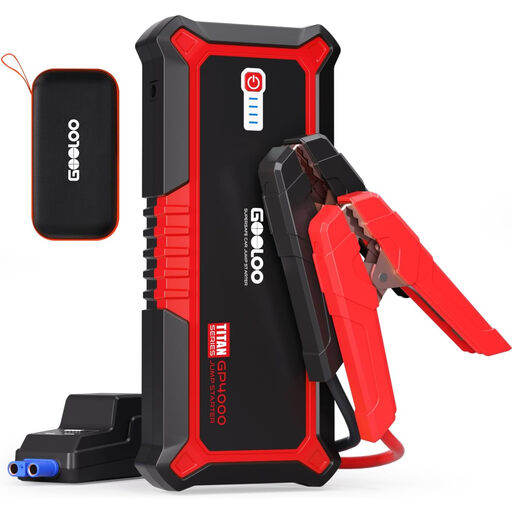
Why it suits this profile: According to GOOLOO’s product information, this model delivers 4000A peak current and supports petrol and diesel engines up to 10.0 litres. That makes it suitable for SUVs, motorhomes, pick-ups and other vehicles with larger engines.
The stated engine limits for petrol and diesel provide more useful guidance than a high amp rating alone. According to the manual, the ten listed protection functions must be used correctly.
Two USB outputs, Type-C connection, smart jump leads, metal clamps, a 400-lumen light and a storage bag included.
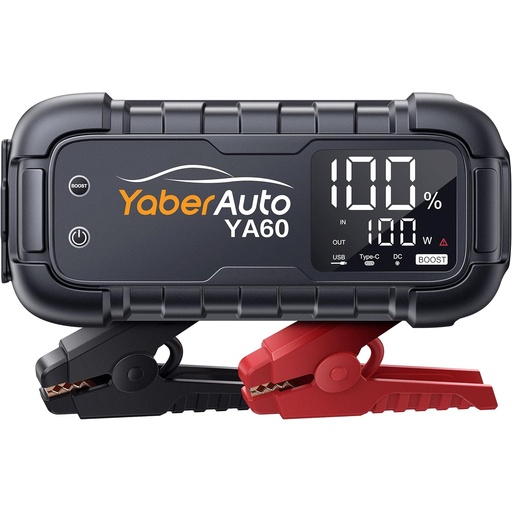
Why it suits this profile: According to YaberAuto, this car jump starter is intended for 12V vehicles with petrol and diesel engines up to 12.0 litres. The 150W DC output and 65W Type-C function are useful for motorhomes, boats and outdoor equipment.
The product specification states both the vehicle type and engine limit. The connections also clearly show what the power bank can be used for; check the power consumption of your devices.
8000A peak current according to the manufacturer, 26,800mAh battery, USB-C 65W, two USB-A outputs, 150W DC output and a 600-lumen light.
We have put together a complete, up-to-date list of products that fully meet these strict selection criteria and the applicable European safety regulations.
Store the device in a dry place, away from direct sunlight and not in an extremely hot car. Check the charge level every two to three months unless the manual specifies a different interval.
No. Check the voltage, battery type and maximum engine size. A 12V model is not suitable for a 24V system. You must also not attempt to start a damaged or frozen battery with a jump starter.
Its lifespan depends on usage, storage temperature and charging maintenance. Lithium batteries lose capacity when they are stored for long periods while flat, very hot or very cold. Regularly topping up the charge according to the manual helps keep the device ready for use.
There are no fuel costs beyond the purchase price, but the compressor uses the internal battery. After inflating several tyres, you will need to recharge the device. For occasional breakdown assistance, it is especially important to monitor the charge status and observe the compressor’s specified rest period.
