
Vandaag of morgen in huis

Kwaliteit gegarandeerd

Welkomstaanbiedingen ontgrendelen: GRATIS bezorging | Tot 80% korting | Gratis 30 dagen JoyPlus-proefperiode
Download de app
A flat car battery or underinflated tyre usually happens at the worst possible time. With a car jump starter with compressor, you can deal with many situations yourself: supporting the 12V battery, topping up a tyre and charging a phone. But not every device with a high amp rating or a 150 PSI label will suit your vehicle or intended use.
As Joybuy Product Recommendation Officer, I therefore focus mainly on verifiable product specifications. Below, you’ll find what to look for before buying a portable jump starter.
Manufacturers often quote an impressive peak current, such as 3000A, 5500A or 6500A. This figure is not the same as the normal starting current. You should therefore also check:
A large diesel engine or big SUV generally requires more starting power than a small petrol car. The manufacturer’s stated compatibility is a guide; battery condition, temperature and cable connections still have an impact.
A jump starter with an air compressor may quote a maximum pressure of 150 PSI, for example. This is primarily an upper limit. The permitted tyre pressure for a car tyre is much lower and the correct value can be found on the door pillar, fuel flap or in your car’s handbook.
In addition to the maximum pressure, look at:
Do not use the compressor for longer than specified in the manual. Some models explicitly recommend taking a break after a few minutes to allow heat to dissipate.
Many models also work as a power bank for a car, phone or tablet. This is practical, but check the types of connections and the charging power. A USB-C port with 65W PD may be suitable for certain laptops, while a 5V/2.4A USB port is mainly intended for phones and smaller devices.
The stated battery capacity also deserves attention. Manufacturers sometimes quote both a nominal capacity and a lower usable capacity. So don’t compare only the number of mAh; also consider charging power, ports and charging time.
Choose a 12V car jump starter that is suitable for your engine capacity. For a compact petrol car, a model rated at 1000A to 2000A may be sufficient according to the stated product information. For SUVs, vans and diesel engines, having a higher margin is practical.
Always check whether the manufacturer mentions your vehicle type. Some models are designed for petrol and diesel engines but not for 24V lorries. A jump starter for petrol and diesel engines will also not start the high-voltage battery of a fully electric car.
A good battery jump starter should provide clear instructions for the red positive clamp and black negative clamp. Useful features include:
Only use forced-start mode when the clamps are connected correctly and securely. Do not start a vehicle with a damaged, leaking or frozen battery. Remove the cables after a successful start according to the manual, and never allow the clamps to touch each other.
A jump starter with LCD display can show the remaining battery level, the set tyre pressure and the current pressure. This is more useful than just a series of LED lights. An automatic stop helps prevent you from having to monitor the inflation process constantly.
LED emergency lighting with steady light, flashing light and SOS can help if you break down on a dark road. Treat this as supplementary lighting, not as a replacement for a warning triangle or other legally required safety equipment.
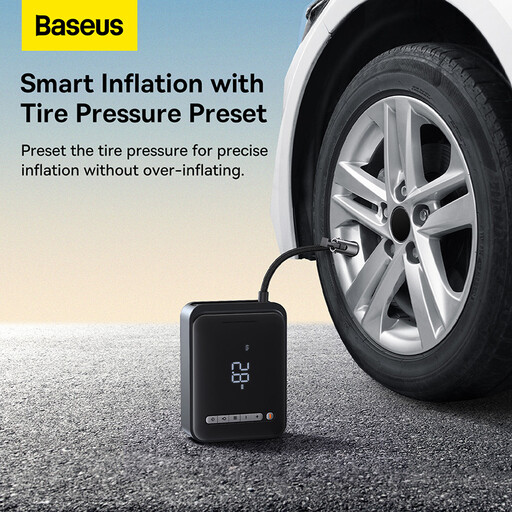
Why it suits this profile: The combination of a 1000A peak current and built-in pump is suitable for drivers looking for a relatively compact device for everyday motoring.
The product specification states both the pump pressure and the estimated inflation time. It also says that the pump supports pressure up to 120 PSI, despite the gauge displaying up to 150 PSI.
1000A peak current, USB outputs and a built-in tyre pressure gauge. Weight according to the product information: approximately 1.36 kg.
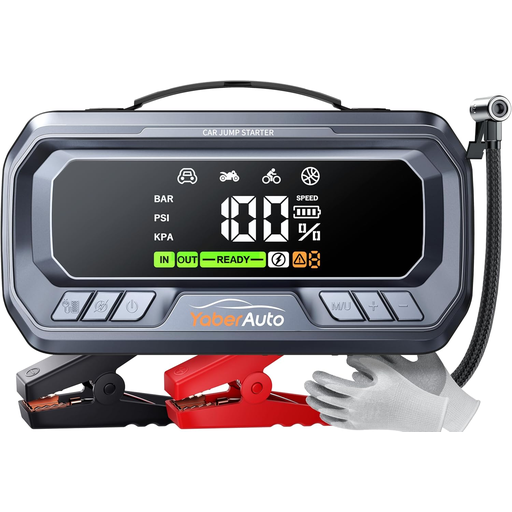
Why it suits this profile: According to the product information, this model is aimed at larger vehicles, longer journeys and users who want several functions in one unit.
The listing distinguishes between peak current and starting current. Check your vehicle and use the stated 8.0L diesel compatibility as a selection criterion, rather than focusing only on the highest amp figure.
160 PSI compressor, 3.3-inch LCD display, 65W two-way USB-C charging and four-mode lighting according to the product description.
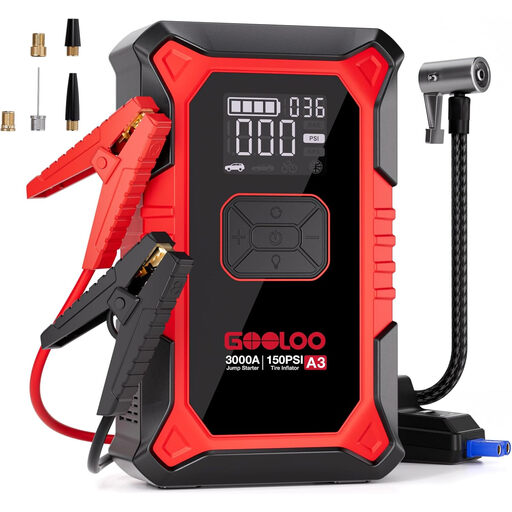
Why it suits this profile: Handy for commuters, campers and motorists who regularly want to inflate tyres, bicycle tyres or balls as well as start vehicles.
The pump has adjustable modes, pressure detection and automatic shut-off. The manufacturer also states a maximum continuous inflation time; you still need to take breaks.
3000A peak current, 150 PSI, 35 l/min air flow, five pump modes and ten stated protection functions.
Fully charge a new car jump starter before storing it. Check the charge level every two to three months, even if you haven’t used the device. Store the battery jump starter somewhere cool and dry, and don’t leave it in a hot, enclosed car for long periods.
Before starting the vehicle, switch off all electrical systems. Connect red to positive and black to negative or a suitable unpainted earth point, depending on the instructions. Do not try to start the engine for several seconds at a time. Allow the device to cool down between attempts and remove the cables immediately after a successful start.
We’ve put together a complete, up-to-date list of products that fully meet these strict selection criteria and the applicable European safety regulations.
No. Check whether your car has a 12V system and compare the stated petrol or diesel engine capacity with your vehicle. A 24V system and a damaged or frozen battery are generally outside the intended use.
This depends on storage, temperature, charging frequency and use. Recharge the device regularly according to the manual and avoid prolonged exposure to heat. Its lifespan is determined not only by the number of mAh, but also by battery quality and charging management.
The device uses its internal lithium battery. Energy consumption when inflating depends on tyre pressure, tyre volume and operating time. A higher PSI rating does not automatically mean lower energy consumption. Recharge the jump starter after use so that it is ready for the next breakdown.
