
Vandaag of morgen in huis

Kwaliteit gegarandeerd

Welkomstaanbiedingen ontgrendelen: GRATIS bezorging | Tot 80% korting | Gratis 30 dagen JoyPlus-proefperiode
Download de app
A flat car battery often happens at the worst possible time: before leaving for work, during a weekend trip or in a dark car park. With a car jump starter, you can sometimes start a 12V vehicle yourself, without help from another car. However, not every model is suitable for every vehicle.
The biggest pitfall is that manufacturers tend to advertise high amperage figures above all else. So do not look only at the number on the packaging. Also check vehicle compatibility, charge level, safety features and how the device is used.
A figure such as 2,000A or 4,000A sounds impressive, but peak current does not guarantee that every vehicle will start. The engine type, engine capacity, battery condition and temperature also play a role. Always compare the stated suitability for petrol and diesel engines.
Most portable jump starters are designed for vehicles with a 12V lead-acid battery. They are not intended for the high-voltage battery in an electric car. Heavy goods vehicles and buses may also use a 24V system. Check your vehicle’s handbook before buying a car battery booster.
Lithium batteries gradually lose charge, particularly during long-term storage and temperature fluctuations. A jump starter left unused in a hot car for months may therefore not have enough power when you need it. Check the charge level regularly and follow the manufacturer’s maintenance instructions.
Look at three details:
A jump starter for petrol and diesel vehicles should explicitly mention both engine types. A more compact model may be sufficient for an ordinary passenger car. An SUV, van, motorhome, boat or tractor may require a higher stated capacity.
Battery capacity is usually shown in mAh or Wh. These values are not always directly comparable, because manufacturers may state either nominal capacity or gross capacity. For example, the Porbi S306 lists 12,800mAh, with a rated output of 7,200mAh.
Also look for:
A jump starter power bank can be useful for a smartphone, sat nav or camera, but it does not charge a vehicle battery in the same way as a battery charger. Instead, it provides a short burst of starting power through the clamps.
A useful portable car jump starter should ideally have smart jump leads with protection against:
Check that these features are clearly stated in the product information. A CE mark means that the manufacturer declares the product meets relevant European requirements; it is not an independent quality ranking. Some models also mention RoHS compliance. Always read the manual and never use a device with a damaged, leaking or swollen battery.

Why it suits this profile: Weighing approximately 330 grams, this compact model is practical for everyday use in a passenger car, motorbike or small boat.
The product information lists a 1,200A peak current, support for 12V petrol and diesel vehicles, and an LCD display showing the charge level.
12,800mAh battery, 10W USB output, LCD display and LED light with continuous, strobe and SOS modes.
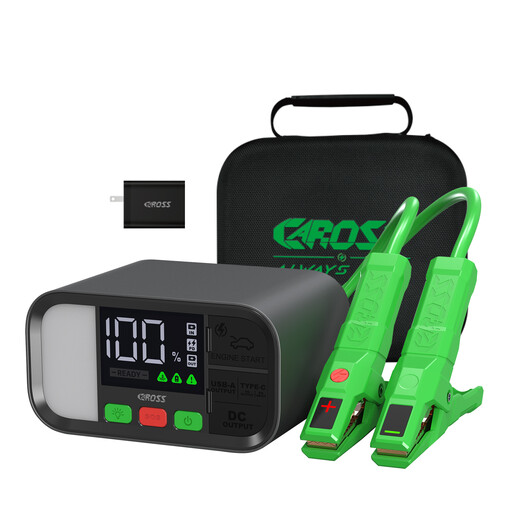
Why it suits this profile: If you value straightforward operation and a comprehensive kit, this model offers a 3-inch screen, protective case and 65W charger.
The stated Smart Connect technology is designed to recognise polarity automatically. Nevertheless, check the manual before use.
16,000mAh, 65W PD output, 3-inch screen and accessories including a protective case and charger.
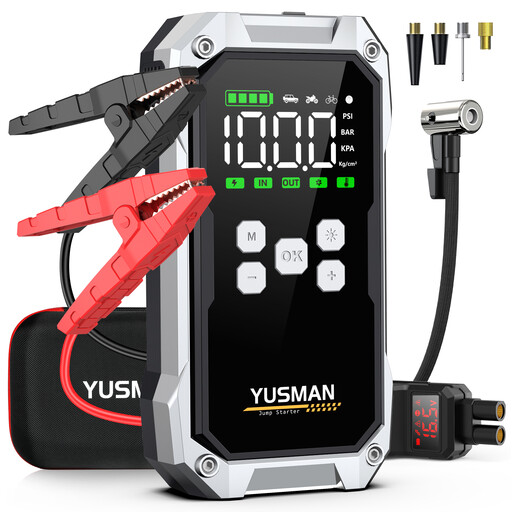
Why it suits this profile: This model is aimed at SUV, motorhome and outdoor enthusiasts who want to inflate tyres as well as jump-start their vehicle.
The product specification lists 12V compatibility, smart safety clamps and an LCD screen displaying tyre pressure.
5,000A peak current according to the product description, 21,800mAh and a built-in compressor up to 150 PSI.

Why it suits this profile: The stated support for up to 9L petrol and 7L diesel engines is aimed at larger vehicles, motorhomes, boats and trucks.
The product information mentions a BOOST mode for low battery voltage and ten protection features. Check your vehicle’s engine limits.
3,000A peak current, USB Quick Charge, Type-C connection and LED light with SOS and strobe modes.
We have compiled a complete, up-to-date list of products that fully meet these strict selection criteria and the applicable European safety regulations.
Do not use a jump starter with a damaged or leaking battery. If the car will not keep running, there may be another technical problem in addition to a flat battery.
That depends on the stated temperature limits. Cold temperatures can temporarily reduce the available capacity, while extreme heat can put strain on the battery. Store the device in a dry place, away from direct sunlight, and recharge it periodically according to the manual.
There is no universal interval. Some product descriptions recommend recharging every two to three months, while other models state a longer standby period. Check the charge level before a long journey and after every use.
Some models have a BOOST mode for very low voltage, but this varies between devices. A completely defective battery, a battery below the minimum activation voltage or a damaged battery may still prevent the vehicle from starting. Always consult the product specifications and user manual.
