
Vandaag of morgen in huis

Kwaliteit gegarandeerd

Welkomstaanbiedingen ontgrendelen: GRATIS bezorging | Tot 80% korting | Gratis 30 dagen JoyPlus-proefperiode
Download de app
A flat battery rarely happens at a convenient time. You may be in a car park, on the motorway or about to leave for a camping trip when the engine refuses to start. A car jump starter can be the answer, but not every model is suitable for every vehicle or situation. High amp ratings, built-in compressors and “smart” jump leads are sometimes given more prominence than the information you really need.
So watch out for these three common pitfalls:
Most models in this category are designed for 12V vehicles with a lead-acid battery. This often includes cars, SUVs, motorbikes, motorhomes, boats and light commercial vehicles. Always check your vehicle’s manual and compare the stated limits for petrol and diesel engines.
A 12V jump starter for a small petrol engine may not provide enough margin for a large diesel engine. For an average car, models specified for engines up to, for example, 4.0 or 6.0 litres are often sufficient according to the product description. For motorhomes, pick-ups and lorries, a higher stated capacity makes more sense, but actual suitability also depends on the condition of the battery, temperature and wiring.
A good car battery booster has clear connection instructions and a protected cable set. Useful features include:
According to the product information provided by various brands, including GOOLOO, some models feature multiple layers of protection. Treat this as a product specification, not as a guarantee that incorrect use is risk-free. Connect the red clamp to the positive terminal and, according to the instructions, the black clamp to the negative terminal or a suitable unpainted metal earth point. Do not use a jump starter with a leaking, damaged or frozen battery.
A portable jump starter should fit in your car without taking up a large part of the boot. Compare the weight, dimensions, storage case and space required for the cables. A compact jump starter power bank with USB outputs can be useful for charging a phone, sat-nav or tablet.
A jump starter with compressor is useful when tyre pressure is low. Look out for:
An LED light with an SOS or flashing mode can improve visibility if you break down in the dark. It does not replace a warning triangle or a safe position away from the carriageway.

Why it suits this profile: The compact casing, weighing around 330 grams, is practical for motorists who want to keep a simple emergency car starter in the glove compartment or a bag.
The product information lists 1200A peak current, 600A starting current and support for 12V petrol and diesel vehicles separately. It also has an LCD display showing the charge level.
12800 mAh according to the product details, a 10W USB output, three light modes and a stated charging time of around four hours.
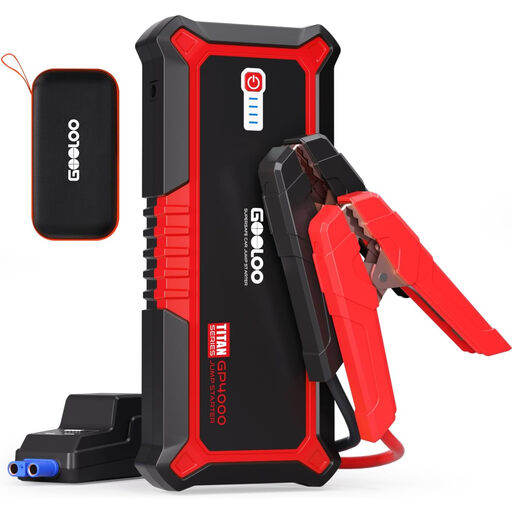
Why it suits this profile: Suitable for drivers with an SUV, motorhome, boat or commercial vehicle who want a robust 12V car jump starter with extra connections.
The stated limits are specific: all petrol and diesel engines up to 10 litres, for 12V vehicles. The manufacturer also lists ten protection functions.
4000A peak current according to the product description, two USB outputs, smart jump leads, an LED light and a stated operating temperature range of -20 °C to 60 °C.
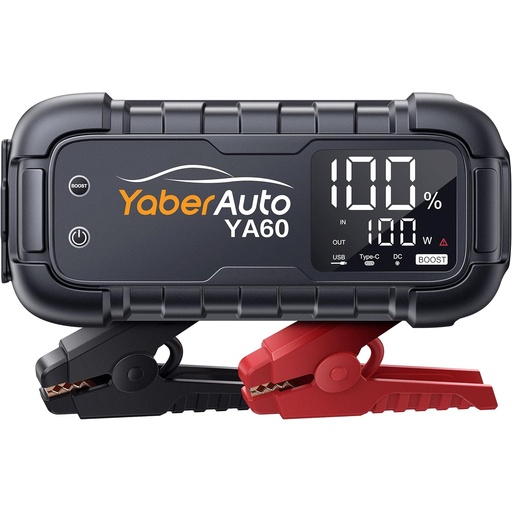
Why it suits this profile: A logical choice for motorhome, boat and SUV owners who want portable power for devices and 12V accessories as well as starting assistance.
The specifications list not only the 8000A peak current, but also the cable type, charging capacity, ports and storage recommendations. This makes it easier to compare than simply looking at the amp rating.
26800 mAh, USB-C up to 65W, two USB-A ports, a 150W DC output and a 600-lumen lamp according to the product information.
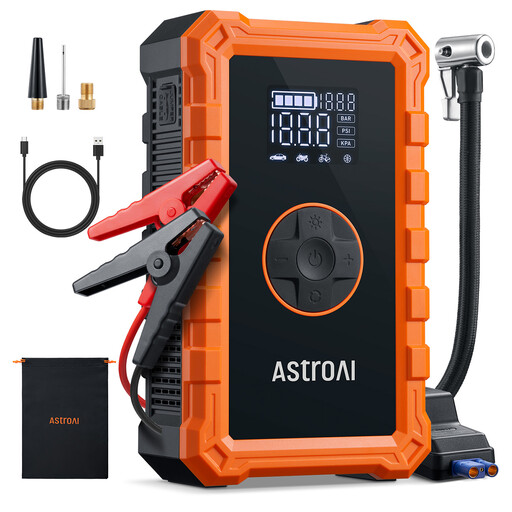
Why it suits this profile: Handy for long journeys, camping trips and motorists who want to carry a car battery booster and tyre inflator in one unit.
Alongside 1500A peak current, the description specifies a 150 PSI compressor, 25 litres per minute, five pressure settings and automatic stop. A break is required after ten minutes of pumping.
According to the product information, suitable for 12V vehicles with petrol engines up to 6.0 litres and diesel engines up to 3.0 litres, with a display, USB ports and three light modes.
Fully charge a new portable battery charger or jump starter before using it for the first time. Store the device in a dry place and do not leave it in a hot car for long periods. Lithium batteries lose capacity due to heat and deep discharge. Check the charge level every two to three months, unless the manual specifies a different interval.
Try starting the engine for short periods and allow the device to cool down between attempts. After a successful start, remove the black clamp first and then the red clamp, following the instructions for the model in question. A CE marking may indicate that a product has been declared to meet applicable European conformity requirements, but it is not an independent performance label. Also check the manual, warranty, manufacturer details and returns policy.
We have put together a complete, up-to-date list of products that fully meet these strict selection criteria and the applicable European safety regulations.
No. Check that your car has a 12V battery and compare the specified engine capacity and fuel type. A model for petrol engines up to 6.0 litres is not automatically suitable for a heavy diesel engine. Do not use the jump starter for electric vehicles or other applications unless the manual permits it.
This depends on the battery type, storage temperature, use and maintenance. Recharge the device regularly according to the manual, even when you are not using it. Do not leave it completely flat in the car for months at a time, and replace it if the casing is damaged, the battery is swollen or the cables are damaged.
That depends on how you plan to use it. If you only need starting assistance, a compact model without a pump is often sufficient. Anyone who regularly drives long distances, goes camping or uses a second vehicle may benefit from a compressor with a pressure display and automatic shut-off. However, check the airflow and cooling time, not just the stated PSI value.
