
Vandaag of morgen in huis

Kwaliteit gegarandeerd

Welkomstaanbiedingen ontgrendelen: GRATIS bezorging | Tot 80% korting | Gratis 30 dagen JoyPlus-proefperiode
Download de app
A flat battery rarely happens at a convenient time. For commuters, motorhome owners, motorcyclists and van drivers, a car jump starter can be a practical addition to the standard equipment. You can use one as temporary starting assistance for your car, but many models also function as a power bank, tyre inflator or emergency light.
However, not every car battery booster is suitable for every vehicle. A high peak current on the packaging does not tell you everything. You should also consider engine size, battery voltage, cables and maintenance. Below, we explain which specifications matter and which popular choices suit different situations.
Manufacturers often state a peak current, such as 1,500, 4,000 or 7,000 A. This is not a universal guarantee that every vehicle will start. Always check the stated compatibility with your petrol or diesel engine. A compact 12V jump starter for a passenger car is not automatically suitable for a large diesel engine, motorhome or lorry.
A jump starter with an air compressor is useful for topping up a tyre, but inflation speed and heat generation vary from one model to another. Check the maximum pressure in PSI, the airflow and whether automatic shut-off is included. A high pressure rating is mainly a technical upper limit; the actual inflation time depends on the tyre size and starting pressure.
Lithium batteries gradually lose charge during storage. In a hot car, their service life may also be adversely affected. Check the charge level regularly and follow the storage temperature recommendations in the manual. A jump starter power bank left flat in the boot will not help when you break down.
Most portable jump starters in this category are designed for 12V vehicles. You should also check the maximum engine capacity specified by the manufacturer. For example, a model may be suitable for petrol engines up to 6 litres and diesel engines up to 3 or 4 litres. Diesel engines generally require more starting power, especially in low temperatures.
Only use the device in accordance with the manual. Check the positive and negative terminals, use the supplied smart jump leads and make sure the clamps do not touch each other.
The peak current is a short-term maximum value. The starting current or capacity provides additional information about how the device is designed, but these figures still do not tell the whole story. Therefore, consider the combination of:
A higher capacity does not automatically make the device more suitable, but it can provide additional charging options.
If you are looking for a car jump starter with compressor, it is best to check:
Other useful features include protection against reverse polarity, short circuits, overcharging and overheating. These safeguards reduce the risk of incorrect connection, but they do not replace careful use.
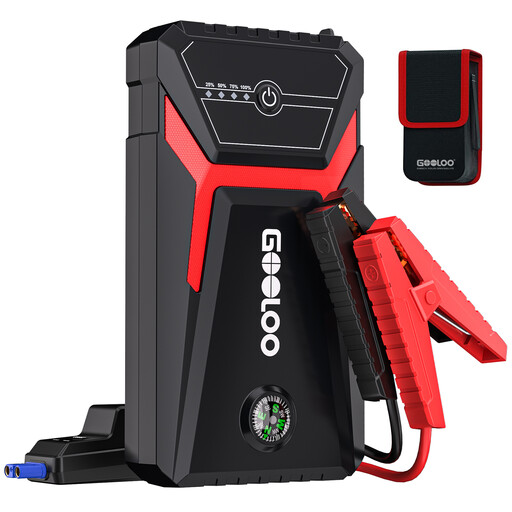
Why it suits this profile: According to the product information, this compact model weighs 0.878 kg and is designed for 12V vehicles, including cars, motorbikes and motorhomes.
The product description explicitly states a range of up to 6.0 litres for petrol and 4.0 litres for diesel. This lets you compare the engine size in advance instead of looking only at the amp figure.
1,500 A peak current, two USB outputs and an LED light with three modes according to the product specifications.
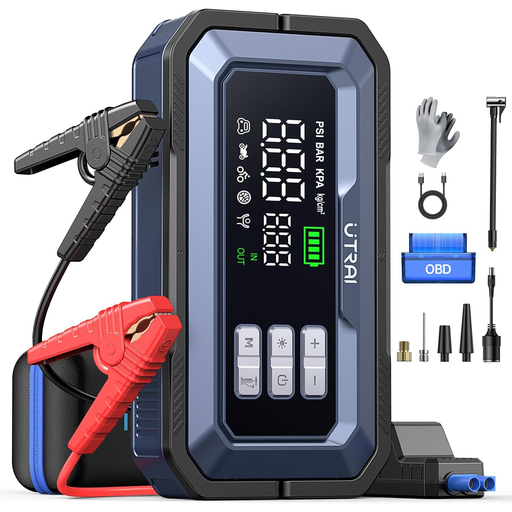
Why it suits this profile: This is a multifunctional choice for drivers who want to carry not only an emergency car starter, but also a compressor, 12V output and lighting.
The product specifications mention an automatic pump, five modes and temperature protection. This makes the compressor function easier to assess than a model with only a standalone PSI claim.
7,000 A peak current, compressor up to 150 PSI, 160 W DC output and USB-C PD 18 W according to the product description.
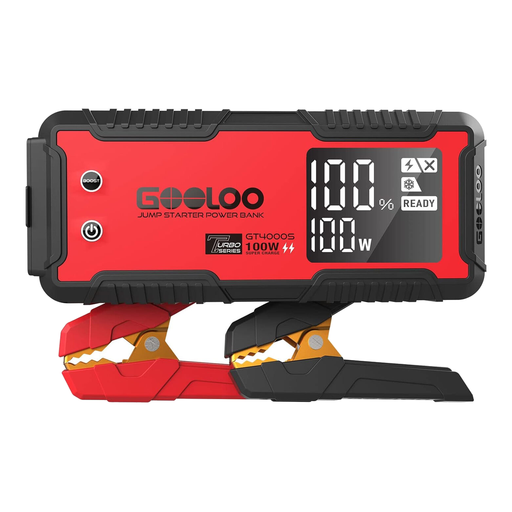
Why it suits this profile: For SUVs, motorhomes, tractors and larger vehicles, the stated engine compatibility is particularly relevant. The model also offers charging functions for mobile devices.
The product information specifies a separate range of up to 12.0 litres for petrol and 10.0 litres for diesel. Always check this against your vehicle’s specifications.
4,000 A peak current, 100 W two-way charging, three USB ports and a 15 V/10 A connection according to the product description.
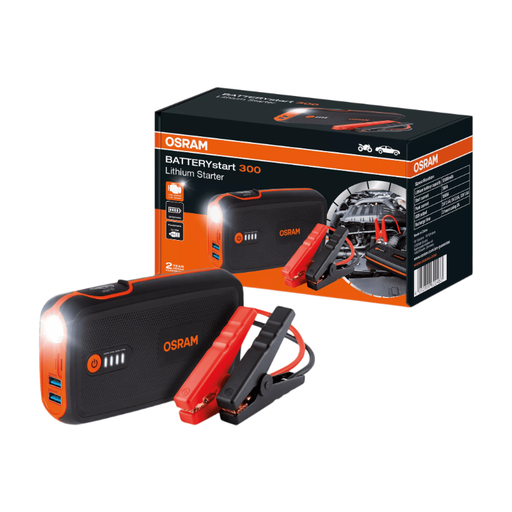
Why it suits this profile: Its compact design is intended for cars and motorbikes, taking up relatively little space in the vehicle.
The product description clearly states a range of up to 6 litres for petrol and 3 litres for diesel. This makes it easy to match the choice to a typical passenger car.
1,500 A peak current, 12V connection, two USB ports and an integrated torch according to the product specifications.
We have put together a complete, up-to-date list of products that fully meet these strict selection criteria and the applicable European safety regulations.
For every car jump starter, follow the instructions for the specific model. In general, the following steps apply:
Store a jump starter in a dry place away from direct sunlight. Check the cables and clamps for damage. Do not use a device with a swollen casing, leakage or damaged cables.
Its service life depends on the battery type, charging cycles, storage temperature and usage. Recharge the device according to the manual if it has not been used for an extended period. Some product descriptions state a standby time or number of cycles; these are product specifications, not a guarantee for every usage situation.
Only if the model has a built-in compressor. A car tyre inflator in the form of a jump starter usually comes with a hose, pressure display and automatic shut-off. Check the maximum pressure, hose length and whether a suitable valve adapter is included before buying.
That varies from model to model. Check the separate limits for diesel and petrol, as a jump starter suitable for, for example, 6 litres of petrol may have a lower diesel limit. Also check whether your vehicle uses a 12V battery.
