
Vandaag of morgen in huis

Kwaliteit gegarandeerd

Welkomstaanbiedingen ontgrendelen: GRATIS bezorging | Tot 80% korting | Gratis 30 dagen JoyPlus-proefperiode
Download de app
A flat battery often strikes at the worst possible time: on a cold morning, by the roadside or on a camping trip with no mains socket nearby. A car jump starter can be a practical emergency solution. However, not every portable jump starter is suitable for every car, van, motorhome or motorbike.
High amp ratings and large battery capacities may sound impressive, but they don’t tell you everything. Above all, check that the 12V jump starter is suitable for your type of vehicle, engine size and intended use.
A figure such as 1.500A, 3.000A or 4.500A is the peak current stated in the product specifications. It doesn’t automatically tell you how long, or under what conditions, the car jump starter will work. Check the stated vehicle compatibility too, such as the maximum engine size in litres for petrol and diesel engines.
A diesel engine generally needs more starting power than a comparable petrol engine. A compact battery booster may be enough for a small city car, while an SUV, van or motorhome may need a more powerful model.
Capacity is often given in mAh. This mainly indicates how much energy is stored and what the device can do as a jump starter power bank. It’s not the same as starting current. Some brands also list both nominal and maximum capacity.
So check whether the product specifications distinguish between, for example, total capacity and rated capacity. The Porbi S901, for instance, is listed as having a capacity of 20.000mAh, with a rated capacity of 10.000mAh.
An LED light, USB port or compressor can be useful, but they don’t automatically make a device suitable as a car jump starter. If you’re choosing a jump starter with a compressor, also check the maximum pressure, hose, automatic shut-off and recommended running time.
A built-in compressor is mainly useful for topping up a tyre. It won’t repair a puncture, and how long it can run depends on the battery’s condition and the conditions of use.
Most cars, motorbikes and light commercial vehicles use a 12V system. Always check your vehicle’s documentation to confirm. Also check that the portable jump starter is suitable for:
Don’t use a jump starter on a visibly damaged, leaking or frozen battery. Follow the instructions when connecting the red and black clamps.
As well as the peak current, check the supplied jump leads and smart clamps. Useful safety features include:
These features reduce the risk of incorrect connections, but you still need to use the device carefully. Connect the clamps to the correct terminals only, and remove the cables once the engine is running, following the product instructions.
A portable battery charger or jump starter power bank will only work if its internal battery has enough charge. So check:
Store an emergency jump starter in a cool, dry place, away from direct sunlight. Temperatures can rise significantly inside a hot car. Check the manual before leaving the device in your car for long periods.
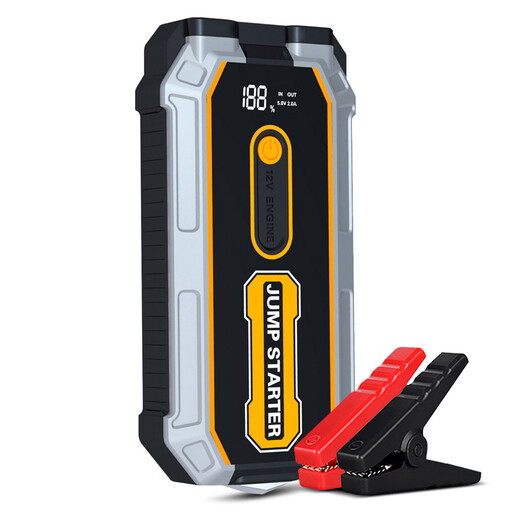
Why it suits this profile: According to the product specifications, this compact model is designed for 12V petrol and diesel vehicles, motorbikes, boats and snowmobiles. At around 330 grams, it’s easy to carry every day, and the LCD display is practical too.
Its stated peak current of 1.200A is accompanied by clear information about 12V compatibility, 12.800mAh capacity and a charge status display. Be sure to check your vehicle’s engine size.
LCD display, USB power bank, three-mode LED light and a compact 165 × 84 × 30 mm casing.
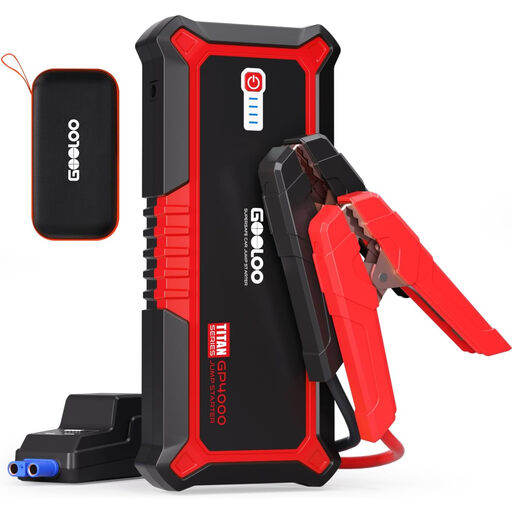
Why it suits this profile: According to the product specifications, this 4.000A battery booster supports 12V vehicles and diesel engines up to 10 litres. That makes it a good option for larger cars, motorhomes, pick-ups and vans, provided your vehicle is within the stated limits.
The description lists several safety features and metal clamps. This gives you more information than a high amp rating alone, although correct connection is still essential.
USB and Type-C ports, LED lighting, a sturdy casing and a stated compatibility range for petrol and diesel engines.
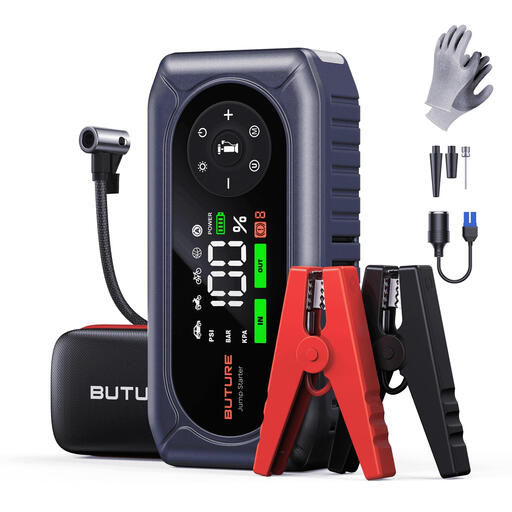
Why it suits this profile: According to the product specifications, this model combines a jump starter for 12V vehicles with a compressor, LCD screen and LED lighting. It’s a good fit for long journeys, motorhomes, SUVs and outdoor use.
The compressor has a stated maximum pressure of 150 PSI, five modes and an automatic shut-off function. Don’t run the compressor for longer than the manual allows, and let it cool down between uses.
4.500A peak current according to the product specifications, a digital tyre pressure display, four nozzles and a four-mode LED light.
We’ve put together a complete, up-to-date list of products that meet these strict selection criteria and current European safety regulations.
First, check that both the device and vehicle use 12V. Switch off the car, connect the red clamp to the positive terminal and the black clamp to the negative terminal or designated connection point. Then follow the starting sequence in the manual. Don’t try to start the engine repeatedly if the device is getting warm.
Its lifespan depends on how it’s used, storage temperature, charging frequency and battery type. Charge the device regularly, even when you’re not using it. Some product specifications recommend charging it every two to three months. Check the battery level before a long journey or holiday.
That depends on how you use it and how much it costs to buy. A jump starter is a one-off purchase and can also work as a power bank or emergency light. Breakdown cover, on the other hand, provides roadside assistance. So think of a jump starter as a handy tool for a flat battery or low tyre pressure, not as a replacement for all types of breakdown service.
