
Vandaag of morgen in huis

Kwaliteit gegarandeerd

Welkomstaanbiedingen ontgrendelen: GRATIS bezorging | Tot 80% korting | Gratis 30 dagen JoyPlus-proefperiode
Download de app
A flat car battery always seems to happen at the worst time: before work, on the way to your holiday destination or in a dark car park. With a car jump starter, you can try to start a 12V vehicle yourself, without needing another car or jump leads. Some models also work as a portable power bank for your car, an LED light and a tyre inflator.
However, not every portable jump starter is suitable for every car. As Joybuy’s Product Recommendation Officer, I focus on verifiable specifications and practical use cases, not just big numbers on the packaging.
A high peak current sounds impressive, but it doesn’t tell you everything about what a device can do in practice. Also check:
A 12V jump starter for a small petrol car won’t necessarily be suitable for a diesel van, motorhome or SUV.
A capacity rating in mAh tells you how much energy the internal battery can store. It’s not the same as the starting current. So a model with a large power bank capacity isn’t automatically a suitable car battery jump starter. Check the stated peak current, starting current and maximum supported engine size.
A jump starter with a compressor is handy when you have a soft tyre, but portable pumps can only be used for a limited time. Check the maximum pressure, airflow and cooling instructions. The stated 150 PSI is also a maximum value; your car’s recommended tyre pressure is shown on the sticker inside the door frame or fuel filler flap, or in the manual.
First, check whether your vehicle has a 12V battery. The models below are designed for 12V vehicles such as cars, motorbikes, SUVs and some vans. They aren’t intended for the high-voltage batteries in electric cars and are generally not suitable for the 24V systems used in heavy goods vehicles.
Then compare the stated support for petrol and diesel engines. Diesel vehicles often need more power to start. If you drive a motorhome, van or large SUV, don’t choose based on the lowest price alone.
Look for smart jump leads with features such as:
These features don’t eliminate the risk of incorrect use. Connect the red clamp to the positive terminal and, following the manual, connect the black clamp to the negative terminal or a suitable unpainted metal earth point. Don’t use a jump starter with a damaged, leaking or frozen battery.
A car jump starter with an LED light can come in handy if you break down in the dark. A power bank function is useful for charging your phone, sat nav or other USB devices. A jump starter with an air compressor is particularly useful if you often drive long distances, go camping or want to inflate bike tyres and balls as well.
Also check the weight, dimensions, included cables and charging method. A heavy model with lots of features is only useful if you actually keep it in your car.

Why it suits this buyer: A compact option for drivers of a standard car, motorbike or SUV who want a straightforward emergency car starter with a power bank and LED light.
The product listing gives separate figures for peak current (1200A) and starting current (600A), and states that it supports 12V petrol and diesel vehicles. This makes the key figures easier to compare.
Weighs 330 grams, with a stated capacity of 12800mAh, an LCD display, USB output and three-mode LED lighting.
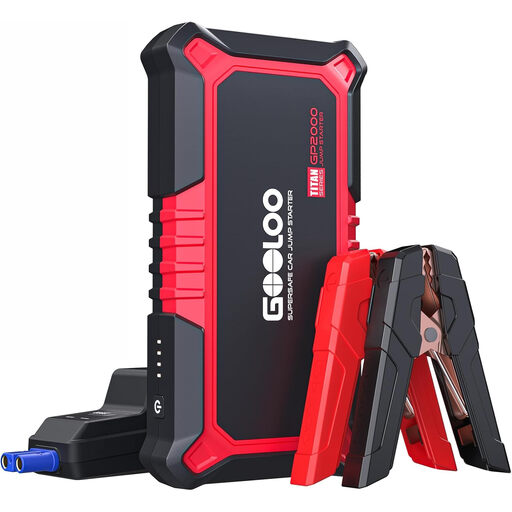
Why it suits this buyer: A handy choice for commuters who want to keep a lightweight device in the car and charge a phone, tablet or sat nav too.
The specifications state a peak current of 2000A, support for petrol engines up to 8.0 litres and diesel engines up to 6.0 litres, plus a weight of around 545 grams. This gives you more to go on than a marketing claim alone.
Two USB outputs, a 400-lumen LED light with three modes, sturdy clamps and a stated standby time of up to 24 months.
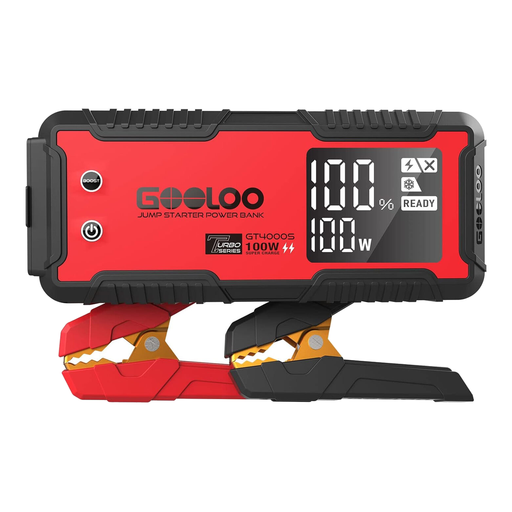
Why it suits this buyer: A good fit for drivers of larger vehicles who value extra charging options, a display and a robust car battery booster.
The product information lists a peak current of 4000A, 100W Type-C charging and built-in safety protections. Before buying, check that the stated engine support is suitable for your vehicle.
Three USB ports, a 15V DC output, a 400-lumen light and a 100W car charger included, according to the product listing.
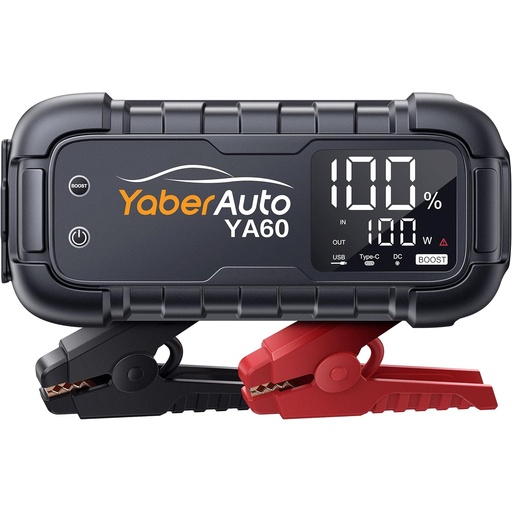
Why it suits this buyer: A compelling option for larger vehicles, motorhomes, outdoor enthusiasts and anyone looking for a powerful power bank with multiple outputs.
The listing gives separate figures for peak current (8000A) and a 26800mAh lithium-polymer battery, and states that it supports 12V petrol and diesel engines up to 12.0 litres. Always compare these limits with your vehicle’s specifications.
65W USB-C, two USB-A ports, a 150W DC output, a 600-lumen light and a stated charging time of around 1.5 hours.
We’ve put together a complete, up-to-date list of products that meet these strict selection criteria and current European safety regulations.
Keep the device dry and don’t leave it in extreme heat for long periods. If you don’t use it often, it’s sensible to recharge it periodically. The recommended interval varies by model and is given in the manual.
No. Check the voltage, vehicle type and stated engine size. A completely faulty, leaking or mechanically damaged battery can’t be repaired with a jump starter. Electric cars with high-voltage batteries are also different from 12V vehicles.
Its lifespan depends on storage temperature, how often it’s charged and how it’s used. Recharge the device periodically according to the manual, even if you rarely use it. Don’t leave it in a hot car, and don’t run the compressor for longer than instructed.
A jump starter mainly uses electricity when it’s being charged and when starting a vehicle. The cost of each charge is generally modest, but varies depending on the capacity and charging source. A model with a power bank or compressor may need charging more often, so it can use more energy than a basic car battery jump starter.
