
Vandaag of morgen in huis

Kwaliteit gegarandeerd

Welkomstaanbiedingen ontgrendelen: GRATIS bezorging | Tot 80% korting | Gratis 30 dagen JoyPlus-proefperiode
Download de app
A flat car battery often strikes at the worst possible moment: in a car park, on the motorway or just before a trip abroad. A car jump starter can be a practical emergency solution. However, these devices vary considerably in starting current, engine compatibility, charging options and ease of use.
When comparing models, don’t focus solely on a high figure on the packaging. The stated peak current doesn’t tell you everything about whether a device is suitable for your vehicle. Check the battery voltage, maximum engine capacity, safety features and maintenance requirements too.
An advert claiming 2000A, 4000A or even 8000A sounds impressive, but the capacity you need depends on your vehicle. A small petrol engine will generally have different requirements from a diesel engine in a van or lorry.
Always check:
A product description doesn’t guarantee that every car will start without a problem. If in doubt, consult your car’s manual and the jump starter’s instructions.
A jump starter with a compressor is handy for topping up a car tyre, bicycle tyre or ball. However, maximum pressure, airflow and automatic shut-off are more important than the PSI figure alone.
A compact compressor may be suitable for emergencies or correcting tyre pressure. If you’re inflating several large tyres one after another, the device may get hot and need a break. Also check whether an air hose and the right valve adaptors are included.
Lithium batteries gradually lose their charge over time. High temperatures in a parked car can also affect their lifespan. A car battery booster that hasn’t been checked for months may be flat just when you need it.
A practical routine:
The peak current is the maximum current delivered for a short time. Also check the stated engine limit. A 12V jump starter rated for engines up to 8.0 litres petrol and 6.0 litres diesel, such as the GOOLOO GP2000 according to the product information, isn’t automatically suitable for every engine with a similar capacity.
Diesel engines often need more current to start. If you drive an SUV, van or lorry, it’s worth choosing a model with a generous diesel rating. Bear the battery’s condition in mind too: a worn or damaged battery may cause further problems after a jump start.
Look for features such as:
These features can help reduce the risk of incorrect use, but they don’t replace the instructions. For a standard procedure, connect the red clamp to the positive terminal and the black clamp to the negative terminal or a suitable unpainted metal earthing point, depending on the manufacturer’s instructions.
A jump starter with an air compressor can combine several devices: an emergency starter, tyre inflator, power bank and torch. Check whether the compressor has a pressure display, preset pressure settings and an automatic stop function.
A model without a compressor is often more compact. This may be more practical if you’re mainly looking for a portable car battery booster for your daily commute. USB ports, a 12V output and an LED light are useful, but they don’t automatically increase starting capacity.
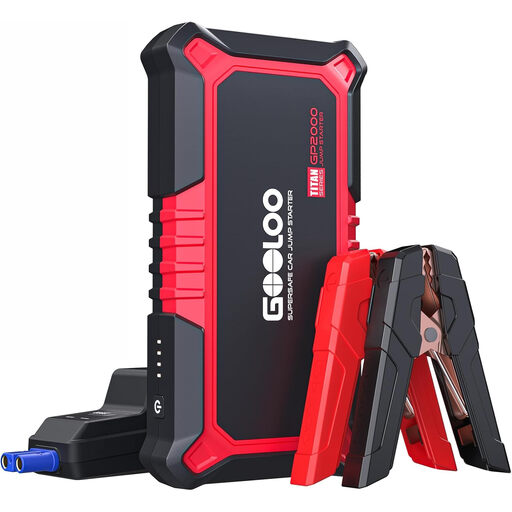
Why it suits this profile: According to the product specifications, this model is designed for 12V vehicles with petrol engines up to 8.0 litres and diesel engines up to 6.0 litres. Weighing around 545 grams, it’s relatively easy to store in a car.
The product information lists ten safety features and gives separate limits for petrol and diesel engines. This makes compatibility clearer than with a model that only states its peak current.
2000A peak current, two USB outputs, a 400-lumen LED light and a storage bag included.
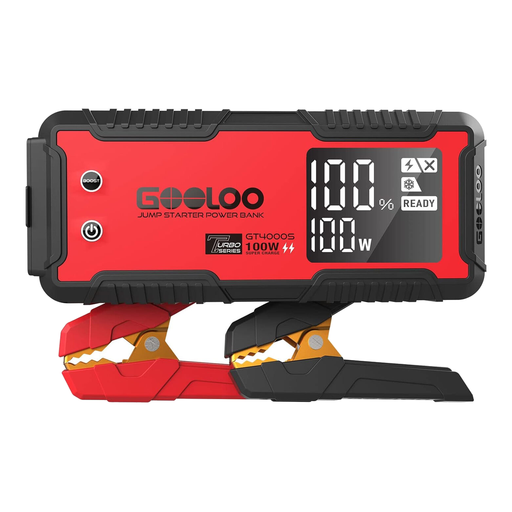
Why it suits this profile: This is an option for drivers looking for extra charging options and a higher stated starting capacity for a range of 12V vehicles.
The product description lists a display, ten protection features and separate engine limits of up to 12.0 litres petrol and 10.0 litres diesel. Always check these against your vehicle’s specifications.
4000A peak current, 100W charging, USB-C, a 12V output and a 400-lumen light, according to the product information.
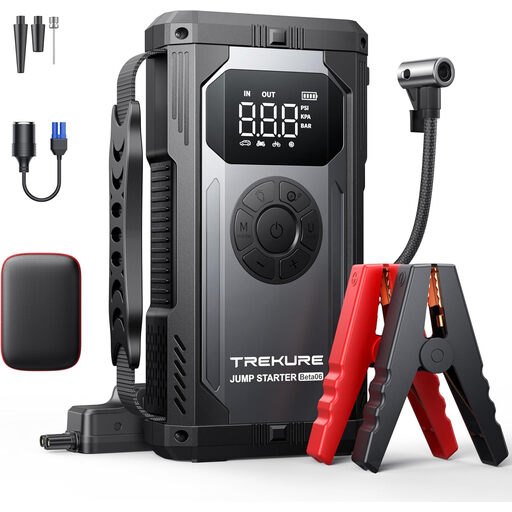
Why it suits this profile: This model combines an emergency starter with a compressor, making it a good fit for travellers, outdoor enthusiasts and drivers of larger vehicles.
According to the product information, the compressor has adjustable pressure, a display and an automatic stop function. This makes it easier to use than a standalone pump without pressure control.
5500A peak current, a compressor rated up to 150 PSI, airflow of up to 35 litres per minute, an LCD display and a 12V output.
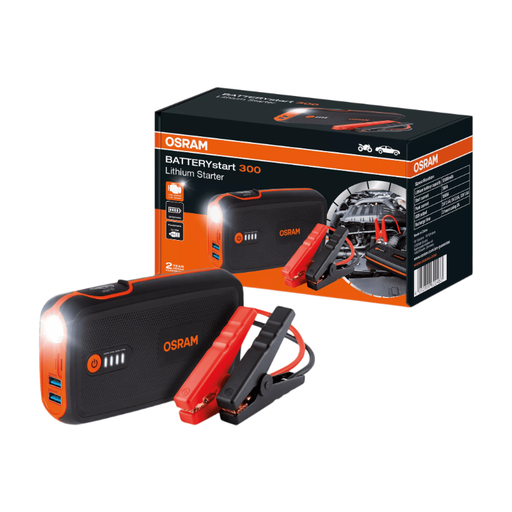
Why it suits this profile: Its stated suitability for petrol engines up to 6 litres and diesel engines up to 3 litres makes it a good match for many everyday cars and smaller vehicles.
The product details state both the maximum engine capacity and a weight of around 706 grams. This lets you compare its size and intended use in advance.
1500A peak current, two USB outputs, a 12V socket and an integrated LED light.
We’ve put together a complete, up-to-date list of products that meet these strict selection criteria and the current European safety regulations.
First, check that the jump starter and car both use a 12V system. Switch off the car, connect the red clamp to the positive terminal and attach the black clamp as instructed in the manual. Wait for the ready signal, if the device has one, then try starting the engine briefly. Once the car has started, remove the clamps in the specified order.
Its lifespan depends on storage temperature, how often it’s charged and how it’s used. Product listings sometimes state a standby time, but this doesn’t guarantee the device’s total lifespan. Recharge it periodically and avoid leaving it in a hot car for long periods.
It depends on how often you use each function. A combined device saves space and can be handy on the road. A separate compressor may be more practical if you inflate tyres regularly. So compare compressor capacity, accessories, charging ports and weight, rather than looking only at the purchase price.
