
Vandaag of morgen in huis

Kwaliteit gegarandeerd

Welkomstaanbiedingen ontgrendelen: GRATIS bezorging | Tot 80% korting | Gratis 30 dagen JoyPlus-proefperiode
Download de app
A flat car battery often happens at the worst possible moment: on a cold morning, during a camping trip or in a car park with no other motorist nearby. With a car jump starter, you may be able to start a 12V vehicle yourself, without car jump leads and without help from a second vehicle.
However, not every portable jump starter is suitable for every vehicle. A high number on the packaging does not tell you everything. Pay particular attention to engine compatibility, safety features and how you maintain the device.
A peak current of, for example, 2000A or 4000A sounds impressive, but this is not the same as the continuous starting current. The stated capacity must also be suitable for your engine. A compact petrol engine generally requires something different from a large diesel engine, van or motorhome.
Always check:
A 24V lorry or heavy-duty bus is not automatically compatible with a 12V jump starter.
A jump starter with a compressor can be useful when a tyre is underinflated. However, the maximum pressure, such as 150 PSI, does not indicate how quickly every car tyre will inflate. The stated figures also depend on tyre size, temperature and the remaining battery charge.
Think of the compressor as an emergency solution for correcting tyre pressure, not as a replacement for regular maintenance at a tyre service centre. Also check whether a hose, suitable valve adapters and automatic shut-off are included.
Lithium batteries gradually lose their charge. A car interior can become much hotter in summer than the recommended storage temperature. In winter, a nearly flat jump starter may be less useful.
Charge the device before using it for the first time and follow the brand’s maintenance instructions. Many product manuals recommend checking or charging the jump starter every two to six months during long-term storage. Ideally, store it somewhere dry, protected from direct sunlight and away from loose metal objects.
The stated peak current is the brief maximum current delivered when starting the engine. Only use this figure together with the specified engine support. A model described as suitable for up to 6.0 litres of petrol and 4.0 litres of diesel is not automatically suitable for a larger diesel engine.
For an ordinary passenger car, a mid-range model may be perfectly adequate. Owners of SUVs, motorhomes, boats and vans should leave extra headroom between their vehicle’s engine size and the jump starter’s upper limit.
Battery capacity is often given in mAh. This figure is only directly comparable when the battery voltage is also the same. Wh gives a more direct indication of the stored energy. Also pay attention to the stated USB output. A car battery charger or power bank function rated at 5V/2A is suitable for many phones and accessories, but not every laptop or fast charger.
A higher capacity can be useful for several starting attempts or charging devices, but it usually also makes the product larger and heavier.
Look for a smart cable with clear polarity markings and protection against:
According to the product information provided by the brands mentioned, these features are built into various models. This is a product specification, not a guarantee that every situation will be risk-free. Follow the instructions, check the clamps and do not attempt to start a visibly damaged, leaking or frozen battery.
A CE mark or reference to European conformity indicates that a manufacturer declares that it meets certain applicable requirements. It is not an independent assessment of starting performance. Therefore, also check the warranty, manual and the seller’s contact details.
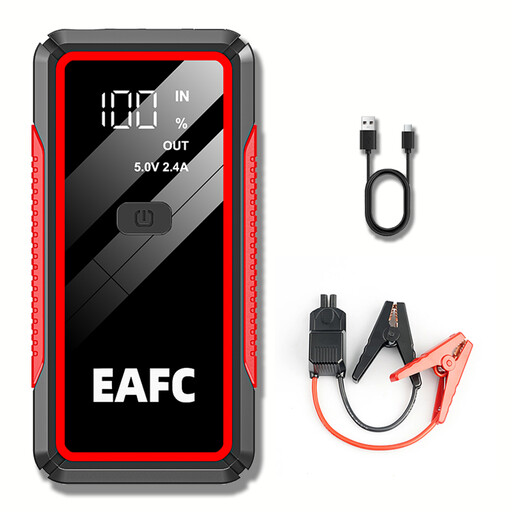
Why it suits this profile: This model combines a 2000A peak current with a compact design and a 10000mAh battery. According to the product information, it is designed for petrol engines up to 6.0 litres and diesel engines up to 4.0 litres.
The product description states the peak current and starting current, engine limits and protected clamps. This allows you to assess its suitability more precisely than by looking at the amp figure alone.
10000mAh capacity, USB output, digital display and LED light with continuous, flashing and SOS modes.
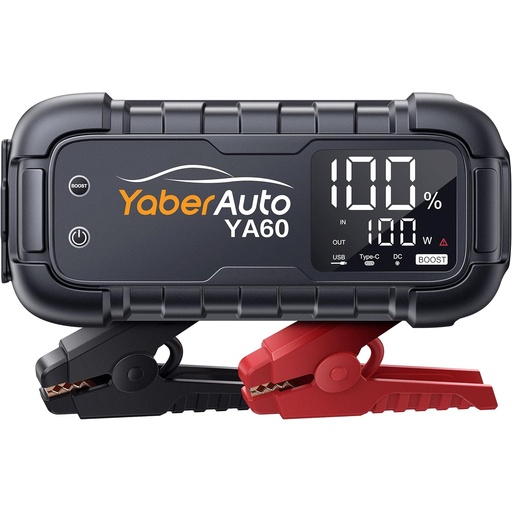
Why it suits this profile: The stated 26800mAh battery, 65W USB-C and 150W DC output are ideal for drivers who want to carry power for several devices as well as a car emergency starter.
The specifications list the connections, charging capacity, temperature range and ten safety features separately. This makes it clear what the power bank function can actually be used for.
8000A peak current according to the product information, 65W bidirectional charging, USB-A and DC output, and 600-lumen LED lighting.
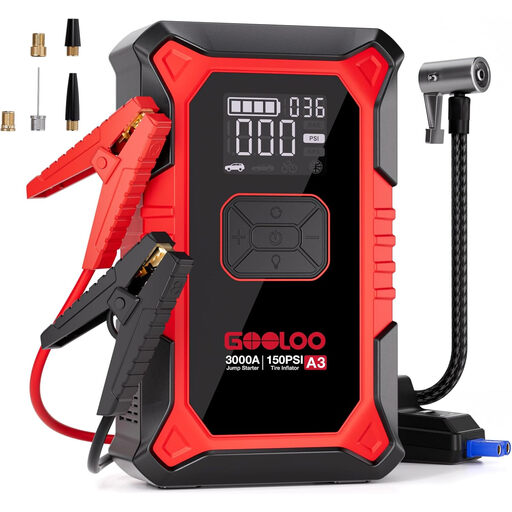
Why it suits this profile: For motorists, motorcyclists and outdoor enthusiasts looking for one device for starting engines, inflating tyres, lighting and USB charging.
According to the product information, the compressor has digital pressure measurement, automatic shut-off and several modes. This makes the function easier to control than a standalone maximum PSI claim.
3000A peak current, compressor up to 150 PSI, airflow of 35 l/min, five inflation modes and 10 safety features according to the product description.
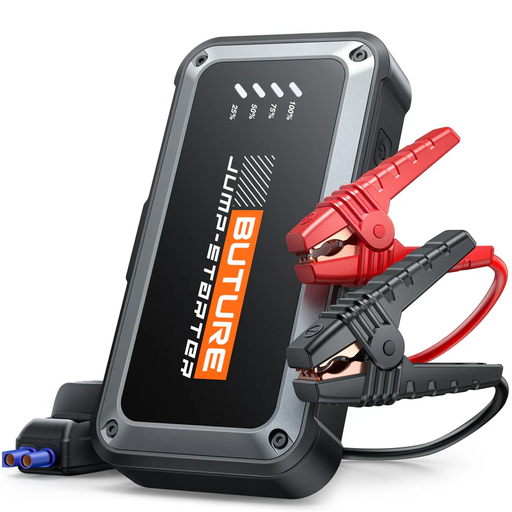
Why it suits this profile: The manufacturer states that it supports petrol engines up to 9.0 litres and diesel engines up to 8.5 litres. This suits larger 12V vehicles, provided your vehicle falls within these limits.
The manual specifies the charge level required before use, the maximum starting time and the cooling period between attempts. This helps prevent overloading caused by repeated starting attempts.
3000A peak current, 16800mAh power bank, four light modes and a stated temperature range of approximately -20°C to 60°C.
We have put together a complete, up-to-date list of products that fully meet these strict selection criteria and the applicable European safety regulations.
Do not use a car emergency starter with a damaged or leaking battery. If starting problems keep recurring, having the battery tested or the charging system checked is wiser than repeatedly using a booster.
You can if the model explicitly supports both fuel types and your engine size. Also check that the vehicle has a 12V system. The description “for petrol and diesel” is not sufficient without checking the maximum engine size.
Its service life depends on usage, storage temperature, charging cycles and maintenance. Recharge the device regularly, even when you are not using it. Store it somewhere dry and follow the manufacturer’s instructions. A stated standby time is a product specification provided by the brand, not a guarantee for every storage condition.
No. A jump starter temporarily delivers a high current to start an engine. A car battery charger gradually recharges the battery through a charging process. A jump starter power bank can help start the engine, but it cannot repair a worn or faulty battery.
