
Vandaag of morgen in huis

Kwaliteit gegarandeerd

Welkomstaanbiedingen ontgrendelen: GRATIS bezorging | Tot 80% korting | Gratis 30 dagen JoyPlus-proefperiode
Download de app
A flat car battery often strikes at the worst possible moment: just before you leave for work, during a weekend trip or on a dark country road. With a car jump starter, you can try to start a vehicle with a flat battery yourself, without needing another car and jump leads.
However, not every car battery jump starter is suitable for every vehicle. A high amp rating on the packaging doesn’t tell you everything. A long list of features can also prove impractical if the device is too heavy, won’t hold its charge or isn’t suitable for your engine size.
A figure such as 4000A, 6000A or 8000A sounds impressive, but peak current isn’t the same as the normal starting current. So check which petrol and diesel engines the product is designed for, according to its description. A small petrol car generally needs something different from a diesel SUV, motorhome or van.
Claims about the number of starts, extreme temperatures or performance come from the manufacturer. Treat them as product specifications, not a guarantee for every real-world situation.
A portable jump starter delivers a short burst of power to help start the engine. A battery charger is designed to charge the battery over a longer period using mains electricity. If you want to maintain your battery regularly, you may be better off with a separate 12V jump starter alongside a smart battery charger.
According to its product description, a charger such as the EAFC 12V 6A is suitable for various lead-acid batteries, including AGM, GEL, EFB and wet batteries. This device is designed for indoor use and must be connected to the battery before you plug it into the mains.
A compressor, power bank or LED emergency light can be useful, but first check the connections, charging method, dimensions and safety features. For example, a jump starter with a compressor may be heavier and take up more room than a compact model without an air pump.
Think about storage, too. Don’t leave lithium-powered devices in a hot, enclosed car for extended periods. Always follow the temperature and charging instructions in the manual.
Check these three things:
For motorbikes, small petrol cars and compact vehicles, a model rated at 1200A to 2000A may be suitable for the stated applications. For SUVs, motorhomes, lorries or larger diesel engines, models with higher stated ratings are often more logical to compare.
Capacity is often measured in mAh. A higher figure may give you more capacity for charging phones or making several starting attempts, but it doesn’t automatically mean the jump starter will start your vehicle faster or deliver more power.
Also check for:
A car power bank is particularly useful if you also want to charge a phone, tablet or sat nav while you’re out and about.
Red clamp to positive, black clamp to negative or a suitable earth point: these basics still matter. Look for verifiable features such as:
Safety features can’t prevent every mistake. Always check the connections yourself, and only use the supplied cables if the manufacturer specifies that you should.
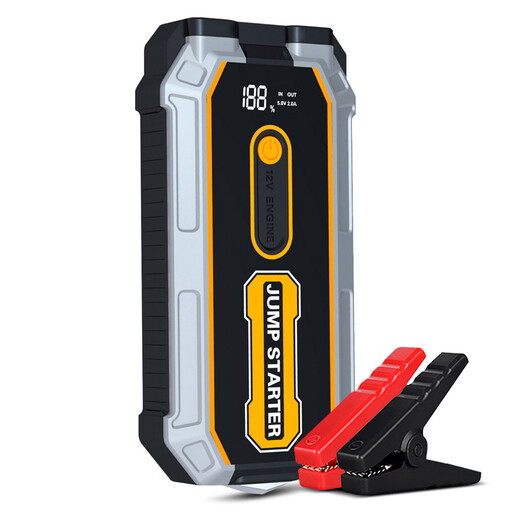
Why it suits this user: According to the product specifications, this compact model is designed for 12V petrol and diesel vehicles, motorbikes, boats and snowmobiles. At around 330 grams, it’s easy to store in a glove compartment or emergency kit.
The LCD display shows the remaining charge, so you’re less likely to set off with a flat jump starter. The specifications state a starting current of 600A and a peak current of 1200A.
12800mAh capacity, USB output, three light modes and a slim 165 × 84 × 30 mm casing.
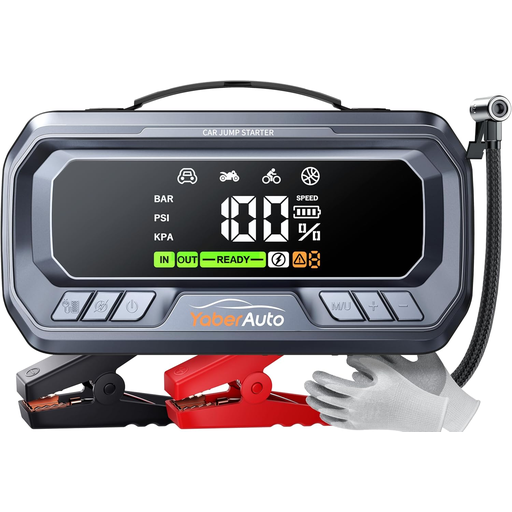
Why it suits this user: SUV, motorhome or lorry owners who also want to inflate their tyres get starting, inflation and portable power in one device.
The product description lists separate starting and peak current ratings, as well as a 160 PSI compressor that switches off automatically once it reaches the set tyre pressure.
6500A peak current according to the product specifications, 16000mAh battery, 65W USB-C charging, LCD screen and emergency light.
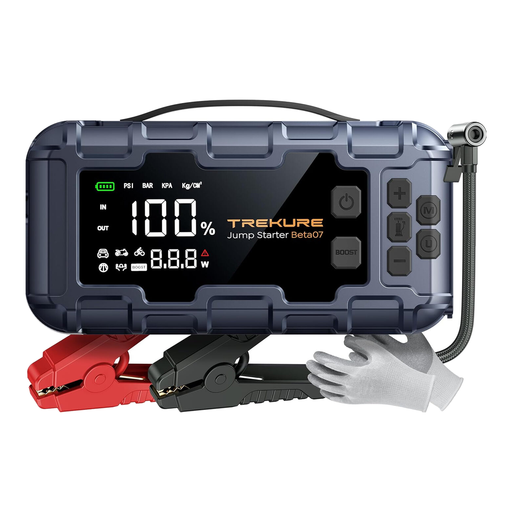
Why it suits this user: According to the product information, this model is designed for larger 12V vehicles and for users who want one multifunctional device to support their tyres, devices and vehicles while on the go.
According to the description, the 3.3-inch display shows information about operation and tyre pressure. The compressor has a stated pressure of 160 PSI and an automatic stop function.
6000A stated peak current, 45W USB-C PD, two USB-A ports, 160 PSI compressor, 600-lumen LED and insulating gloves included.
We’ve put together a full, up-to-date list of products that meet these strict selection criteria and the applicable European safety regulations.
Fully charge the battery booster before you put it in your car. Then check the charge regularly, for example every two to six months, following the product-specific instructions. Store the device in a dry place, out of direct sunlight and out of reach of children.
When using it:
A jump starter won’t fix a faulty battery. If your car repeatedly struggles to start, have the battery and charging system checked.
Only if the product specifications support diesel engines and the stated engine size is suitable for your vehicle. A diesel engine often needs more power to start than a small petrol engine. Also check that the device is suitable for 12V systems.
That depends on the lithium battery, storage temperature, charging frequency and how you use it. Charge the device according to the manual and don’t leave it in a hot car for extended periods. If the charge is low, the jump starter may not be ready when you need it.
Not always. A jump starter works on its own and doesn’t need a second vehicle. Jump leads can still be a useful extra if another car or a suitable power source is available. With either method, make sure the polarity is correct and follow the safety instructions for your vehicle and device.
