
Vandaag of morgen in huis

Kwaliteit gegarandeerd

Welkomstaanbiedingen ontgrendelen: GRATIS bezorging | Tot 80% korting | Gratis 30 dagen JoyPlus-proefperiode
Download de app
A flat battery often strikes at the worst possible time: in a car park, on a camping trip or just before you leave for work. With a car jump starter, you can sometimes start a 12V vehicle yourself, without another car or traditional jump leads. However, many models appear more powerful and versatile than they are in practice.
The main pitfalls usually come down to three things:
Pay attention to the product type too. A car battery charger runs from mains power and charges the battery gradually. A car jump starter, emergency car starter or portable jump starter, on the other hand, delivers a high current for a short time to start the engine. A charger doesn’t automatically replace a jump starter.
Check whether your car, motorbike, campervan, boat, tractor or van uses a 12V battery. Then check the maximum engine capacity the manufacturer states for petrol and diesel engines. Diesel engines generally need more starting power than petrol engines.
A model rated for, say, petrol engines up to 6.0 litres and diesel engines up to 4.0 litres isn’t automatically suitable for a heavy van or lorry. For SUVs, campervans and larger vehicles, it can make sense to allow for some extra capacity. Use the stated figures as a guide and check your vehicle handbook if you’re unsure.
Peak current is a brief maximum rating. Starting current gives you a different idea of what the car battery booster can deliver when starting the engine. So don’t just compare 1200A, 3000A or 6000A. Also check:
Smart jump leads with protection against reverse polarity, short circuits, overheating and overcurrent reduce the risk of incorrect use. They don’t remove the need to connect everything correctly.
A portable jump starter should be easy to read and carry. An LCD screen may show the charge level, temperature or connection status. An LED light with an SOS or flashing mode is useful if you break down in the dark.
Also check:
Claims such as ‘starts dozens of times’ or ‘stays charged for months’ are brand or product claims. Don’t treat them as guaranteed results in all conditions. Actual performance depends on factors including temperature, battery condition and vehicle type.
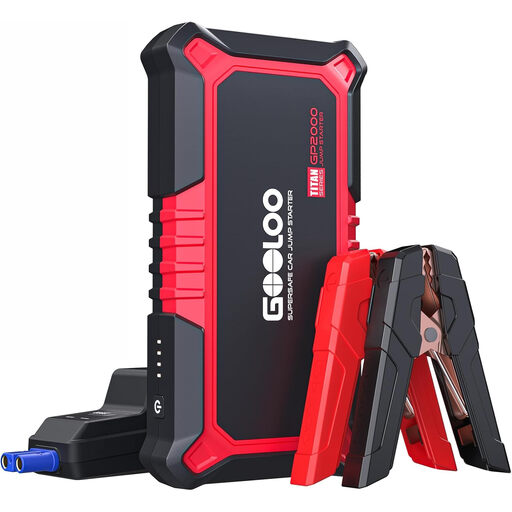
Why it suits this type of user: According to the product description, this 2000A car battery booster is designed for 12V vehicles with petrol engines up to 8.0 litres and diesel engines up to 6.0 litres. That makes it suitable for many cars, SUVs and motorbikes.
The stated vehicle and engine sizes make it easier to compare than relying on a high amp rating alone. According to the product information, the smart cables have several safety features.
Power bank with two USB outputs, a 400-lumen light and a stated weight of around 545 grams.
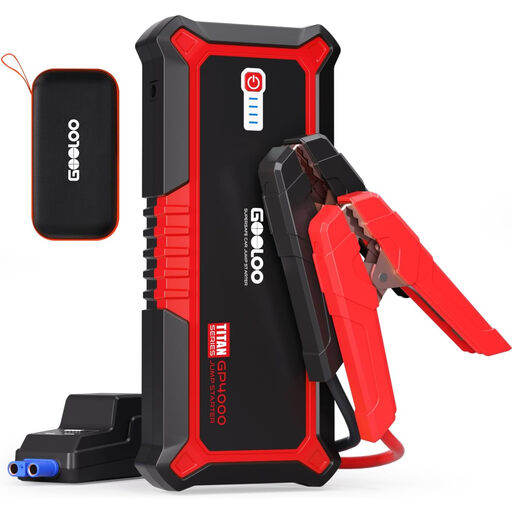
Why it suits this type of user: This model is aimed at drivers of larger 12V vehicles. The product description states a peak current of 4000A and support for petrol and diesel engines up to 10.0 litres.
Vehicle compatibility is clearly stated. According to the product information, it has ten types of protection and comes with metal clamps.
Two USB ports, a USB-C input, an LED light and a BOOST function for very low battery voltage.
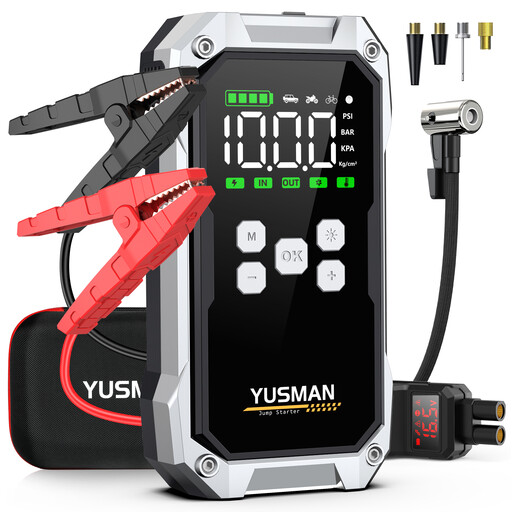
Why it suits this type of user: For anyone who wants to carry a tyre inflator as well as a car jump starter. The product description states that the compressor reaches up to 150 PSI and that the device supports 12V vehicles.
According to the product description, the LCD display shows tyre pressure and device status. The smart clamps warn you if they’re connected incorrectly.
5000A peak current, stated capacity of 21800mAh, an air compressor and four LED modes.

Why it suits this type of user: At around 330 grams, its compact body is handy for a motorbike, boat or car, or to keep in a rucksack when space is limited.
The specifications state both a peak current of 1200A and a starting current of 600A. This makes the difference between the two figures clear when comparing models.
Stated battery capacity of 12800mAh, LCD display, USB output and LED lighting with SOS and flashing modes.
We’ve put together a complete, up-to-date list of products that meet these strict selection criteria and the applicable European safety regulations.
Always read the manual for your chosen model. The usual steps are:
Don’t use a booster if the battery is visibly leaking, cracked or frozen. Don’t keep trying to start the engine over and over either; allow the device to cool down between attempts. A jump starter won’t fix a worn-out or faulty battery in the long term.
It can, as long as the model is suitable. Check the stated diesel engine capacity and 12V compatibility specifically. A model listed only for small petrol engines isn’t a sensible choice for a diesel campervan or van.
Follow the manufacturer’s instructions. Product information for various models recommends charging every two to six months when the device isn’t in use. Check the charge level before a long journey and recharge it after use.
No. The power bank function is usually for charging phones, tablets or other USB devices. A car battery charger is designed to charge a vehicle battery in a controlled way from mains power. So, to maintain a lead-acid battery, you’ll need a suitable smart charger, not just a jump starter.
