
Vandaag of morgen in huis

Kwaliteit gegarandeerd

Welkomstaanbiedingen ontgrendelen: GRATIS bezorging | Tot 80% korting | Gratis 30 dagen JoyPlus-proefperiode
Download de app
A flat battery often strikes at an inconvenient time: on a cold morning, after a weekend away or while you’re travelling in a campervan. With a car jump starter, you can try to start a 12V vehicle yourself, provided certain conditions are met. However, not every portable jump starter is suitable for every car.
Many buyers look only at the highest amp figure on the packaging. This can be misleading. A compact casing, low battery capacity or unclear safety features can also make a car battery booster less practical over time. Below, you’ll find the key things to consider, along with a few models for different needs.
A claim such as 2,000A, 4,000A or 8,000A sounds impressive, but it doesn’t tell you everything about everyday use. Peak current is a short-term maximum value. So, check the following too:
A model for a small petrol engine doesn’t need the same specifications as a jump starter for an SUV, van, campervan or lorry.
A car power bank with USB ports is handy for charging a phone or sat nav. Make sure you check the output power and available connections. A torch with an SOS or flashing mode can be useful by a dark road, but also check that the battery has enough charge.
A jump starter with an air compressor is versatile, but it has more parts and uses extra power. Check the maximum pressure, hose, included valve adapters and whether the device needs time to cool down between uses.
Brands often mention protection against reverse polarity, short circuits, overheating and overcharging. Don’t take this as a guarantee that incorrect use will have no consequences. According to the relevant brands’ product descriptions, certain models have these types of safety features. Always follow the instructions and check the connections before starting the engine.
Don’t use an emergency car jump starter if the battery is visibly leaking, cracked, swollen or frozen.
Start by checking the stated engine size. A product may, for example, be suitable for petrol engines up to 8.0 litres and diesel engines up to 6.0 litres. Diesel engines generally need more starting power, especially in low temperatures.
For a typical car or motorbike, a model in the 1,200A to 2,000A range may be sufficient, according to the stated product specifications. For a large SUV, campervan or van, a battery jump starter with a higher stated capacity may make more sense. Always check your vehicle’s manual.
Choose a 12V jump starter with clearly marked red and black clamps. Useful features include a ready indicator, a warning for incorrect connections and short-circuit protection. Metal clamps and thicker cables may be suitable for heavier use, but check their length and grip too.
A common procedure is:
A jump starter can sit in your car for months. Check how often the manufacturer recommends recharging it. The product information for various models recommends recharging every two to six months. Store the device somewhere dry and don’t leave it in extreme heat for long periods.
Also consider the weight. A compact booster weighing around 330 grams is easy to carry, while a model with an air compressor or larger battery can be considerably heavier.
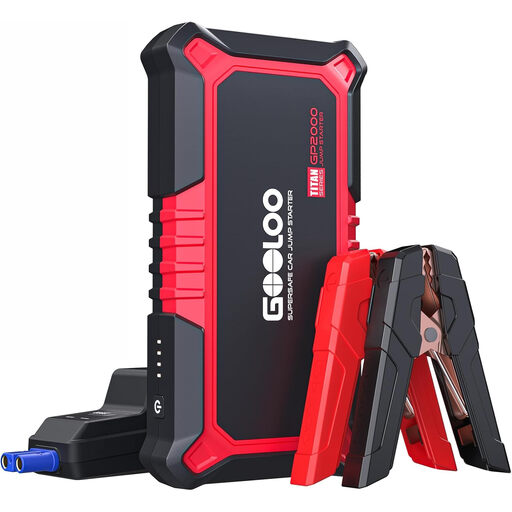
Why it suits this profile: This model combines a stated peak current of 2000A with USB outputs and a 400-lumen light. According to the product description, it’s suitable for petrol engines up to 8.0 litres and diesel engines up to 6.0 litres.
Vehicle compatibility and charging requirements are clearly stated. According to the manufacturer, the smart cable has several safety features.
12V support, two USB outputs, a three-mode torch and a stated weight of around 545 grams.
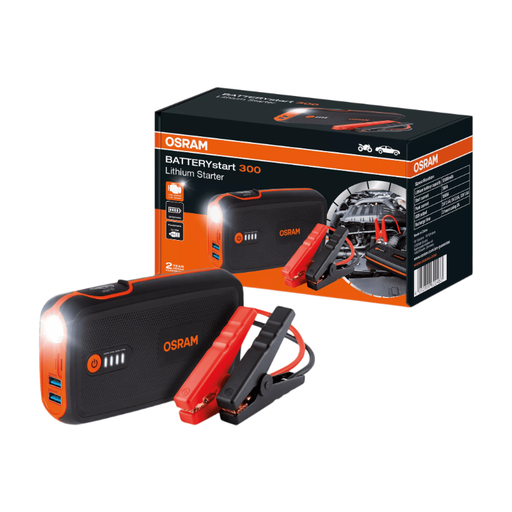
Why it suits this profile: If you’re looking for clear product specifications from a well-known manufacturer, compare this model’s 1500A peak current, 12V support and stated suitability for petrol engines up to 6.0 litres and diesel engines up to 3.0 litres.
The stated engine limits, 13,000mAh capacity and maintenance instructions are specified, so you don’t have to rely on a peak current claim alone.
Two USB outputs, an integrated LED light, a 12V system and, according to the product information, a two-year manufacturer’s warranty.

Why it suits this profile: This is an option for drivers looking for a jump starter with an air compressor. According to the product description, it has a stated peak current of 8000A, a 150 PSI compressor and supports 12V vehicles.
According to the product information, the LCD display shows the battery status and tyre pressure. The manual says to allow the compressor to cool down between uses.
26,800mAh capacity according to the product description, USB connections, LED lighting and four preset compressor modes.
We’ve put together a complete, up-to-date list of products that meet these strict selection criteria and current European safety regulations.
Fully charge a new car jump starter before using it for the first time. Store the cables in the supplied bag so the metal clamps can’t come into contact with other objects. Check the charge before a long journey and recharge the device regularly as instructed in the manual.
A jump starter is designed as an emergency solution for a flat battery. If your car repeatedly fails to start, have the battery, alternator and charging voltage checked. A booster won’t fix an underlying electrical problem.
No. Check that the car has a 12V lead-acid battery and compare the maximum stated engine size for petrol and diesel. Electric vehicles aren’t automatically compatible; some models’ product information explicitly states that they aren’t designed for them.
This varies by model and storage conditions. Manufacturers sometimes state a standby period of 18 to 24 months, but still recommend recharging regularly. Follow the maintenance schedule in the manual and check the charge before use.
It depends on how you’ll use it. If you only need to start your car, a compact model may be enough. If you often go on long drives, go camping or want to top up your tyre pressure yourself, the extra weight and power consumption of a compressor may be worthwhile. Check the maximum pressure, hose and cooling time.
