
Vandaag of morgen in huis

Kwaliteit gegarandeerd

Welkomstaanbiedingen ontgrendelen: GRATIS bezorging | Tot 80% korting | Gratis 30 dagen JoyPlus-proefperiode
Download de app
A flat battery often strikes at the worst possible time: in a car park, on the motorway or during a weekend away in a campervan. A car jump starter can come to the rescue, but not every model is suitable for every vehicle. If you only look at the highest amp rating, you could end up buying a device that’s too powerful, unsuitable or difficult to use.
The main pitfalls:
For most cars, motorbikes and light commercial vehicles, look for a 12V jump starter. A 24V system in a heavy goods vehicle or bus is different. Check your vehicle’s documentation before buying.
Next, check the stated engine size. For example, a model may be suitable for petrol engines up to 8.0 litres, but only for diesel engines up to 6.0 litres. Diesel engines generally need more starting power, especially in low temperatures. So only use a jump starter for a diesel car within the limits stated in the product description.
The amp rating is a manufacturer’s figure. According to the manufacturer’s own product information, a model may deliver a certain peak current, but the likelihood of a successful start also depends on the condition of the battery, cable connections, temperature and vehicle type.
A practical car battery booster has clearly marked connections and protection against:
Smart cables with an indicator or display can help you check the connections. This makes the process easier to follow, but always read the manual first. A safety feature doesn’t replace correct connection.
Also check that the clamps are sturdy, the cables are long enough and a storage bag is included. A compact portable jump starter left loose in the boot could get damaged or lost.
A jump starter power bank can charge smartphones, navigation devices and cameras via USB. An LED light with SOS or flashing mode is useful if you break down in the dark. These features may come in handy if you regularly go on long drives, camping trips or boat trips.
A jump starter with a compressor combines starting power with a portable air compressor for your car. Check the:
A higher pressure rating doesn’t mean the device will inflate every car tyre faster. Actual inflation speed depends on tyre volume, temperature and the condition of the compressor.

Why it suits this user: This compact model is a good fit for drivers who want a simple emergency starter to carry for a 12V car, motorbike, boat or snowmobile.
The specifications state that it’s compatible with 12V vehicles and has an LCD display and a clear starting current of 600A. This makes it easier to see when it needs charging, so you’re not choosing a device based solely on a large mAh figure.
1200A peak current, 12800mAh battery, 10W USB output, three-mode LED light and a weight of around 330 grams.

Why it suits this user: This is a good choice for drivers of larger SUVs, campervans, boats or pick-ups who want more reserve power than a compact car jump starter can offer.
According to the product information, this model is designed for 12V vehicles with petrol engines up to 9.0 litres or diesel engines up to 7.0 litres. Always check these limits against your vehicle’s manual.
3000A peak current, manufacturer-stated Boost function, USB-C and QC3.0 connections, 400-lumen LED light and multiple safety features.
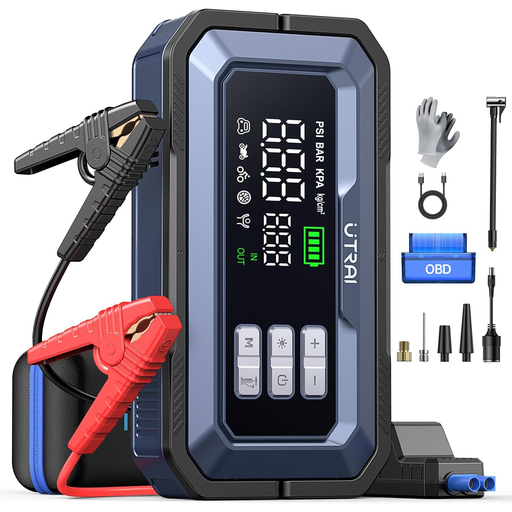
Why it suits this user: This model is a good fit for SUV and lorry owners, campervan users and outdoor enthusiasts who want to top up tyres and power 12V devices as well as jump-start a vehicle.
According to the product specifications, the built-in compressor has automatic shut-off, five modes and temperature protection. This makes it easier to monitor than a basic pump without a pressure display.
7000A peak current, stated support for diesel engines up to 14 litres, compressor up to 150 PSI, 160W DC output and 18W USB-C charging.
We’ve put together a complete, up-to-date list of products that meet these strict selection criteria and the applicable European safety regulations.
If the battery is visibly damaged or leaking, or the car won’t start despite the connections being correct, stop and contact roadside assistance or a garage. A jump starter won’t fix a faulty battery.
This depends on the battery type, storage temperature, charging frequency and how it’s used. For example, check the charge every two to three months unless the manual recommends a different interval. A model with an LCD screen makes it easier to check the remaining capacity.
Yes, some models are suitable for diesel engines according to their product information. However, the permitted engine size varies by model. A 12V jump starter for a small diesel car won’t automatically be suitable for a large van, SUV or lorry. Always check the diesel engine limit and your vehicle’s voltage.
The electricity cost per charge is usually low, but the exact amount depends on the battery capacity, charging losses and local electricity rate. Correct maintenance matters more: don’t run the compressor for longer than recommended, take cooling breaks and only use it for the specified pressure and applications.
