
Vandaag of morgen in huis

Kwaliteit gegarandeerd

Welkomstaanbiedingen ontgrendelen: GRATIS bezorging | Tot 80% korting | Gratis 30 dagen JoyPlus-proefperiode
Download de app
A flat battery often strikes at the worst possible moment: in a dark car park, on a camping trip or just before you need to leave for work. With a car jump starter, you can try to get your vehicle started yourself in some situations, without jump leads or immediate help from another driver.
However, a high amp rating doesn’t tell you everything. Pay particular attention to vehicle compatibility, safety features and lithium battery maintenance. Read on to find out what to look for and which models suit different needs.
A rating such as 2000A, 3000A or 4500A may seem straightforward, but check the stated engine size and fuel type too. A car jump starter rated for petrol engines up to 8.0 litres won’t necessarily be suitable for every diesel engine or vehicle type.
So, check the following:
A jump starter with a power bank or LED light can be handy, but only if the connections, controls and battery capacity are clearly specified. For example, a 5V/2A USB output will suit many smartphones, but not every device with a fast-charging function.
For a model with a compressor, maximum pressure isn’t the only thing to consider. Check whether it has an LCD display, automatic shut-off, suitable valve adapters and a specified maximum running time.
A portable jump starter isn’t something you buy once and then forget about for years. Lithium batteries slowly lose their charge, even when the device isn’t being used. Product information for various models recommends charging them periodically, for example every three to six months.
Store your car battery booster:
For most cars, SUVs, motorbikes and light commercial vehicles, a 12V jump starter is the relevant category. Always check your vehicle’s manual and the limits specified for the device.
A higher peak current may be useful for larger engines, but it doesn’t guarantee that every flat or damaged battery can be restarted. Don’t use a car jump starter with a battery that is visibly damaged, frozen or leaking.
Look for features such as:
Connect the red clamp to the positive terminal and the black clamp to the negative terminal or a suitable metal earth point, following the instructions for the device and vehicle. Put the car in Park or neutral, and switch off the lights, radio and other electronics.
A car jump starter with a compressor is especially useful for drivers who also want to be prepared for a soft tyre. An LCD screen with preset tyre pressures and automatic shut-off makes the tyre inflator easier to use. Check the maximum continuous running time, though: some models need a cooling break after no more than ten minutes.
A jump starter with an LED light can help when connecting the clamps in the dark. Steady light, flashing light and SOS are common modes. A power bank is useful for charging a phone or sat nav, but check the USB specifications before relying on it.
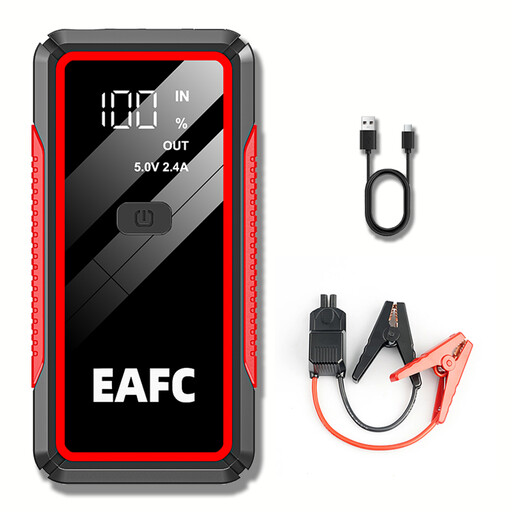
Why it suits this user: This compact model is designed for drivers of cars, SUVs, motorbikes and light vehicles who want to keep a straightforward jump starter in the boot.
The product information specifies a 2000A peak current, a digital display and protected clamps. This makes it easier to check the battery status and connection than with a model that has no indicators.
10.000mAh battery, USB output, LED light with three modes, and stated support for petrol engines up to 6.0 litres and diesel engines up to 4.0 litres.
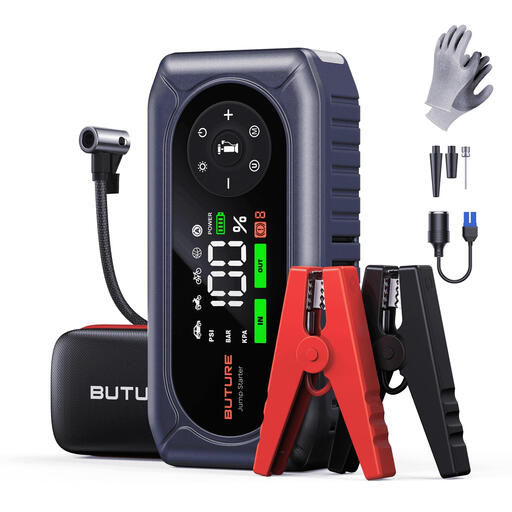
Why it suits this user: This model combines a powerful car battery booster with a digital tyre inflator, so you won’t need to carry as much separate emergency equipment.
The specifications list ten safety features, an LCD screen and automatic shut-off when the preset tyre pressure is reached. The compressor should not run for more than ten minutes at a time.
4500A peak current, compressor up to 150 PSI, four nozzles, power bank function and four light modes. According to the product information, this model is designed for 12V vehicles.
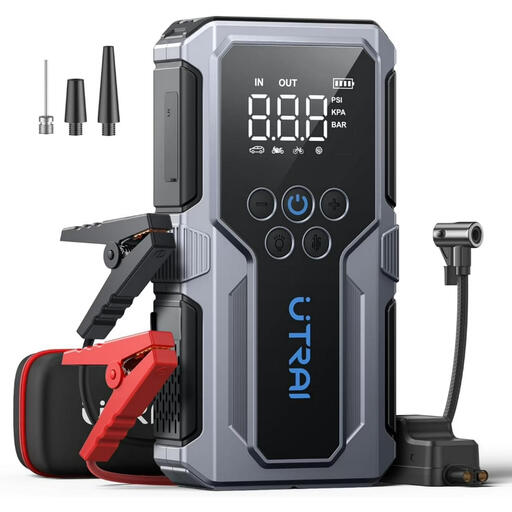
Why it suits this user: A good fit for anyone travelling in an SUV, motorhome, boat or larger vehicle who wants to inflate tyres or charge mobile devices as well as jump-start the engine.
According to the product information, the LCD controls show the battery level, tyre pressure and inflation mode. A green light on the safety cable confirms that the connection is correct.
3000A peak current, 150 PSI compressor, 15.000mAh power bank, USB and USB-C ports, and support for petrol engines up to 8.5 litres and diesel engines up to 6.5 litres, according to the product information.
We’ve put together a complete, up-to-date list of products that meet these strict selection criteria and the applicable European safety regulations.
No. Check that the device is designed for a 12V system, and compare its supported engine size with your car’s. Pay attention to the difference between petrol and diesel engines too. We don’t recommend using a jump starter if the battery is damaged, leaking or frozen.
Its lifespan depends on charging cycles, storage temperature and maintenance. Charge the device according to the manual and check its remaining charge every few months. Don’t leave a lithium battery completely flat for a long time.
Usually not. A jump starter briefly delivers a high current to help start a vehicle. A car battery charger generally charges the vehicle’s battery slowly and in a controlled way. So, for regular charging, you’ll need a suitable charger; a jump starter is mainly for emergencies.
