
Vandaag of morgen in huis

Kwaliteit gegarandeerd

Welkomstaanbiedingen ontgrendelen: GRATIS bezorging | Tot 80% korting | Gratis 30 dagen JoyPlus-proefperiode
Download de app
A flat car battery often strikes at the worst possible moment: before you leave for work, in a dark car park or during a road trip. A car jump starter can get you going without relying on another car or breakdown assistance. However, not every model is suitable for every vehicle or situation.
Watch out for these three common pitfalls:
Most models in this category are designed as 12V jump starters. Check whether your car, SUV, van, motorbike, motorhome or boat uses a 12V system. Depending on the model, a jump starter for petrol and diesel vehicles may support different maximum engine sizes.
A diesel engine generally needs more starting power than a petrol engine. So look beyond the peak current and check the stated starting current, supported fuel type and maximum engine capacity. According to the product specifications, a model with a peak current of 1200A may be sufficient for a standard compact petrol car. For a larger diesel SUV or van, it’s more practical to allow a bigger margin.
Capacity mainly determines how many times you can use the device and how many USB devices you can charge. For example, the Porbi S306 lists a battery capacity of 12.800 mAh and a stated starting current of 600A. The Porbi S903 lists 20.000 mAh, a starting current of 800A and a peak current of 2000A.
These figures come from the product information. They don’t guarantee that every car will start in all conditions. A deeply discharged, damaged or frozen battery can cause additional problems.
A jump starter with compressor is useful if you have a soft tyre as well as a flat battery. Check the maximum pressure, airflow rate, hose length and automatic shut-off. A stated pressure of 150 or 160 PSI doesn’t mean every tyre will inflate at the same speed.
A jump starter with LED light can help when checking your vehicle at the roadside. SOS and flashing modes are useful as warning signals, but always use your vehicle’s required safety equipment too. Also check:
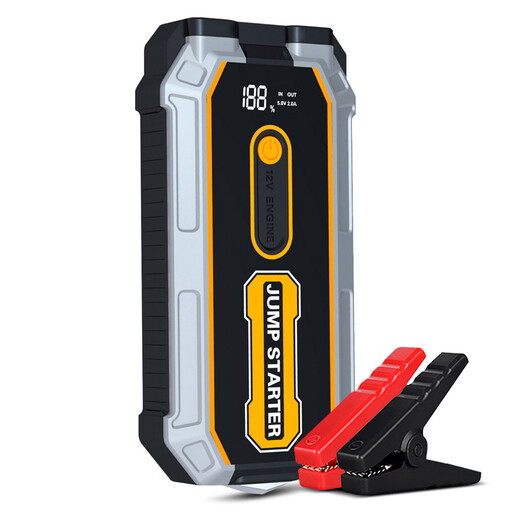
Why it suits this user: According to the product information, this compact model weighs around 330 grams and is designed for 12V petrol and diesel vehicles, motorbikes and boats. It fits neatly in a glove compartment or a small emergency kit.
The specifications list both a starting current of 600A and a peak current of 1200A, so you can see more than just one big marketing figure.
12.800 mAh battery according to the product description, 10W USB output, LCD indicator and LED light with steady, flashing and SOS modes.
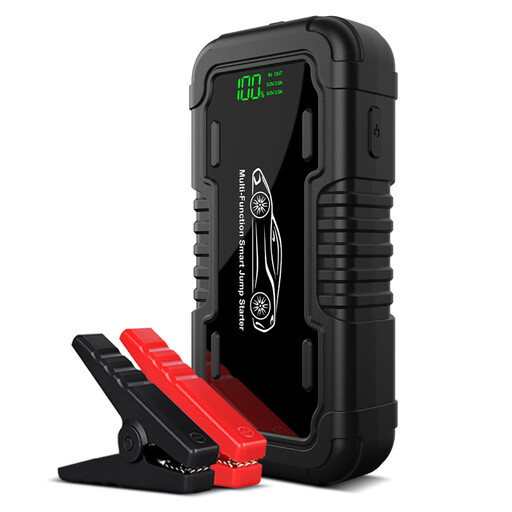
Why it suits this user: Its higher capacity and 800A starting current make it an interesting option for SUV and van drivers, or anyone who regularly takes longer journeys.
The product listing gives separate figures for 20.000 mAh, 16.000 mAh nominal capacity, 800A starting current and 2000A peak current. This makes it easier to compare.
QC3.0 charging up to 18W, USB-C input, LCD display, LED SOS function and, according to the product information, IP44 protection.
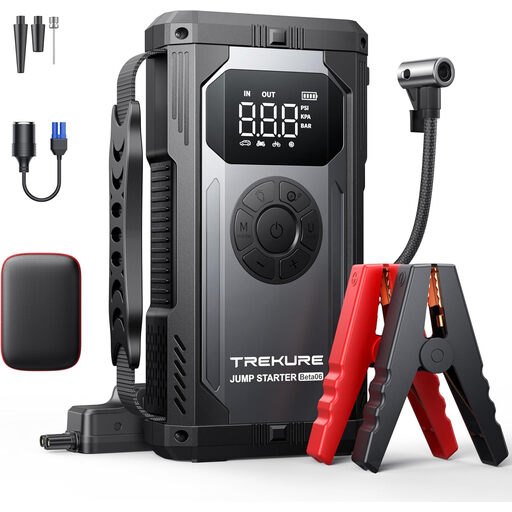
Why it suits this user: This model combines a car battery jump starter with a compressor and, according to the product description, is designed for petrol and diesel vehicles with engines up to 10 litres.
The product specifications list more than just a peak current of 5500A: they also include a 150 PSI compressor, an airflow rate of 35 l/min and automatic shut-off at the preset pressure.
23800 mAh according to the product listing, LCD display for battery level and tyre pressure, 12V output, three LED modes and a storage case included.
We’ve put together a complete, up-to-date list of products that meet these strict selection criteria and the applicable European safety requirements.
Read the instructions for your chosen model before use. Switch off the car, check the connection points and attach the red clamp to the positive terminal. According to the instructions, the black clamp should go on the negative terminal or a suitable earth point. Don’t use damaged cables, and don’t let the clamps touch each other.
Crank the engine only briefly each time, and wait between attempts if the instructions say to. Disconnect the cables as soon as the engine starts. Don’t use the jump starter with a leaking, swollen or visibly damaged battery. A jump starter also won’t fix a battery that keeps going flat.
Recharge the device after use and check its charge level every few months. Store it somewhere dry, away from direct sunlight and not for long periods in extreme heat or cold. Also check that the accessories supplied are suitable for your vehicle.
No. Check the stated diesel engine capacity and starting current. Diesel engines often need more power to start. Only use a model whose manufacturer specifies that it’s suitable for your vehicle type and engine category.
Its lifespan depends on storage temperature, charging frequency, battery type and how it’s used. Follow the manufacturer’s maintenance instructions. Some models recommend charging after a few months in storage; others state a longer standby time. Treat these claims as the brand’s product specifications, not as a guarantee for every situation.
No. A compressor can top up the air when tyre pressure is too low. A puncture, damaged tyre or valve problem needs to be assessed separately. Don’t drive on a visibly damaged tyre.
