
Vandaag of morgen in huis

Kwaliteit gegarandeerd

Welkomstaanbiedingen ontgrendelen: GRATIS bezorging | Tot 80% korting | Gratis 30 dagen JoyPlus-proefperiode
Download de app
A flat car battery always seems to happen at the worst time: on a cold morning, after a weekend away or in a car park with no help nearby. A car jump starter can be a practical addition to your jump leads. But not every model is suitable for every vehicle. In particular, inflated amp claims, unclear battery capacity and missing safety features can lead to a poor purchase.
As a Joybuy Product Recommendation Officer, I focus on specifications you can check: vehicle compatibility, starting current, safety features, connections and size.
A peak current of, say, 2.000A or 4.000A sounds impressive, but it doesn’t tell you everything about how suitable a product is in practice. Check which engine size and type of engine the product is designed for, according to its specifications. A diesel engine generally needs different starting support from a smaller petrol engine.
Also look at the difference between peak current and the regular starting current. The peak figure is a brief maximum; the regular starting current gives you a better idea of what to expect in everyday use.
A jump starter will usually help you start a vehicle, but it won’t fully recharge a flat car battery like a battery charger. After starting, the car needs to be driven for a while or connected to a suitable charger. Think of a jump starter as car starting assistance or an emergency starter battery, not a replacement for a proper trickle charger.
Incorrectly connected clamps, short circuits and overheating are important risks to consider. Ideally, choose a model with reverse polarity protection, short-circuit protection and a clear status indicator. Check how often it needs recharging, too. Some models need topping up every few months, even if they haven’t been used.
A 12V jump starter is suitable for many cars, motorbikes, SUVs and vans, provided the vehicle uses a 12V lead-acid battery. Check your vehicle’s manual to make sure. A jump starter listed as suitable for petrol engines up to 8,0 litres isn’t automatically suitable for every diesel engine.
Use the product specifications as a guide to the minimum you need:
According to the product description, models such as the GOOLOO GP2000 are specified for petrol engines up to 8,0 litres and diesel engines up to 6,0 litres. The manufacturer describes the EAFC 2000A as suitable for petrol engines up to 6,0 litres and diesel engines up to 4,0 litres. Always check these details against the information for your own vehicle.
Look for sturdy metal clamps, well-insulated handles and smart jump leads with safety features. A jump lead set with safety features can warn you if the clamps are connected incorrectly or cut off the current if there’s a problem.
Useful extras include:
Check the weight, too. A model weighing around 330 to 580 grams is easy to store in a glove compartment or rucksack. Heavier models may offer more capacity or extra connections, but they take up more room.
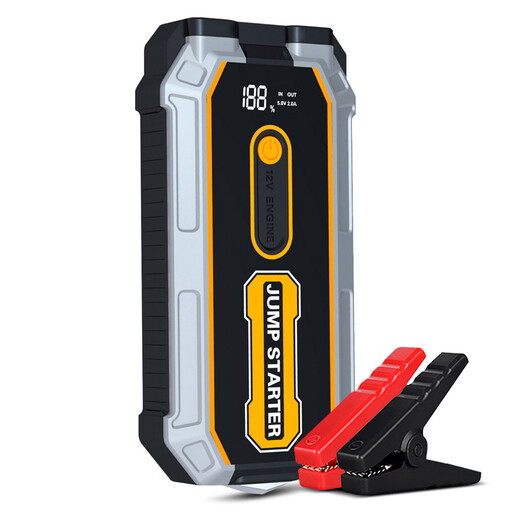
Why it suits this profile: This compact model is designed for 12V petrol and diesel vehicles and weighs around 330 grams according to the product specifications. It’s a good choice for drivers who want to keep a simple emergency starter battery in the car.
The LCD indicator shows the remaining battery charge, making it less likely that you’ll forget to recharge it. The specifications list a peak current of 1200A and a starting current of 600A.
330 grams, 10W USB output, LCD display and LED light with three modes.

Why it suits this profile: According to the product information, this model is suitable for 12V vehicles with petrol engines up to 9 litres and diesel engines up to 7 litres. That makes it a good fit for larger SUVs, motorhomes, boats and vans.
The product description mentions a BOOST function for batteries with very low voltage, as well as several safety features, including reverse polarity and short-circuit protection.
3000A peak current, USB-C and USB connections, 15V output and LED lighting with SOS and flashing modes.
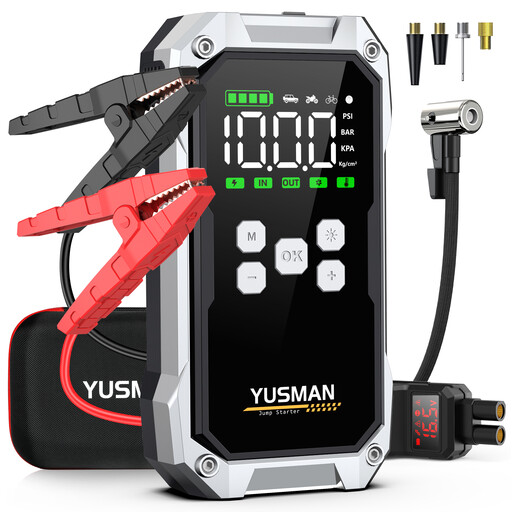
Why it suits this profile: This model combines a jump starter with a built-in compressor. It’s a practical option for drivers who cover long distances, use a van or want extra features for the road.
The product information lists smart clamps that provide warnings for issues including incorrect polarity, overheating and overloading. Always follow the instructions in the manual.
150 PSI compressor, LCD screen, 5000A peak current and USB outputs with 5V/3A.
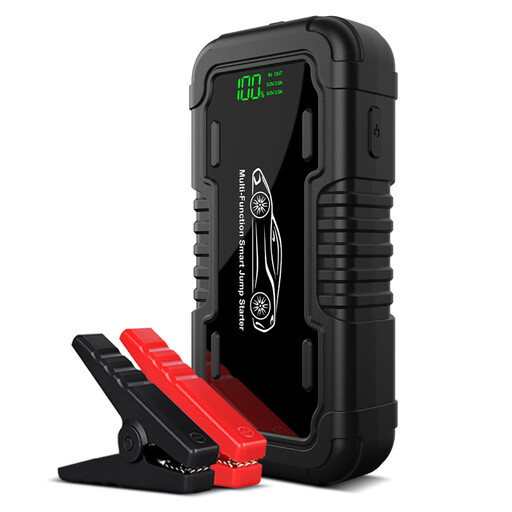
Why it suits this profile: The stated 20.000mAh battery capacity, QC3.0 charging, LCD display and IP44 protection make this model suitable for camping, road trips and use away from town.
The LCD screen shows the charge level. The stated IP44 rating doesn’t mean the device can be submerged, so keep the connections dry.
2000A peak current, 800A starting current, 18W fast charging and LED light with three modes.
We’ve put together a complete, up-to-date list of products that meet these strict selection criteria and the applicable European safety regulations.
Always follow the instructions for your chosen model. The general steps are usually:
Don’t use the device with a damaged, leaking or swollen battery. A jump starter isn’t intended for electric vehicles either, unless the product information explicitly says otherwise.
It depends on the condition of the battery and the model you choose. Some products have a BOOST function for very low voltage, but this doesn’t guarantee that a damaged or completely faulty battery will start. Check the connections and follow the instructions in the manual.
Follow the manufacturer’s maintenance instructions. With many models, it’s a good idea to check the charge level every few months and recharge the device. Store the jump starter somewhere dry and avoid leaving it in extreme heat for long periods.
The USB output can charge phones, cameras and other devices, but capacity varies by model. Check the stated battery capacity, USB output and charging standards. A compact model is often enough if you only need to charge a smartphone; for several devices or longer trips, a larger battery may be more practical.
