
Vandaag of morgen in huis

Kwaliteit gegarandeerd

Welkomstaanbiedingen ontgrendelen: GRATIS bezorging | Tot 80% korting | Gratis 30 dagen JoyPlus-proefperiode
Download de app
A flat battery often strikes at the worst possible moment: before your commute, at a campsite, at a boat ramp or after several cold nights. A car jump starter can get you out of a sticky situation, but not every model is suitable for every car, motorbike or campervan. So look beyond the peak current figure on the packaging.
A high peak current sounds impressive, but it doesn’t tell you everything about whether a jump starter is suitable. Check which engine sizes and types the portable jump starter is designed for, too. Petrol engines generally need different support from diesel engines. An SUV, van, campervan or boat will often need a more powerful model than a compact city car.
A jump starter delivers a short burst of extra power to start the engine. A car battery charger, on the other hand, charges the battery over a longer period. So if you’re mainly looking for battery maintenance or trickle charging, you’ll need a different product from someone who wants an emergency car starter to keep in the boot.
A charger such as the EAFC 12V 15A is described as being designed for 12V lead-acid batteries and certain AGM, EFB and GEL batteries. This makes this type of device useful for maintenance, but it isn’t a compact lithium jump starter.
A power bank, torch and USB port are handy, but check the basics first: are the cables long enough, are the clamps clearly labelled, and can you store the device in your car while it’s charged? Check the storage temperature, charging intervals and manufacturer’s instructions, too. A powerful jump starter won’t help if it’s flat in your boot.
Compare the stated peak current, but pay particular attention to the vehicle categories listed. The product descriptions below mention, among other things:
This information is based on the product details provided by the respective brands. It doesn’t guarantee that every vehicle will start in all conditions, so check your vehicle’s manual as well.
Look for clear polarity markings, protection against short circuits and overloading, and a warning if the clamps are connected incorrectly. Some models specify spark-proof clamps and multiple layers of protection. According to GOOLOO’s product description, these features are included in the GP3000 and GT4000S. Always use the cables according to the instructions and don’t let the clamps touch each other while connecting them.
A lithium jump starter is compact and can also be used as a power bank. Check how many USB ports it has and whether a USB-C connection or car charger is included. Look at the recommended charging frequency, too. Some models need regular top-ups, while others are described as holding their charge for longer. Treat this as a manufacturer’s product specification, not a guarantee of how long the charge will last in practice.
For battery maintenance, an intelligent 12V battery charger or a charger with automatic shut-off is more practical. Check whether your battery is one of the lead-acid, AGM, EFB or GEL types listed. A motorbike jump starter should also be easy to store and, ideally, not take up unnecessary space.
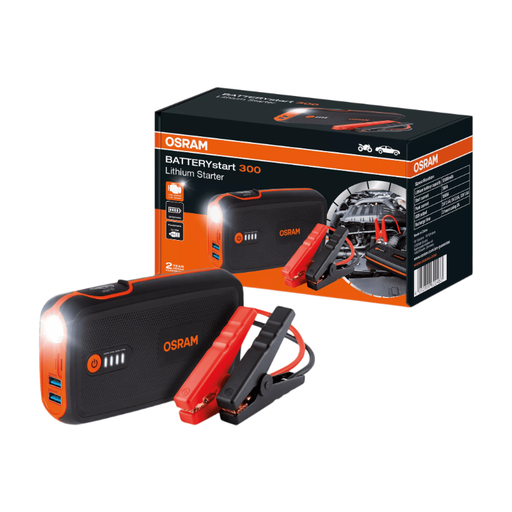
Why it suits this profile: This model is designed for everyday use with cars and motorbikes. According to the product description, it supports petrol engines up to 6 litres and diesel engines up to 3 litres.
The compatible engine sizes and 12V specification are clearly stated. That means you don’t have to rely on a general peak current figure alone.
1500A peak current, two USB outputs, a built-in LED light and a stated weight of 706 grams.

Why it suits this profile: According to GOOLOO, this model is designed for larger vehicles, including cars, trucks, campervans and boats. The product description lists support for petrol engines up to 9 litres and diesel engines up to 7 litres.
The product details list vehicle types, engine sizes and several safety features. This gives you more to go on than a marketing claim about starting power alone.
3000A peak current, USB-C and USB connections, 15V output, a torch and an included storage case.
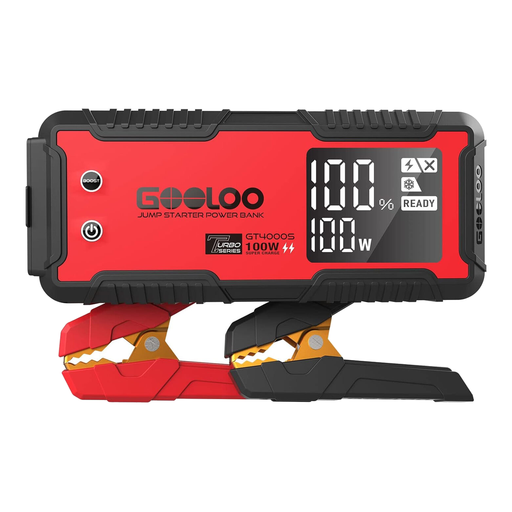
Why it suits this profile: The higher stated capacity may be useful for drivers of large SUVs, campervans, pick-ups, boats or commercial vehicles. According to the product description, this model supports petrol engines up to 12 litres and diesel engines up to 10 litres.
The engine limits and connection options are clearly listed in the product details. Always check that they’re suitable for your vehicle.
4000A peak current, 100W charging via USB-C, a display, three USB ports, 15V output and a 400-lumen light according to the product description.
Is your main concern a battery that slowly loses charge, perhaps in a classic car, motorbike or boat that’s only used seasonally? In that case, choose a car battery charger with automatic charging control. According to the product description, the EAFC 12V 15A includes features such as automatic shut-off, a display, temperature modes and support for several types of 12V lead-acid batteries.
A car polisher won’t solve a starting problem. It’s a separate tool for waxing, polishing and paintwork care. According to the product description, the BATOCA cordless polisher has a 12V battery, six speed settings and a 5 mm orbital throw. So only buy this product if you’re looking after your vehicle’s finish, not looking for an emergency car starter.
We’ve put together a complete, up-to-date list of products that meet these strict selection criteria and the applicable European safety regulations.
Switch off the vehicle, check that the jump starter is sufficiently charged, then connect the red clamp to the positive terminal. Next, connect the black clamp to the negative terminal or the designated earth point. Start the vehicle according to the instructions and remove the clamps once the engine is running. The exact procedure may vary by model.
It depends on the lithium battery, storage conditions and charging interval. Store the device somewhere dry and away from extreme heat. Check the charge level regularly, even when you’re not using the jump starter. Storage times quoted by brands are product specifications and may vary in practice.
No. At a minimum, check the voltage, engine size, fuel type and recommended vehicle category. A model for a compact petrol car isn’t automatically suitable for a diesel van, campervan or boat. If in doubt, check your vehicle’s manual and the product specifications.
