
Vandaag of morgen in huis

Kwaliteit gegarandeerd

Welkomstaanbiedingen ontgrendelen: GRATIS bezorging | Tot 80% korting | Gratis 30 dagen JoyPlus-proefperiode
Download de app
A flat car battery often strikes at the worst possible time: before you leave for work, in a car park or during a camping trip. With a car jump starter, you can sometimes start a vehicle with a flat 12V battery yourself, without relying on another car and a set of jump leads.
However, not every portable jump starter is suitable for every car. Manufacturers’ claims about amperage, engine size and performance in low temperatures don’t tell the whole story. Before buying a car battery booster, look out for these common pitfalls.
A figure such as 3000A or 7000A sounds impressive, but it usually refers to the peak current. That’s not the same as the sustained starting current. Battery condition, cable quality, temperature and engine size all play a part too.
So always check:
A jump starter for a small petrol car won’t necessarily have enough capacity for a large diesel SUV or van.
Lithium batteries gradually lose charge while in storage. A car jump starter left in the boot for months may not have enough power when you need it. Some product descriptions recommend recharging the device every two to three months; always follow the manufacturer’s instructions.
Also check whether a mains charger is included. Some models come with only a USB cable, so you’ll need to provide a suitable adapter.
A jump starter with a compressor, LCD screen, several USB ports and a torch is versatile, but it may also be larger or heavier. A compact car battery booster is easier to keep in a glove compartment, while a model with a compressor takes up more space.
Think about how you’ll actually use the device. If you only need it for starting, a basic 12V jump starter may be enough. For long journeys, camping or a vehicle with larger tyres, a jump starter with compressor may be more practical.
Don’t just look at the peak current; consider the full combination of current and engine limits. According to its product information, for example, a model may be suitable for petrol engines up to 6.0 litres and diesel engines up to 4.0 litres. These are the manufacturer’s product specifications, not a guarantee that every vehicle will start in all conditions.
For an everyday car, a mid-range car jump starter is often sufficient. If you drive an SUV, motorhome or van, or use a tractor or motorbike, it’s worth checking the specifications carefully against your vehicle’s handbook.
Look for features such as:
These features reduce the risk of incorrect connections, but they don’t replace the instructions. On many models, you connect the red clamp to the positive terminal and the black clamp to a suitable earth point or the negative terminal. Check the instructions for each product. Don’t use a jump starter with a damaged, leaking or frozen battery.
Capacity is often given in mAh, but this figure isn’t always directly comparable between models. Also check the rated capacity, weight, size and the cables supplied.
A portable car battery charger with USB outputs can charge a phone, tablet or sat nav while you’re on the move. If you also want to connect a laptop or another more powerful device, check the charging standards and output. A built-in light with steady, flashing or SOS modes is useful if you break down in the dark, but use it only as supplementary lighting.

Why it suits this type of user: At around 330 grams, its compact design is easy to store in your car or emergency bag. According to the product information, this model is designed for 12V petrol and diesel vehicles, motorbikes, boats and snowmobiles.
The product page lists both a peak current of 1200A and a starting current of 600A, so you get more information than just a single marketing figure.
12800mAh according to the product specifications, LCD status display, USB output and three lighting modes.
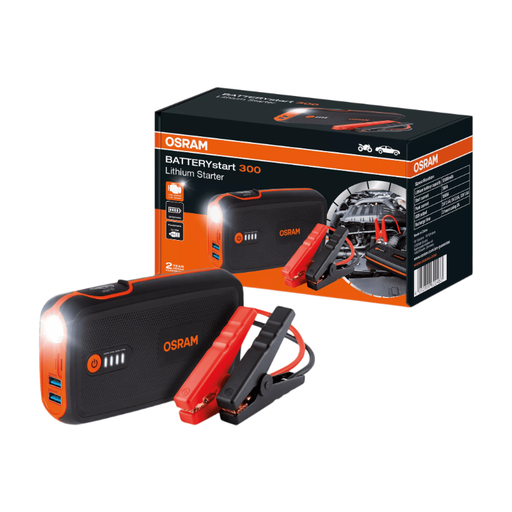
Why it suits this type of user: This model combines a 1500A peak current with a compact design and a stated weight of 706 grams. According to the product information, it’s suitable for petrol engines up to 6 litres and diesel engines up to 3 litres.
The product description lists a rated current of 600A alongside the peak figure. Before buying, check that your engine size is within the stated limits.
Dual USB output, integrated LED torch and, according to the product listing, a two-year manufacturer’s warranty.
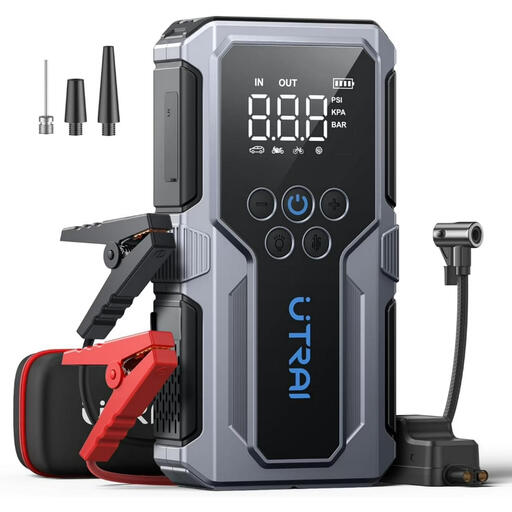
Why it suits this type of user: A good option for drivers who want to carry a tyre inflator as well as an emergency car jump starter, whether for a car, motorbike, bicycle or inflatables.
According to the product information, the LCD gauge shows tyre pressure and the compressor switches off automatically once it reaches the set pressure. Don’t run the compressor continuously for more than ten minutes.
3000A peak current, compressor up to 150 PSI, USB and USB-C ports, and ten listed safety features.
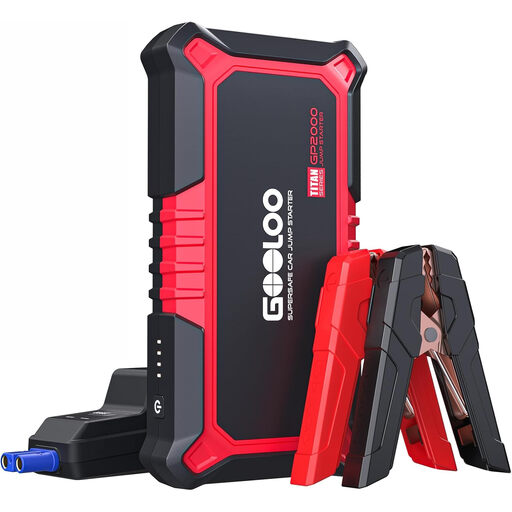
Why it suits this type of user: Its stated compatibility with petrol engines up to 8.0 litres and diesel engines up to 6.0 litres makes it suitable for many SUVs, light trucks, vans and motorbikes with a 12V battery.
The product page lists ten types of protection, including reverse polarity, overheating and short-circuit protection. Even so, check the status indicator before starting.
2000A peak current, two USB outputs, a 400-lumen light and a stated weight of around 545 grams.
We’ve put together a complete, up-to-date list of products that meet these strict selection criteria and the applicable European safety regulations.
A jump starter is an alternative to jump leads, not a replacement for a faulty battery or alternator. If the car cuts out again soon after a successful start, have the charging system checked.
No. Check the voltage, engine type, engine size and minimum battery voltage supported by the model. A 12V jump starter isn’t suitable for 24V systems. Electric cars also have a high-voltage traction battery; a standard jump starter is intended only for the 12V electrical system, and only if the instructions allow it.
That depends on the battery technology, storage temperature, how often it’s used and how it’s charged. Recharge the device periodically according to the product instructions, even when you’re not using it. Before a long journey, check the charge indicator and the condition of the cables and clamps.
The electricity used to charge it is generally minimal. The main costs are the purchase price and any replacement needed when the internal battery loses capacity over time. A model with a power bank or compressor may offer extra features, but it’s often larger than a basic car jump starter.
