
Vandaag of morgen in huis

Kwaliteit gegarandeerd

Welkomstaanbiedingen ontgrendelen: GRATIS bezorging | Tot 80% korting | Gratis 30 dagen JoyPlus-proefperiode
Download de app
A flat car battery always seems to happen at the worst time. You might be in a car park, on the hard shoulder or at a campsite with no mains socket nearby. A car jump starter could get you out of a tight spot, but only if it suits your vehicle and how you plan to use it.
Marketing copy often focuses on a high amperage, a large battery or extra features. But those details don’t always tell you enough. Read on to find out which specifications matter, which pitfalls to avoid and which models suit different types of driver.
A figure such as 2.000A, 5.000A or 8.000A sounds impressive. However, peak current is the maximum current supplied for a short time. The stated starting current, vehicle compatibility and maximum engine capacity give you a clearer picture.
A small petrol car will generally need something different from a large diesel SUV, van or boat. Always check that the jump starter is suitable for 12V systems and for your vehicle’s engine type.
A jump starter power bank might list a capacity of 12.800mAh or 26.800mAh. Manufacturers may also give a lower nominal or rated capacity. The difference is down to the voltage used and energy lost during conversion.
So don’t look at mAh alone. Check the recommended charging frequency, charging time and the battery level needed for a jump start. A compact portable jump starter that sits unused in your car for months still needs to be charged regularly.
A jump starter with a compressor can come in handy if a tyre is losing pressure, but check the maximum running time and cooling period. A high pressure rating, such as 150 or 160 PSI, doesn’t mean the compressor can run continuously.
An LED light, LCD screen and power bank function are useful too, but they don’t automatically make a device right for your car. Check the cable quality, safety features and manual first.
When choosing a car jump starter, these details are important:
The manual is especially important if you’re using the jump starter with a motorbike, boat, snowmobile or campervan. A product that’s suitable for a car won’t necessarily be suitable for every other vehicle.
Look for reverse polarity, short-circuit, overheating, overload and overvoltage protection. Smart cables with visual or audible warnings can help you spot an incorrect connection.
Always use the clamps as instructed in the product manual. Red usually goes on the positive terminal, and black on the negative terminal or a suitable earth point. Don’t use a jump starter with a damaged, leaking or frozen battery.
A model weighing around 330 to 700 grams will usually fit easily in a glove compartment or emergency kit. Heavier models may offer more capacity, a compressor or extra connections, but they also take up more space.
Store lithium-powered devices in a dry place, out of direct sunlight. A hot car can put strain on the battery. Fully charge the unit before using it for the first time, then check the charge every three to six months unless the manufacturer recommends a different interval.
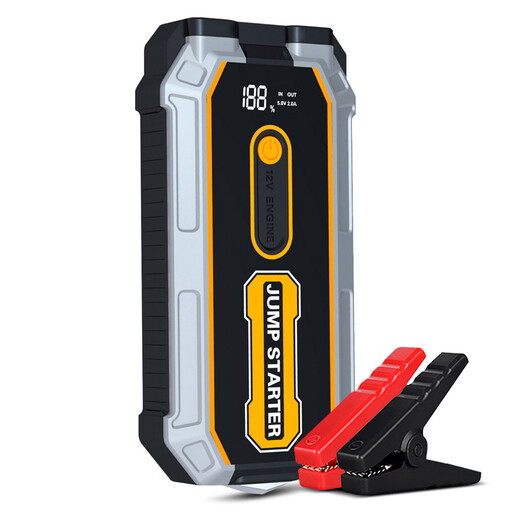
Why it suits this type of user: This compact model is designed for 12V petrol and diesel vehicles, including cars, SUVs, motorbikes and boats. Measuring 165 × 84 × 30 mm and weighing around 330 grams, it’s easy to store.
The product description gives both the 1200A peak current and 600A starting current. It also lists the rated capacity of 7200mAh alongside 12800mAh, making the figures easier to compare.
12V support, 10W USB output, LCD indicator and LED modes for constant light, strobe and SOS.
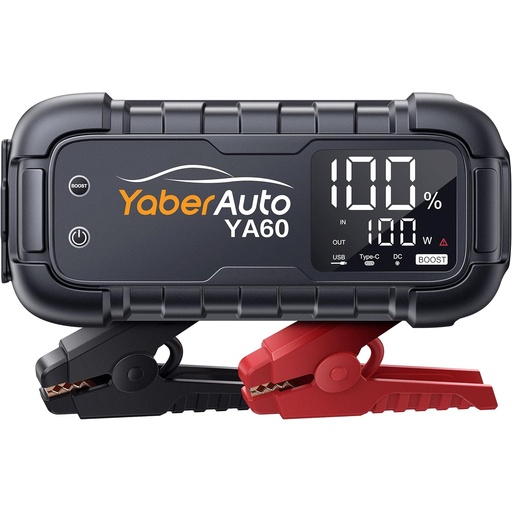
Why it suits this type of user: This model is aimed at drivers of larger vehicles and anyone who wants to charge several devices on the go. The product information says it supports 12V petrol engines and diesel engines up to 12.0 litres.
The manufacturer lists 10 intelligent safety features and recommends limiting each starting attempt to five seconds, with breaks in between. Always follow the supplied manual.
26800mAh, 65W USB-C, two USB-A outputs, 150W DC output and a 600-lumen LED light with three modes.
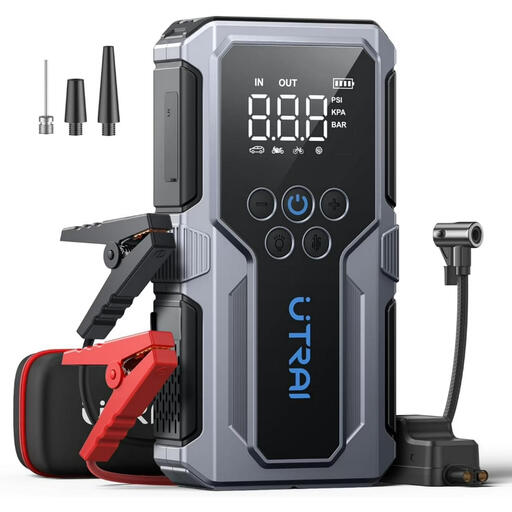
Why it suits this type of user: A handy choice for SUV drivers, campers and travellers who want to inflate tyres and charge USB devices as well as jump-start their car in an emergency.
According to the product description, the LCD screen displays the battery level and tyre pressure. The compressor switches off when it reaches the set pressure, but shouldn’t be used continuously for more than ten minutes.
3000A peak current, compressor up to 150 PSI, 15000mAh power bank, USB and USB-C ports, and three LED modes.
We’ve put together a complete, up-to-date list of products that meet these strict selection criteria and the applicable European safety regulations.
Put the car in Park or neutral and switch off the lights, radio and any other equipment. Connect the red clamp to the positive terminal and the black clamp to the negative terminal or a suitable earth point. Start the engine according to the manual, then remove the clamps once the engine is running. Only use the supplied cables if the manufacturer instructs you to.
Its lifespan depends on storage temperature, charging habits and how often it’s used. Fully charge the device before using it for the first time, then check the charge level regularly. Don’t leave it in direct sunlight or a hot car for long periods. If the casing is swollen, there’s a leak or a cable is damaged, stop using the device.
Most of the power is used when charging the device and running the compressor. If you only use it occasionally to top up a soft tyre, the cost is generally limited to recharging it via USB-C or an adapter. Let the compressor cool down as instructed in the manual, and don’t run it for longer than the stated maximum time.
