
Vandaag of morgen in huis

Kwaliteit gegarandeerd

Welkomstaanbiedingen ontgrendelen: GRATIS bezorging | Tot 80% korting | Gratis 30 dagen JoyPlus-proefperiode
Download de app
A flat car battery often happens at the worst possible moment: on a cold morning, at the campsite or in a remote car park. With a portable jump starter, you can sometimes restart a 12V vehicle yourself, without another car or traditional jump leads.
However, not every car jump starter is suitable for every vehicle. Manufacturers use different methods to measure starting current and battery capacity. So don’t just look for a high amp rating. Also consider vehicle compatibility, safety features and how you intend to use the device.
A rating such as 2000A or 4000A sounds clear, but peak current is not the same as the current available for an extended period during starting. Always check the stated engine capacity for petrol and diesel. A jump starter with a high peak current may still be unsuitable for a large diesel engine.
Most cars, motorbikes, motorhomes and light commercial vans have a 12V system. Heavy goods vehicles and some commercial vehicles, however, use 24V. A 12V jump starter is not automatically suitable for these vehicles. Check the vehicle handbook before buying a car battery booster.
A jump starter is not a maintenance-free product. Lithium batteries gradually lose charge during storage and can be affected by prolonged heat or cold. Check the charge level regularly and recharge the device after use. Always follow the manufacturer’s instructions.
Look at three details:
A model described as suitable for a 6.0-litre petrol engine is not automatically suitable for a 6.0-litre diesel engine. Diesel engines often require more power to start. If you’re unsure, a model with some extra capacity is the more practical choice.
Where possible, choose smart clamps with features such as:
These features make incorrect connection less likely, but they do not replace reading the instructions carefully. Connect the red clamp to the positive terminal and, as instructed, connect the black clamp to the negative terminal or a suitable unpainted metal earth point.
Capacity in mAh mainly indicates how the device can be used as a power bank and the amount of energy available. Also consider the weight and dimensions. A heavier model with a compressor can be useful for an SUV or motorhome, but less convenient if you’re simply looking for a compact emergency jump starter.
Extra features can be useful:
A jump starter with a compressor is particularly useful if you also want to check your tyre pressure while on the road. However, the pump is not a replacement for a regular tyre inflator when used frequently or for extended periods.
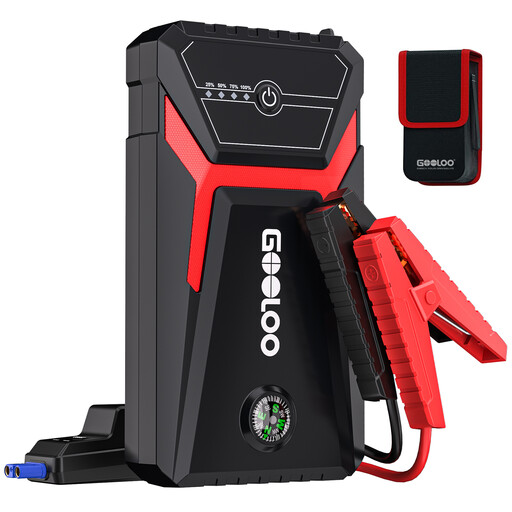
Why it suits this profile: The product description states a 1500A peak current and support for 12V vehicles with engines up to 6.0 litres petrol and 4.0 litres diesel. That makes it suitable for many cars, motorbikes and light recreational vehicles.
The compatibility is clearly stated in the product specifications. According to the product information, the smart cable also incorporates ten safety features.
Two USB outputs, a three-mode light, carry case and a stated weight of approximately 0.878 kg.

Why it suits this profile: For SUVs, motorhomes, boats and larger vehicles, the product listing offers a 3000A peak current and support for up to 9.0 litres petrol or 7.0 litres diesel.
The listing mentions a BOOST function for low battery voltage and ten safety features. Always check the exact operating procedure in the manual.
USB and USB-C connections, a 400-lumen light and a stated operating temperature range of -20 °C to 60 °C.
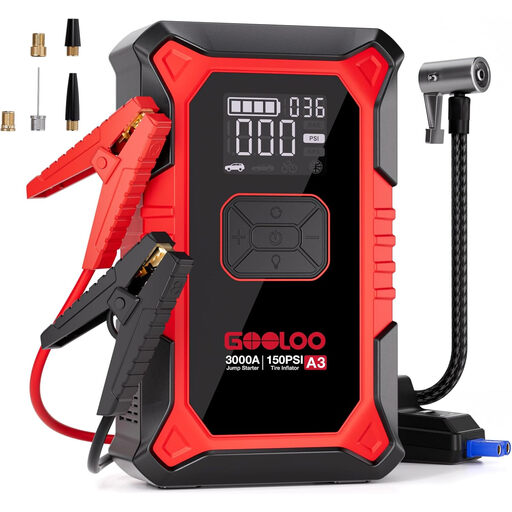
Why it suits this profile: Combining a jump starter with an air compressor is practical for road trips, motorhomes, SUVs and outdoor activities where tyre pressure may drop while you’re on the move.
The product description mentions automatic shut-off, pressure detection and ten safety features. The stated engine limit is 9.0 litres petrol and 6.5 litres diesel.
Compressor up to 150 PSI, 35 l/min airflow, five inflation modes and a digital display.
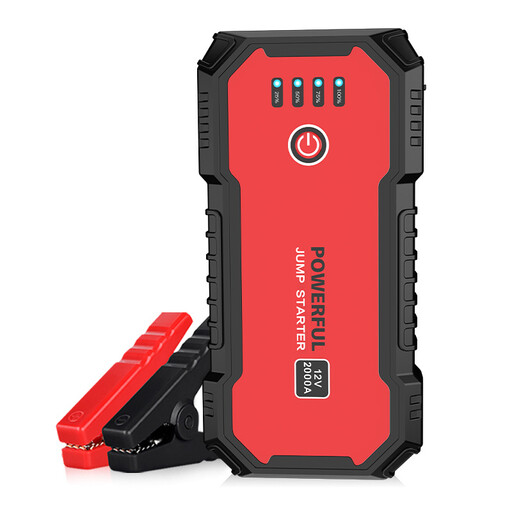
Why it suits this profile: With a stated weight of approximately 430 grams, this model is aimed at motorists and motorcyclists who want to keep a portable jump starter in the glove compartment or a bag.
The product details state a 1500A peak current, 12V application and IP44 rating. Before buying, check that the stated engine limit is suitable for your vehicle.
Stated battery capacity of 14,000 mAh, QC3.0 18W output, LCD display and three light modes.
We’ve put together a complete, up-to-date list of products that fully meet these strict selection criteria and the applicable European safety regulations.
Do not use a car jump starter if the battery is visibly damaged, leaking or frozen. If in doubt, contact a breakdown recovery service or garage.
No. A jump starter is designed to provide temporary starting power. If the battery is internally faulty or goes flat again after starting, it must be checked or replaced. A portable battery charger is therefore not a permanent solution for a worn-out battery.
This varies by model. Follow the manufacturer’s maintenance instructions and check the charge level regularly, for example before a long journey or winter. Recharge the device after use, even if some remaining capacity is still shown.
That depends on how you plan to use it. If you’re only looking for emergency starting power, a compact model may be sufficient. For SUV, motorhome and outdoor enthusiasts, a compressor can be particularly useful. Compare the maximum pressure, airflow, hose length and automatic shut-off rather than looking only at the PSI figure.
