
Vandaag of morgen in huis

Kwaliteit gegarandeerd

Welkomstaanbiedingen ontgrendelen: GRATIS bezorging | Tot 80% korting | Gratis 30 dagen JoyPlus-proefperiode
Download de app
A flat car battery often happens at the worst possible time: just before you leave for work, in a dark car park or during a camping trip. With a car jump starter, you can often try to start a 12V vehicle yourself, without needing a second car or traditional jump leads.
However, not every portable jump starter is suitable for every car. Marketing often focuses on a high amp rating, while other features are just as important. Below, we explain what to look for and which models suit different situations.
A figure such as 2000A or 8000A sounds impressive, but it does not tell you everything about everyday usability. Also check the stated starting current, the supported engine capacity and whether the device is suitable for both petrol and diesel engines.
A small petrol engine generally has different requirements from a large diesel engine in a van or motorhome. Use the manufacturer’s stated values as a starting point, and take into account the condition of your battery, the outdoor temperature and the cables being used.
A jump starter with a power bank function might state 10,000 or 20,000mAh. This indicates the amount of energy stored, but it is not the only factor determining whether your car will start. The maximum current output, battery technology and jump-lead protection also play a role.
Also pay attention to the difference between nominal capacity and usable capacity. The Porbi S306, for example, lists 12,800mAh, with a stated rated output of 7,200mAh. Figures like these cannot be compared directly with those from other brands.
A car emergency starter left unused in the boot for months may be partially discharged. Some product descriptions mention a long standby time, but practical availability depends on temperature, age and storage conditions.
Check the charge before a long journey and follow the instructions for regular charging. Do not store a lithium model in a very hot car for extended periods, despite any stated operating temperature. Do not use a swollen, damaged or leaking battery.
A car jump starter is generally intended for 12V lead-acid batteries in cars, motorbikes, SUVs, motorhomes and vans. Always check your vehicle’s manual. A jump starter is not automatically suitable for electric cars, hybrid systems or other voltages.
Next, compare the maximum engine capacity:
A 12V jump starter with a suitable engine limit is a more sensible choice than simply selecting the model with the highest marketing figure.
Where possible, choose a car battery booster with smart jump leads. Useful safety features include reverse-polarity, short-circuit, overheating, overload and overcurrent protection. These functions reduce the risk of incorrect connection, but they do not replace careful use.
Look for sturdy, insulated clamps and cables of sufficient length. The red clamp should be connected to the positive terminal (+). According to the instructions, the black clamp should be connected to the negative terminal or a suitable unpainted metal earth point. Do not use the car jump booster if the battery is visibly damaged or leaking.
A compact device is easy to store, but a larger model may offer more connections and greater capacity. Look at:
A power bank function is useful for charging a phone, GPS device or tablet. Treat this as an additional feature: suitability for your vehicle remains the most important criterion.

Why it suits this profile: According to the product description, this compact model weighs around 330 grams and is designed for 12V petrol and diesel vehicles, motorbikes and boats. This makes it practical for everyday use.
The specifications state both a peak current of 1200A and a starting current of 600A. This provides more clarity than quoting just one peak figure.
Stated capacity of 12,800mAh, LCD display, USB output and LED lighting with continuous, strobe and SOS modes.
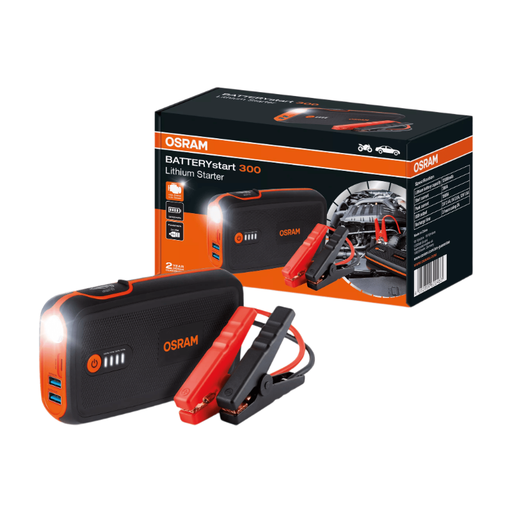
Why it suits this profile: If you value a well-known brand, extra connections and warranty information, you can compare this model based on its stated specifications.
The product information lists not only a 2000A peak output, but also a 400A nominal starting current and support for up to 8L petrol and 4L diesel engines.
16,800mAh, two USB ports, a 12V output, LED lamp and, according to the product information, a 2-year manufacturer’s warranty.
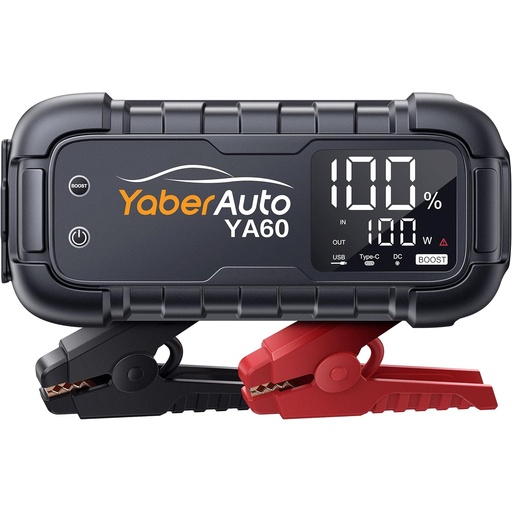
Why it suits this profile: According to the product description, this model is aimed at larger 12V vehicles, outdoor use and situations where a tyre inflator or additional power output would also be useful.
In addition to the peak current, the manufacturer states engine limits, 8AWG cables, a 65W charging function and ten listed safety protections. Always check these details against your vehicle’s specifications.
26,800mAh, USB-C 65W, two USB-A outputs, 150W DC output and a 600-lumen LED lamp, according to the product description.
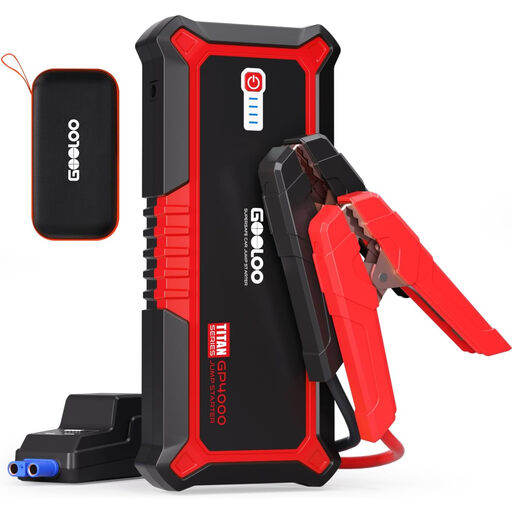
Why it suits this profile: The stated support for petrol and diesel engines up to 10 litres makes this model interesting for larger vehicles, provided the specifications match your battery.
The description mentions ten types of protection and fully metal clamps. These are more specific points to check than a general safety claim.
4000A peak current according to the product information, two USB ports, USB-C charging, a storage case and a built-in torch.
A car jump starter is not a substitute for diagnosing a worn battery. If the car regularly fails to start, have the battery, alternator and connections checked.
We have put together a complete, up-to-date list of products that fully meet these strict selection criteria and the applicable European safety regulations.
Only if the product description specifies both fuel types and supports your engine capacity. A petrol and diesel jump starter may have different limits, such as up to 6 litres for petrol and 4 litres for diesel. Also check whether your vehicle uses a 12V battery.
Service life varies depending on the battery type, charging frequency, storage temperature and usage. Charge the device according to the instructions, check the charge level regularly and avoid prolonged exposure to heat. A stated standby time or number of charging cycles is information provided by the manufacturer, not a guarantee for every usage situation.
After purchase, the direct running costs are limited to recharging the internal battery. However, its service life may be reduced if the device becomes deeply discharged or is stored incorrectly. A model with a power bank, LED emergency light or 12V output can be especially practical, but only choose these features if you will actually use them.
