
Vandaag of morgen in huis

Kwaliteit gegarandeerd

Welkomstaanbiedingen ontgrendelen: GRATIS bezorging | Tot 80% korting | Gratis 30 dagen JoyPlus-proefperiode
Download de app
A flat 12V battery often strikes at the most inconvenient moment: when you're heading to work, on a camping trip, or after your car has been sitting outside for a few days. A car jump starter can then serve as a portable jump-starting device, without needing a second vehicle and jump leads.
However, not every battery booster is suitable for every car. The biggest mistake is often looking only at the highest amp rating. Engine size, battery voltage, cable quality and safety features also determine whether a jump starter is practical to use.
Brands often list a peak current, for example 1,200A, 2,000A or 4,000A. This is a short maximum value under specific conditions. It doesn't automatically tell you how much starting current the device delivers consistently.
So also check:
A jump starter is intended as an emergency car starter, not as a replacement for a worn vehicle battery or a garage inspection.
A larger battery capacity doesn't automatically mean more starting power. What's more, the capacity is sometimes stated at cell level, while the usable output is lower. The Porbi S306, for example, states 12,800mAh, with a specified nominal capacity of 7,200mAh.
So pay attention to the difference between battery capacity, nominal capacity and starting current. For occasional use in a passenger car, a compact model may be sufficient. For an SUV, diesel van, campervan or boat, a wider margin is wiser.
A jump starter with a power bank, LED light or compressor can be handy, but these features also make the device larger and may require extra maintenance. A tyre compressor is useful if you regularly make long journeys, whereas a simple car battery jump starter may be more logical if you mainly want to be prepared for a flat battery.
Most portable jump starters in this category are designed for 12V systems. Check this in the manual for your car, motorbike, campervan or boat. A 24V system, such as in some heavy lorries, is not automatically compatible.
Also look at the stated engine capacity. A model that is suitable for petrol engines up to 8.0 litres may have a lower limit for diesel engines. Diesel generally requires more starting power, especially in low temperatures.
A good car jump starter should have clear connection instructions and appropriate protections. Think about:
According to the product description, the GOOLOO GP2000 features ten safety protections, including protection against reverse polarity, overheating and short-circuiting. This is a product specification from the brand and not a guarantee that incorrect use is risk-free. Always read the included instruction manual.
A CE marking indicates that the manufacturer declares the product meets relevant EU requirements. When buying, also check the manufacturer details, warranty conditions and Dutch-language safety information when available.
A jump starter often sits unused in the car for months. So choose a size that fits in the glovebox, boot or emergency kit. An LCD screen can help you check the charge level before you set off.
Lithium batteries don't hold their charge indefinitely. Recharge the device after use and check the level every few months. Store it in a dry place, out of direct sunlight and not for long periods in extreme heat. The temperature inside a closed car in the Netherlands can rise considerably in summer.
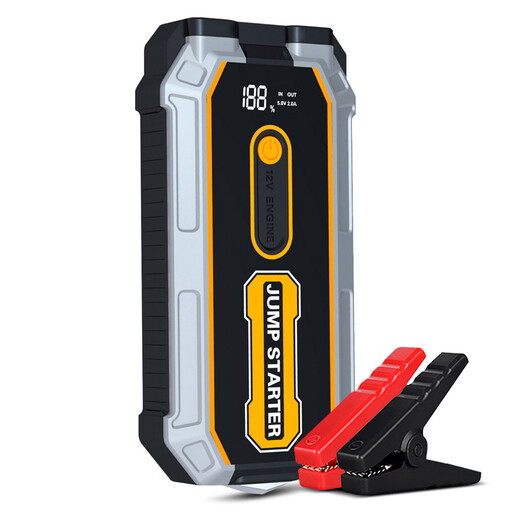
Why this fits the profile: According to the product description, this is a compact 12V jump starter weighing around 330g for petrol and diesel vehicles, motorbikes and boats. Its size fits easily into a car emergency kit.
The specifications list both 1,200A peak current and 600A starting current. This means you see more than just the marketing figure. Do check the engine limits before purchasing.
12,800mAh battery according to the product description, USB output, LCD display and LED light with constant, strobe and SOS modes.
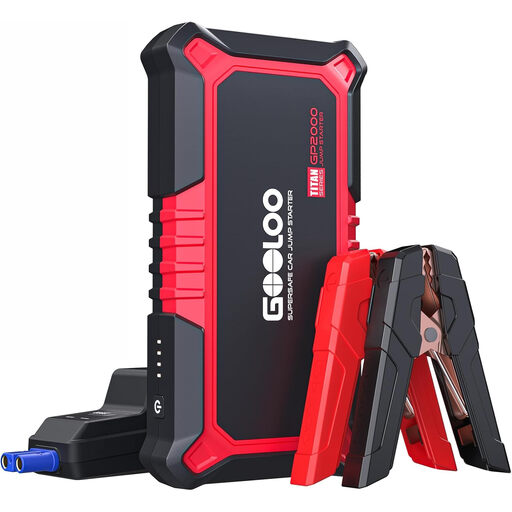
Why this fits the profile: According to the product information, this model is rated for 12V vehicles with petrol engines up to 8.0 litres and diesel engines up to 6.0 litres. That suits larger cars, SUVs, vans and recreational vehicles.
The product description mentions 2,000A peak current and ten safety protections. This gives you information about both power and user safety, rather than just a peak value.
Smart metal clamps, USB outputs, a 400-lumen LED light and a stated weight of approximately 545g.
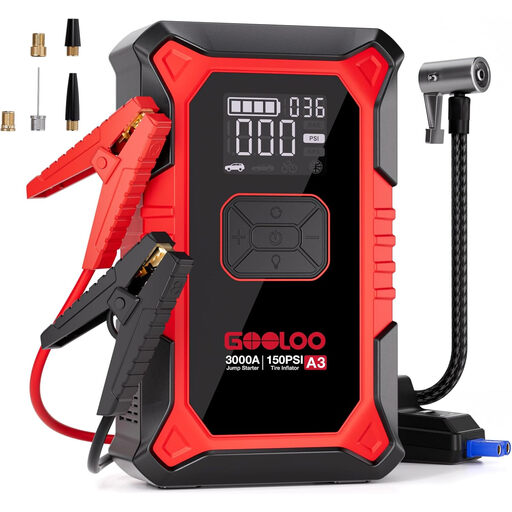
Why this fits the profile: According to the product description, this model combines a 3,000A peak current with a compressor of up to 150 PSI. That's practical for SUVs, campervans, motorbikes and users who also want to check tyre pressure.
The specifications list separate functions for starting and inflating, plus an automatic shut-off at the set tyre pressure. Allow for rest periods during prolonged pumping.
Compressor, digital pressure display, USB power bank, LED light and stated support for up to 9.0 litres petrol or 6.5 litres diesel.
Do not use a jump starter on a damaged battery, if there is visible leakage, or if you are unsure where the connection points are. A jump lead alternative also won't help if the problem lies with the alternator, fuse or starter motor.
We've put together a full, up-to-date list of products that fully meet these strict selection criteria and current European safety regulations.
Yes, it can if the model is rated for it and the car has a compatible 12V system. Always check the maximum engine capacity for both fuel types. A jump starter for petrol and diesel often has a lower stated limit for diesel.
The lifespan depends on usage, storage temperature and charging habits. Recharge the device after use and check it every few months. Do not store it for long periods in direct sunlight or a very hot car. The battery capacity decreases over time, even when the device is used infrequently.
That depends on your usage. For motorists who only want to start a flat battery, a simple car jump starter may suffice. For campervan owners, SUV drivers, motorcyclists and outdoor enthusiasts, a jump starter with a compressor can be extra practical, as you have one device for starting, inflating tyres and USB charging.
