
Vandaag of morgen in huis

Kwaliteit gegarandeerd

Welkomstaanbiedingen ontgrendelen: GRATIS bezorging | Tot 80% korting | Gratis 30 dagen JoyPlus-proefperiode
Download de app
A flat battery never happens at a convenient time. You might be in a car park, on the motorway or at a campsite when you discover that your engine won’t start. A car jump starter can get you out of a fix, but not every model is suitable for every vehicle or situation.
The biggest mistake is focusing on one impressive figure on the packaging. A high peak current doesn’t tell you everything about how suitable a jump starter is. Check the engine type, maximum engine size, battery voltage and how you plan to use the device.
A jump starter rated at 6000A or 8000A sounds powerful, but always check the stated compatibility with petrol and diesel engines. Manufacturers might specify a maximum engine size of 8.0 litres for petrol and 6.0 litres for diesel. This is more useful than the peak current figure alone.
Also check that the model is suitable for 12V vehicles. Some models aren’t designed for the 24V systems found in certain heavy lorries, buses or commercial vehicles.
mAh mainly indicates how much energy the battery stores and how it performs as a power bank. On its own, it doesn’t determine whether a device can start your engine. So check both the battery capacity and the stated starting and peak currents.
A portable jump starter with USB ports is handy for charging a phone or sat nav, but that doesn’t automatically make it suitable as a battery booster for a large diesel engine.
A jump starter with an air compressor is handy if you have a soft tyre, but check:
A high PSI rating alone doesn’t tell you how quickly a tyre will inflate. If you regularly use it with a motorhome, boat or SUV, airflow and hose length are just as important.
Start by checking the vehicle label or handbook. A 12V jump starter is generally designed for cars, motorbikes, SUVs, motorhomes, boats and light commercial vehicles with a 12V battery system. Then check:
Some models have a BOOST or force-start function for very low voltage. Product information says this can help with certain models, but it’s no guarantee of success if the battery is completely faulty.
Choose a car jump starter with clear protection against short circuits, reverse polarity, overheating and overcurrent, among other hazards. These features reduce the risk if the device is connected incorrectly, but always check the clamps yourself.
The usual order is:
Don’t crank the engine for too long. Several product handbooks recommend a maximum of 3 to 5 seconds per attempt, with a pause between attempts.
If you only need an emergency car starter, you may not need a compressor. Extra features can be useful for long journeys, camping or boating. Look for:
Don’t leave a lithium jump starter in direct sunlight or in a very hot car for long periods. Recharge it periodically according to the handbook, even when you’re not using it.
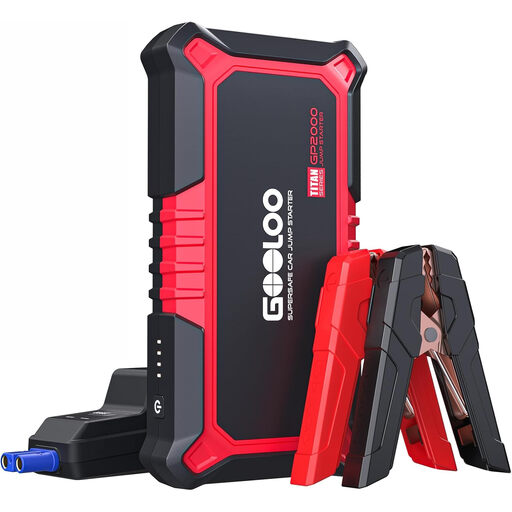
Why it suits this type of user: The GP2000 is designed for drivers looking for a compact 12V booster for a car, motorbike, SUV or van, without a compressor.
The product information explicitly states support for petrol engines up to 8.0 litres and diesel engines up to 6.0 litres, plus 10 safety features. Still, check that it’s suitable for your vehicle.
2000A peak current, around 545 grams, two USB outputs and a 400-lumen LED light, according to the product specifications.
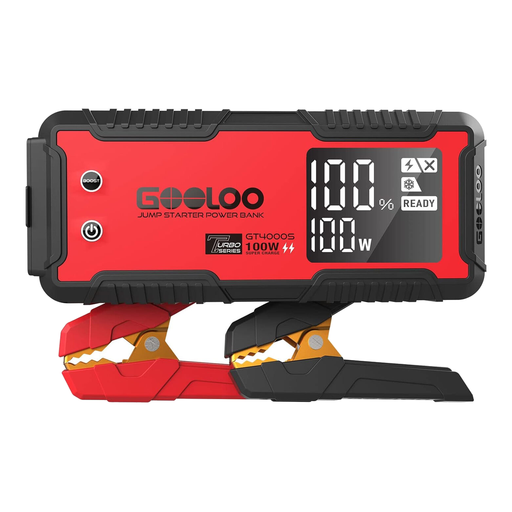
Why it suits this type of user: A good fit for drivers of larger SUVs, motorhomes, pick-ups and diesel vehicles who value extra charging options.
The product specifications state 4000A, support for petrol engines up to 12.0 litres and diesel engines up to 10.0 litres, plus a 3.2-inch status display.
100W charging, three USB ports, a 15V output and an LED light with three modes, according to the product description.
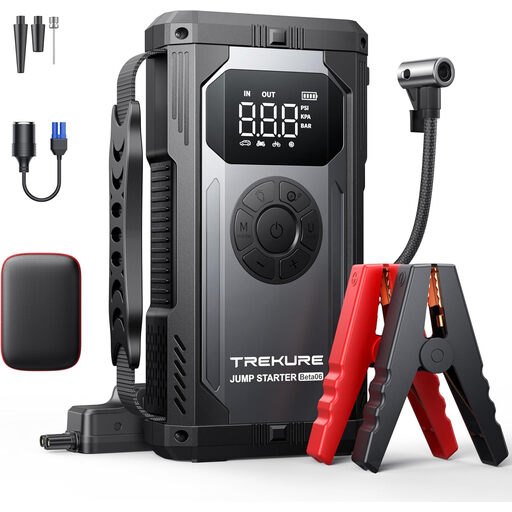
Why it suits this type of user: A practical choice for SUV, motorhome and outdoor enthusiasts who want to combine a jump starter with an air compressor and emergency lighting.
Alongside the stated 5500A, the manufacturer specifies a 35 l/min compressor, 150 PSI and automatic shut-off when the set tyre pressure is reached.
Supports petrol and diesel engines up to 10.0 litres, with an LCD pressure display, two USB outputs and a 12V socket.
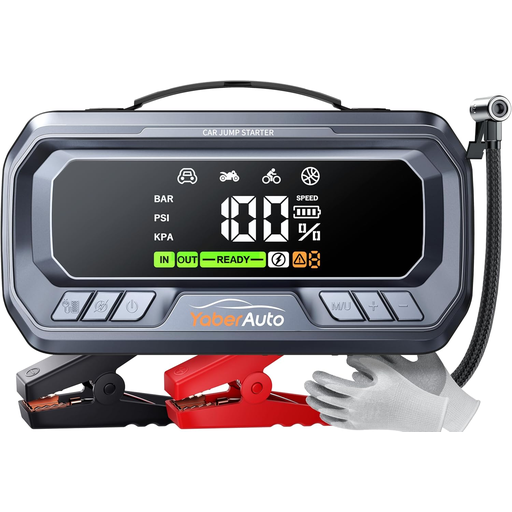
Why it suits this type of user: A good option if you’re looking for a portable car power bank with a compressor, fast USB-C charging and multiple outputs.
The listing states vehicle support for diesel engines up to 8.0 litres, a 160 PSI compressor, temperature monitoring and a forced-start function.
65W bidirectional USB-C charging, a 16000mAh battery, 12–16V/10A DC output and a 600-lumen light with four modes.
We’ve put together a complete, up-to-date list of products that meet these strict selection criteria and current European safety regulations.
Yes, if the model is suitable. Check the stated maximum engine size for diesel. A car battery jump starter that supports an 8.0-litre petrol engine isn’t automatically suitable for a diesel engine of the same size.
Follow the manufacturer’s instructions and recharge the device after use. For longer periods in storage, product handbooks often recommend recharging every few months. Check the battery level before a long journey; an emergency car starter with a flat internal battery won’t help if your vehicle battery is flat.
No. A jump starter provides temporary starting power, but it can’t replace a faulty or worn-out vehicle battery. If the car starts after use but the battery goes flat again, have the charging system and battery checked. Use a separate 12V battery charger if you want to charge the vehicle battery slowly.
