
Vandaag of morgen in huis

Kwaliteit gegarandeerd

Welkomstaanbiedingen ontgrendelen: GRATIS bezorging | Tot 80% korting | Gratis 30 dagen JoyPlus-proefperiode
Download de app
A flat car battery often happens at the worst possible moment: before setting off for work, in a car park while camping or when you are out on the road in a van. A car jump starter can get you moving again without needing a second vehicle. However, not all models are the same. A high amp rating on the packaging does not tell you everything about suitability, ease of use or storage.
In this guide, you will learn what to look for in a car jump starter, which specifications matter and which type is right for your vehicle and how you use it.
A figure such as 1200A, 2000A or 4000A sounds clear, but peak power is only one part of the specification. Also check the stated starting current, the maximum engine size and the distinction between petrol and diesel engines.
A 12V jump starter suitable for a smaller petrol engine will not automatically be suitable for a diesel van or large SUV. Use the engine size stated in the product description as a guide and, if in doubt, check your vehicle’s handbook.
Manufacturers often state capacity in mAh. Some models also specify a lower rated capacity or nominal output capacity. This is because the internal battery voltage and the conversion to USB or starting voltage affect the amount of energy actually available.
A higher mAh rating does not therefore automatically mean more starting attempts. Also consider the charging time, the charge level during storage and the recommendation to recharge the portable battery booster regularly.
Features such as spark-free clamps, reverse-polarity protection and short-circuit protection help reduce the risk of incorrect use. However, they do not replace making the correct connections. According to the product descriptions of various brands, several layers of protection are built in; always check the supplied handbook and product specifications.
A safe connection generally means:
Do not use a jump starter with a 24V lorry system or on a vehicle where the manufacturer specifies a different procedure.
Most portable jump starters in this category are designed for 12V vehicles, such as cars, motorbikes, motorhomes, boats, tractors and light commercial vehicles. Next, check the stated engine support. For example, one model may be suitable for up to 6.0-litre petrol engines and 4.0-litre diesel engines, while a more powerful car battery booster may quote higher figures.
A higher rating is particularly relevant if you drive an SUV, van, motorhome or boat. For a compact petrol car, a larger model may be less practical because of its additional weight and size.
The jump leads supplied with the booster should be long enough to reach the battery and an earth point. Sturdy clamps with insulated handles are useful for repeated use. Look for features such as:
Brands mention these features in their product descriptions. Treat them as product characteristics that can be checked, rather than a promise that every incorrect connection will be harmless.
A portable jump starter will usually sit unused in your car for months at a time. A compact model weighing around 330 grams is easy to carry, while a larger 20000mAh jump starter may offer more reserve capacity but will also be heavier.
A jump starter power bank can also charge a smartphone, tablet, GPS device or camera. To do this, check the type of USB connection and the output, such as 5V/2.1A or QC3.0 up to 18W. An LCD display is useful for checking the remaining charge level. An LED light with steady, flashing and SOS modes can be helpful if you break down in the dark, but it does not make a high-visibility vest and warning triangle unnecessary.
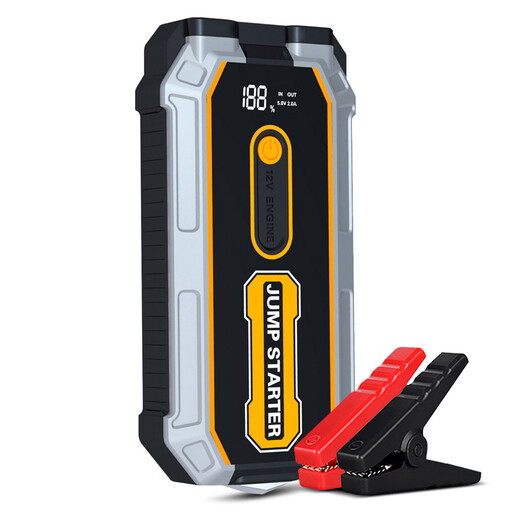
Why it suits this profile: The S306 is compact, weighs around 330 grams and has an LCD display. This makes it suitable for motorists looking for a straightforward emergency car starter to keep on the road.
The product description states both a peak current of 1200A and a starting current of 600A, and specifies support for 12V petrol and diesel vehicles. This gives you more information than just a large marketing figure.
12800mAh battery according to the product information, 10W USB output, LCD display and LED lighting with steady, strobe and SOS modes.
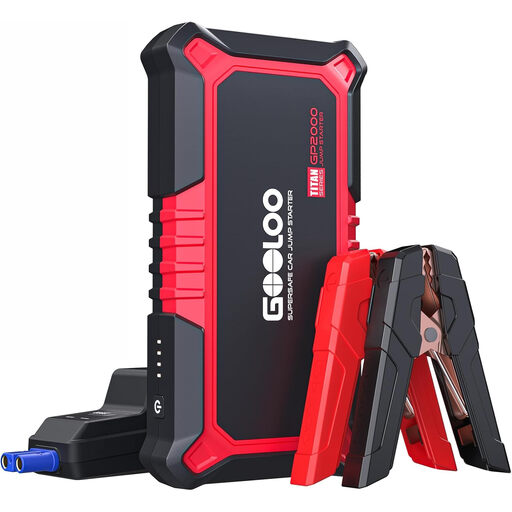
Why it suits this profile: This model is aimed at drivers of SUVs, vans, motorbikes and other 12V vehicles who value a sturdy casing and multiple safety features.
The product description specifies a peak current of 2000A, support for petrol engines up to 8.0 litres and diesel engines up to 6.0 litres, plus a Ready indicator and ten stated protection features.
Two USB outputs, a 400-lumen lamp with three modes, a storage case and a standby time of up to 24 months stated by the brand.
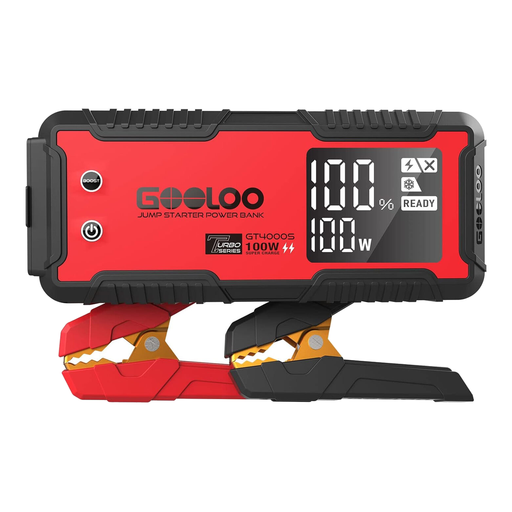
Why it suits this profile: For motorhomes, larger SUVs, boats, tractors or professional use, a higher stated starting capacity may be relevant, provided it matches your engine.
The product specification states a peak current of 4000A and support for engines up to 12.0 litres petrol or 10.0 litres diesel. Always check these figures against your vehicle’s specifications.
According to the product description, this model supports 100W two-way charging, has an informative LED screen, three USB ports and a 400-lumen lamp.
We have put together a complete, up-to-date list of products that fully meet these strict selection criteria and the applicable European safety requirements.
Fully charge a new car battery booster before storing it. Check the charge level every few months, even when you are not using it. Store the device somewhere dry and do not leave it in direct sunlight or an extremely hot car for long periods. The product descriptions for the models mentioned specify different charging intervals and temperature ranges, so follow the instructions for your particular model.
Keep the jump starter in a fixed place in the car, together with gloves, a high-visibility vest and a warning triangle. That way, you will not have to search through the boot if you break down. A jump starter is intended as temporary car starting assistance. If the battery keeps going flat, have the battery and the vehicle’s charging system checked.
You can, provided the model is explicitly suitable for both fuel types and the correct 12V system. Always check the maximum engine size. Diesel cars often require different starting capacities from comparable petrol models.
This varies according to the battery, storage conditions and usage. Some brands state a standby time of up to 18 or 24 months, but regular checks are still advisable. Charge the device according to the handbook, for example every two to three months when it has not been used for an extended period.
Many models have USB outputs and can therefore work as a portable battery booster for phones, tablets, cameras or GPS devices. However, check the output power and connections. A jump starter is not a replacement for a household emergency power supply and should be used according to the stated temperature and storage instructions.
