
Vandaag of morgen in huis

Kwaliteit gegarandeerd

Welkomstaanbiedingen ontgrendelen: GRATIS bezorging | Tot 80% korting | Gratis 30 dagen JoyPlus-proefperiode
Download de app
A flat car battery often strikes at an inconvenient time: in a car park, during a road trip or at home just before you set off. With a car jump starter, you can often try to start a 12V vehicle yourself. However, not every model is suitable for every vehicle or situation.
A high amp rating on the packaging doesn’t tell you everything. Engine size, vehicle voltage, safety features, cables and charge level all affect whether a car battery jump starter is practical to use. Read on to find out what to look for and which models suit different needs.
A rating such as 3000 A or 8000 A sounds impressive, but means little without further context. Always check which petrol and diesel engines the manufacturer says the device can support. For example, a model may be suitable for petrol engines up to 9.0 litres, but have a lower limit for diesel engines.
Also check the difference between peak current and rated or starting current. Peak current is a maximum value delivered for a short time. Don’t take it as a guarantee that the device will start every engine in all conditions.
Most cars, motorbikes, motorhomes and light commercial vehicles use a 12V battery system. Heavy goods vehicles and some commercial vehicles run on 24V. A 12V jump starter isn’t designed for a 24V system, so check your vehicle’s manual before buying.
A car jump starter also isn’t suitable for an electric car’s high-voltage battery. It may be possible to use one with a separate 12V auxiliary battery, but check your vehicle’s instructions first.
A portable jump starter only works when its internal battery has enough charge. Some models can be stored for months, but that doesn’t mean you can skip maintenance in the meantime. Charge the device as instructed in the manual and check its charge level before you travel.
Choose a model based on the largest engine you actually want to support. For a small petrol car, a model rated at 1000 to 1500 A may be suitable according to its stated specifications. For an SUV, motorhome, van or diesel engine, it’s useful to have more headroom.
A car jump starter should also be suitable for the correct battery type. Check whether the product is specifically described as suitable for 12V lead-acid batteries or the battery type in your vehicle.
Look for features such as:
These features make connecting the device more straightforward, but they don’t replace reading the manual. The red clamp usually goes on the positive terminal and the black clamp on the negative terminal or a suitable unpainted metal earth point. Always follow the instructions for your specific model.
A jump starter with a power bank can charge smartphones, tablets and other USB devices. Check how many USB ports it has and which charging outputs it supports.
A jump starter with a compressor combines jump-starting assistance with an air pump. Don’t just look at the stated maximum pressure in psi; check the airflow, supplied nozzles, cable length and automatic shut-off too. A high maximum pressure doesn’t necessarily mean a car tyre will inflate quickly.
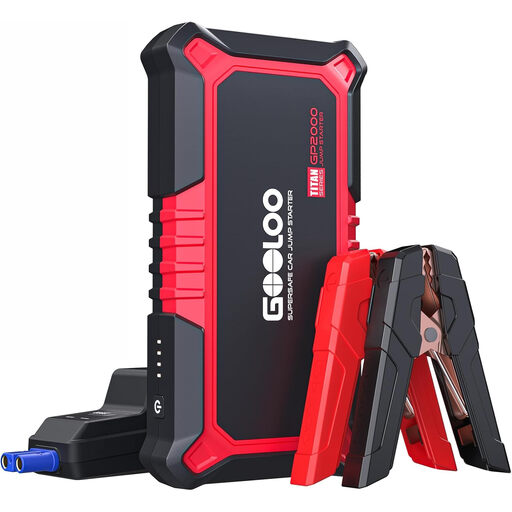
Why it suits this type of user: According to GOOLOO’s product information, the GP2000 is designed for 12V vehicles with petrol engines up to 8.0 litres and diesel engines up to 6.0 litres. It weighs around 545 grams and is compact enough to fit easily in your car.
The stated engine limits and 12V compatibility are clearly listed. According to the product information, the smart cable has 10 safety features.
2000 A peak current, two USB ports, a 400-lumen LED light and a stated standby time of up to 24 months.
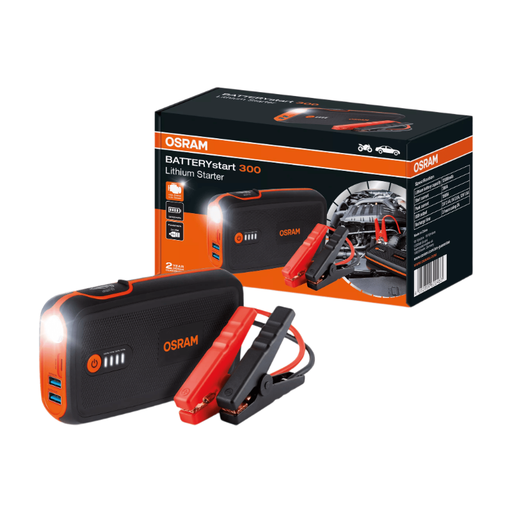
Why it suits this type of user: This model combines a 12V emergency car starter with a power bank, 12V output and LED light. According to OSRAM’s product information, it’s suitable for petrol engines up to 8 litres and diesel engines up to 4 litres.
The product specifications state a rated voltage of 12 volts and separate engine limits for petrol and diesel.
16800 mAh battery capacity, two USB ports and an extra 12V socket for accessories such as a tyre inflator.
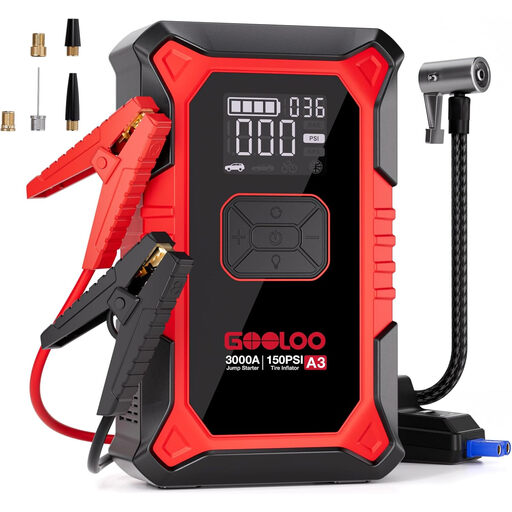
Why it suits this type of user: A practical choice for road trips, camping and drivers who also want to inflate tyres, bike tyres or balls. According to GOOLOO’s product information, the compressor has five modes.
As well as the stated 3000 A peak current, the specifications cover airflow, pressure display, automatic shut-off and the supplied nozzles.
150 psi maximum pressure, 35 l/min airflow, digital pressure monitoring and support for petrol engines up to 9.0 litres and diesel engines up to 6.5 litres.
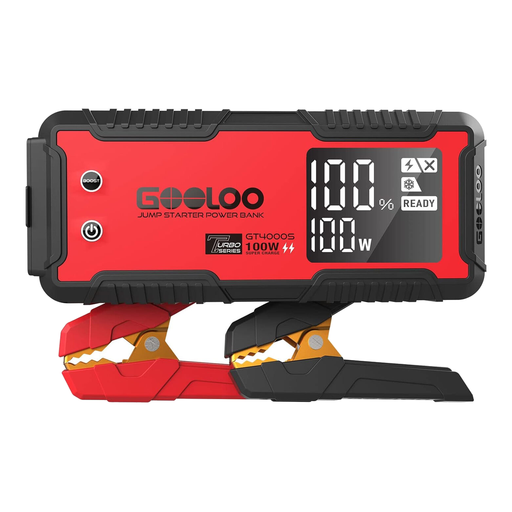
Why it suits this type of user: According to GOOLOO’s product information, this model is aimed at larger 12V vehicles, motorhomes, pick-ups and more frequent use on the road.
The product specifications give separate limits of up to 12.0 litres for petrol and 10.0 litres for diesel, as well as a display and safety features.
4000 A peak current, 100W charging via USB-C, three USB ports, a 400-lumen LED light and a 15V/10A output.
We’ve put together a complete, up-to-date list of products that meet these strict selection criteria and the applicable European safety regulations.
Store your portable jump starter in a dry place, away from direct sunlight, heat and naked flames. Check its charge level regularly, especially if it hasn’t been used for several months.
No. Check your vehicle’s voltage, battery type and the stated engine limit. A 12V jump starter isn’t suitable for 24V vehicles, and the stated limit for diesel engines may be lower than the one for petrol engines.
Its lifespan depends on how it’s stored and charged, as well as the temperature and how often it’s used. Follow the charging intervals in the manual and recharge the device after use. Any stated number of charge cycles or standby time is information from the manufacturer, not a guarantee for every use case.
That depends on how you plan to use it. If you only need jump-starting assistance, a compact model with a power bank may be enough. If you often go on long drives, camp or want to check tyre pressure while you’re out and about, a jump starter with a compressor could be useful. In that case, pay particular attention to airflow, pressure settings, nozzles and automatic shut-off.
