
Vandaag of morgen in huis

Kwaliteit gegarandeerd

Welkomstaanbiedingen ontgrendelen: GRATIS bezorging | Tot 80% korting | Gratis 30 dagen JoyPlus-proefperiode
Download de app
A flat car battery always seems to happen at the worst time: on a cold morning, at a campsite or at the roadside. With a car jump starter, you can start a 12V vehicle without another car or traditional jump leads. However, not every model is suitable for every engine.
As Joybuy Product Recommendation Officer, I cut through the marketing copy to highlight the product specifications that matter most. This helps you see which features make a practical difference and which claims are worth checking before you buy a portable car battery jump starter.
A high amp figure catches the eye, but it doesn’t tell the whole story. Check which engine type and capacity the 12V jump starter is designed for, too. For example, a model might be suitable for petrol engines up to 8.0 litres, but only for diesel engines up to 6.0 litres.
Also check the difference between peak current and continuous or starting current. Peak current is a brief maximum value. Actual performance also depends on the battery’s condition, temperature, cables and connections.
A car jump starter will generally work with a 12V lead-acid battery. That doesn’t automatically mean it’s suitable for 24V lorries, electric cars’ high-voltage batteries or every type of vehicle. So check:
A battery booster won’t fix a faulty battery. Don’t use the device with a leaking, swollen or frozen battery.
A power bank, LED light, display and fast charging are useful, but only if the essentials are right. A large, high-capacity device can be awkward to store in a small car. On the other hand, a very compact model might not be suitable for a diesel engine or frequent use.
Check the included cables, clamp lead length, storage case and how the device is charged. A charger isn’t included with every model.
For a typical car, a model with a stated engine capacity range that includes your own will usually be sufficient. SUVs, motorhomes, boats and vans often need more headroom. For example:
These are stated product specifications, not a guarantee that every vehicle will start in all conditions.
A portable battery booster should provide protection against reverse polarity, short circuits, overheating and overloads. Some models also list spark-proof clamps or an automatic status indicator.
Always follow the instructions. In many cases, you’ll connect the red clamp to the positive terminal and the black clamp to a suitable unpainted metal earth point. Then crank the engine briefly, usually for no more than a few seconds at a time. Remove the clamps once the engine is running.
The stated capacity in mAh is useful for the power bank function, but it isn’t the only factor that determines starting performance. Also look for:
A lithium jump starter should be stored somewhere dry and cool, out of direct sunlight. Recharge it regularly according to the instructions, even when you’re not using it.

Why it suits this type of user: This compact model is designed for 12V petrol and diesel vehicles and weighs around 330 grams, according to the product information. That makes it practical for everyday use in a car, motorbike or boat.
The stated specifications give more than just a peak current of 1,200 A: they also list a 12,800mAh lithium battery, an LCD display and support for petrol and diesel vehicles.
Around 330 grams, 5V/2.1A USB output, LCD display and an LED light with three modes.
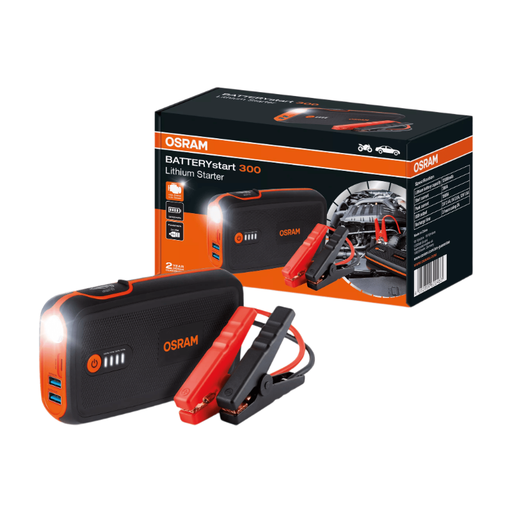
Why it suits this type of user: According to the product information, this model combines 2,000 A peak power with a 12V output. That makes it a good choice for drivers who want to power a tyre inflator, cool box or other 12V device as well as jump-start their vehicle.
The product description gives separate limits for petrol engines up to 8 litres and diesel engines up to 4 litres. This lets you compare engine compatibility more clearly than by looking at the amp figure alone.
16,800mAh, two USB ports, 12V output, built-in LED light and a stated two-year warranty.
Why it suits this type of user: Its stated 8,000 A peak current, 26,800mAh battery and 65W USB-C function make it well suited to use with SUVs, motorhomes, boats or vehicles with larger engines.
As well as its high peak current, the product information lists 8AWG cables, ten safety features and a separate 150W DC output. Always check the instructions and vehicle compatibility.
65W two-way charging, USB-A outputs, 150W DC output, 600-lumen LED light and a stated operating temperature of around -20 °C to 60 °C.
We’ve put together a complete, up-to-date list of products that meet these strict selection criteria and the applicable European safety regulations.
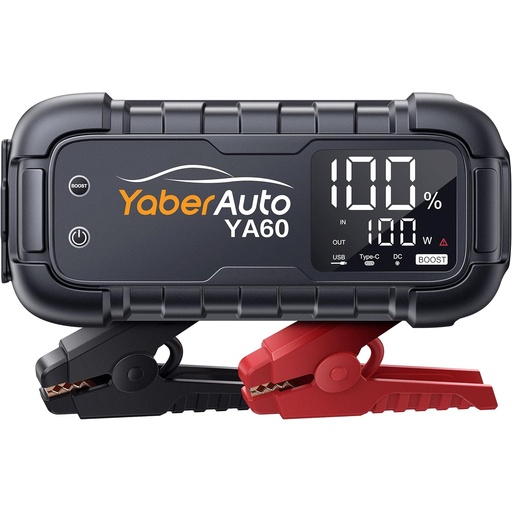
That depends on the minimum battery voltage and whether the jump starter has a boost function. Some models have a special forced-start mode for low voltage. For example, the YaberAuto YA60 has a boost button, according to the product description. Use this function only as described, and never with a damaged or leaking battery.
Storage life varies by model, temperature and battery age. Some product descriptions state a standby time of up to 18 or 24 months, but check the charge regularly. For everyday use, it’s a good idea to check your portable battery booster every few months and recharge it after use.
The cost of electricity for charging is generally low. The main costs are the purchase price, possible replacement as the battery wears out, and a suitable charger if one isn’t included. So compare more than just the price: check the warranty, accessories, charging power and suitability for your vehicle.
