
Vandaag of morgen in huis

Kwaliteit gegarandeerd

Welkomstaanbiedingen ontgrendelen: GRATIS bezorging | Tot 80% korting | Gratis 30 dagen JoyPlus-proefperiode
Download de app
A flat 12V battery usually happens at the worst possible time: on a cold morning, by the motorway or at a campsite with no power socket. With a portable jump starter, you can try to get your car going yourself in many situations, without relying on another vehicle. But not every model is right for every vehicle.
Product information often includes high amp ratings and broad compatibility claims, too. So don’t just look at the biggest number. Engine size, battery voltage, safety features and maintenance all affect whether a car jump starter will be practical to use.
A rating such as 2000A, 4000A or 8000A sounds clear-cut, but peak current alone doesn’t tell you how well a jump starter will perform. It’s a maximum value delivered for a short time. Also check which petrol and diesel engines the model is designed for, according to the product information.
A jump starter for a small petrol engine doesn’t need the same capacity as an emergency starter for a van, SUV or diesel campervan.
Most portable models in this category are designed for vehicles with a 12V lead-acid battery. That doesn’t automatically mean they’re suitable for electric cars, hybrid systems or every vehicle with a different electrical set-up. Check your vehicle’s manual and the jump starter’s instructions before connecting it.
A car jump starter can sit unused in your boot for months. Lithium batteries gradually lose their charge, and high temperatures inside a parked car can affect their lifespan. Fully charge the device before using it for the first time, then follow the charging interval in the manual. Some models recommend charging periodically, for example every two to six months.
Start with your vehicle type:
A model with a higher peak current isn’t automatically necessary for a small car. However, extra headroom can be useful in cold weather, with a larger engine or when the battery is very heavily discharged.
Look for a smart cable set with clear status lights or a display. Useful safety features include reverse polarity protection, short-circuit protection, overheating protection, overload protection and spark-free connection. These features reduce the risk of connecting the cables incorrectly, but they don’t replace careful handling.
Connect the red clamp to the positive terminal and the black clamp as directed in the manual, often to a suitable unpainted metal earth point. Don’t try to start a vehicle with a damaged, leaking or frozen battery. Avoid turning the engine over for a long time repeatedly; keep each attempt short and give the device time to cool down.
The stated capacity in mAh is mainly relevant to the number of possible starting attempts and use as a power bank. Also compare the weight, dimensions and included cables.
A jump starter with power bank can charge phones and other USB devices. A jump starter with compressor can also help with a soft tyre, but a built-in compressor often adds weight and needs extra attention when it comes to cooling and charging time. An LED light with an SOS or flashing mode is useful if you break down in the dark, but it’s no substitute for a warning triangle or a safe place away from the road.

Why it suits this type of buyer: According to the product information, this compact model combines a 1200A peak current with a 12800mAh battery, an LCD display and a power bank function for 12V petrol and diesel vehicles.
The LCD indicator shows the remaining battery level, so you’re less likely to set off with a half-charged jump starter.
330 grams, a 10W USB output and an LED light with steady, flashing and SOS modes.
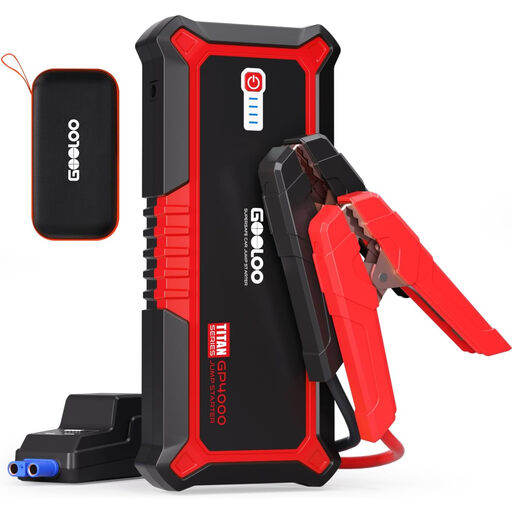
Why it suits this type of buyer: According to the product description, this 4000A jump starter is designed for 12V vehicles, all petrol engines and diesel engines up to 10.0 litres.
The vehicle and engine limits are clearly stated; make sure to check them against your own vehicle’s specifications.
Two USB ports, a USB-C input, metal clamps and built-in lighting.

Why it suits this type of buyer: According to the product information, this model combines a powerful 12V jump starter with a compressor rated up to 150 PSI, an LCD display and four attachments.
The display shows the battery level and tyre pressure. The compressor needs to cool down between uses; it isn’t designed for prolonged, continuous use.
26800mAh, a 150 PSI compressor, power bank function and smart clamp protection.
We’ve put together a complete, up-to-date list of products that meet these strict selection criteria and the applicable European safety regulations.
No. A 12V rating only tells you the voltage. Also check the maximum engine capacity, engine type and the manufacturer’s instructions. A model for cars isn’t automatically suitable for a heavy diesel van or a 24V lorry.
That depends on the battery type, storage temperature, use and maintenance. Recharge the device periodically according to the manual. Don’t store it for long periods in extreme heat, and don’t use it if the casing is damaged, swollen or leaking.
Charging it uses electricity, but usually less than keeping a device plugged in continuously. The main costs are the purchase price and, eventually, replacing the internal lithium battery. A model with a compressor uses more power when you inflate tyres as well.
