
Vandaag of morgen in huis

Kwaliteit gegarandeerd

Welkomstaanbiedingen ontgrendelen: GRATIS bezorging | Tot 80% korting | Gratis 30 dagen JoyPlus-proefperiode
Download de app
A flat car battery often strikes at the worst possible time: on a cold morning, after a weekend camping or when your car has been parked for several weeks. With a car jump starter, you can try to start a 12V battery yourself, without needing another car or jump leads.
However, not every portable jump starter is suitable for every car. Manufacturers often quote a high peak current, but that figure doesn’t tell you everything. Engine size, fuel type, the quality of the jump leads and how you store the device all play a part too. Below, you’ll find the key things to consider, along with a selection of models for different needs.
A figure such as 2000A or 4000A sounds impressive, but it usually refers to the peak current. That’s not the same as the sustained starting current. So always check the stated suitability for petrol and diesel engines.
For example, a 12V jump starter for a compact petrol car has different requirements from an emergency starter for a diesel van, SUV or lorry. A model described as suitable for petrol engines up to 8.0 litres isn’t automatically suitable for every diesel engine.
A car emergency kit is only useful if the portable jump starter has enough charge. Lithium batteries gradually lose power in storage. Some models have a long stated standby time, but you should still check the charge level regularly.
Don’t leave the device loose in a damp boot. High temperatures in a parked car can also affect the life of the internal battery. Always follow the instructions for use and storage.
Smart jump leads may include features such as reverse-polarity, short-circuit, overheating and overcharge protection. These can help if the leads are connected incorrectly, but they don’t remove the need to work carefully. Always check the positive and negative terminals, and don’t use a jump starter with a damaged or leaking battery.
Start by checking three things:
A powerful jump starter with a high peak current may be useful for SUVs, vans, motorhomes and larger engines. A more compact model may be enough for an average city car. If you’re unsure, it’s sensible to allow some extra capacity, especially for diesel engines and winter use.
Check the quality of the supplied clamps. All-metal clamps, strong springs and well-insulated handles can make them more practical for repeated use. A display or clear status indicator shows whether the jump starter is ready to use.
Useful safety features include:
These features don’t guarantee that every starting attempt will work. A battery that’s internally faulty, frozen or seriously damaged may need a different solution.
Capacity is often listed in mAh, but practical performance also depends on the voltage and design. A jump starter with a power bank can charge phones, GPS devices or cameras via USB. Some models also have a USB-C input, fast charging, a 12V output or an LED light with SOS and flashing modes.
Think about which features you’ll actually use. For a car emergency kit, a clear charge indicator, sturdy storage case and built-in light are often more useful than a large number of ports.

Why it suits this profile: Weighing around 330 grams, this compact model is ideal for drivers who want to keep a simple car jump starter in the glove compartment or a small emergency bag.
The LCD indicator shows the remaining charge. The product description lists a peak current of 1200A and suitability for 12V petrol and diesel vehicles; always check that it’s compatible with your engine size.
Compact design, USB power bank, LCD display and LED light with three modes.
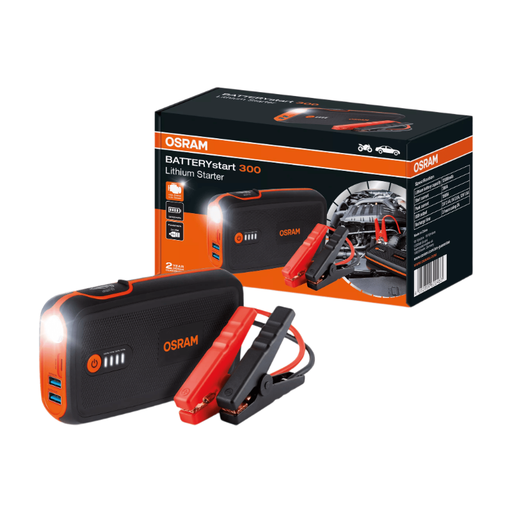
Why it suits this profile: This model is a good fit for drivers who want a car jump starter that can also power 12V accessories and act as a dual USB power bank.
The product specifications give separate limits of up to 8 litres for petrol engines and 4 litres for diesel engines. This makes it easier to compare compatibility than relying on the current rating alone.
2000A peak current, dual USB ports, 12V output and built-in LED light; the stated weight is around 1174 grams.
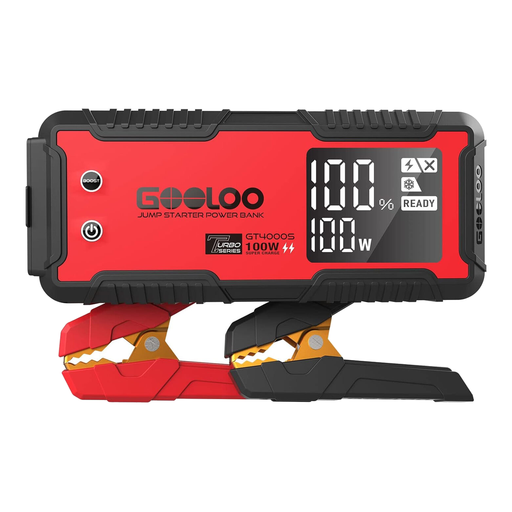
Why it suits this profile: This portable jump starter is designed for larger vehicles and frequent use, as well as for people who want to charge laptops or 12V equipment while travelling.
The product description lists separate engine limits of up to 12 litres for petrol and 10 litres for diesel, as well as a BOOST function for very low battery voltage. Always follow the instructions when using it.
4000A peak current, 100W charging, three USB ports, 15V output and a display; according to the product information, it’s suitable for 12V vehicles.
We’ve put together a complete, up-to-date list of products that meet these strict selection criteria and current European safety regulations.
Don’t use a car jump starter on an electric car unless the manufacturer explicitly says it’s suitable. The 12V auxiliary battery in some electric vehicles is a separate system from the high-voltage battery pack.
It depends on the condition of the battery and the model. Some devices have a BOOST or override function for very low voltage. Don’t try to jump-start a battery that’s internally damaged, frozen or leaking with a portable battery booster.
Check the charge level every few months and after each use. Follow the manufacturer’s maintenance instructions. A model with a stated long standby time won’t need daily charging, but you should still check it before setting off on a journey.
Not necessarily. Check the separate specifications for petrol and diesel, the maximum engine capacity and the required 12V voltage. Diesel cars often need more current to start, especially in cold weather.
