
Vandaag of morgen in huis

Kwaliteit gegarandeerd

Welkomstaanbiedingen ontgrendelen: GRATIS bezorging | Tot 80% korting | Gratis 30 dagen JoyPlus-proefperiode
Download de app
A flat battery often happens at the worst possible time: on a cold morning, during a camping trip or in a car park with no power socket nearby. A car jump starter can help you restart a 12V vehicle without needing another car and jump leads.
However, not every portable car jump starter is suitable for every vehicle. Marketing claims about thousands of amps, large battery capacities and “extreme” performance don’t tell the whole story. Pay particular attention to compatibility, the stated engine size, safety features and maintenance.
A rating such as 2000A or 4000A sounds impressive, but peak current isn’t the same as the normal starting current. Check whether the manufacturer also states the starting current and which petrol and diesel engines the 12V jump starter is designed for.
A small car will generally have different requirements from an SUV, campervan, van or diesel minibus. Don’t choose a model based solely on the biggest number on the packaging.
A capacity stated in mAh tells you something about the internal battery, but not directly how many start attempts it will provide. Some product listings also mention a “rated capacity”, which may be lower. This is normal for battery products, but it can make comparisons less straightforward.
Also check the charging time, charging port and advice on how often to recharge the device. A car jump starter left unused in the boot for months may not have enough charge when you need it.
A car battery booster should offer protection against reverse polarity, short circuits, overheating and overloading, among other things. Check whether the smart clamps warn you if they’re connected incorrectly.
Also pay attention to the storage instructions. A lithium battery shouldn’t be left in direct sunlight or an extremely hot car for long periods. An IP rating such as IP44 or IP65 also doesn’t mean the device is fully submersible.
Most models in this category are designed for vehicles with a 12V lead-acid battery. Check your car’s manual to confirm. A jump starter for petrol and diesel cars isn’t automatically suitable for electric vehicles or for every vehicle with a non-standard electrical system.
Next, compare the stated engine compatibility:
The starting current gives you a more practical indication of the power available when starting the engine. Peak current is mainly a brief maximum value. A model with a peak current of 1500A may be suitable for a small car, while a heavier vehicle may need more headroom.
A larger battery often makes a device more versatile as a power bank, but it can also make it heavier and bulkier. If you’re only looking for an emergency car-starting solution, a compact model may suit you better than a large power station.
Check that the set includes sturdy clamps, cables of sufficient length and clear status alerts. An LCD display can show the remaining charge or charging status. A jump starter with an LED light is useful if you break down in the dark, especially if the light also has SOS or flashing modes.
A jump starter with a power bank can also charge smartphones, sat navs and cameras. Check the type of USB port and its output: QC3.0 and USB-C at 18W, 65W or 100W aren’t equivalent.
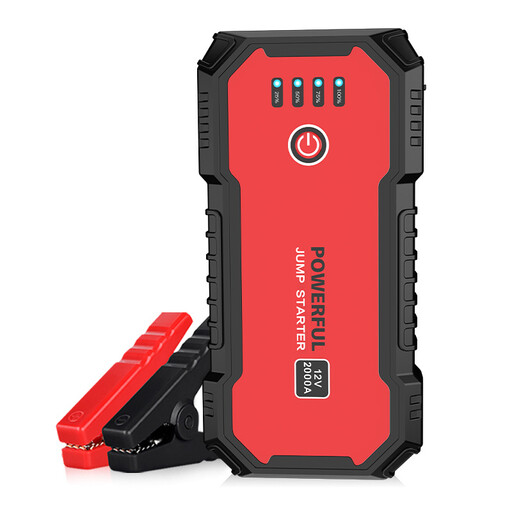
Why it suits this profile: According to the product listing, this is a compact 12V booster for petrol and diesel vehicles, weighing around 430 grams. It’s a good fit for drivers who want to keep simple emergency starting equipment in their car.
As well as a 1500A peak current, the listing mentions a 20000mAh battery and an 18W Type-C input. Before buying, check that the stated engine size is suitable for your vehicle.
Three-mode LED light, QC3.0 output, LCD status display and a stated weight of around 430 grams.

Why it suits this profile: According to the product information, this model is designed for 12V vehicles and engines up to the petrol and diesel capacities stated in the listing. It also offers extra features for drivers of SUVs, campervans and boats.
The listing mentions spark-proof clamps, a reverse-polarity warning and several safety protections. Always check these features against the supplied manual.
3000A peak current according to the product listing, USB fast charging, a Type-C port and an LED light with SOS and strobe modes.
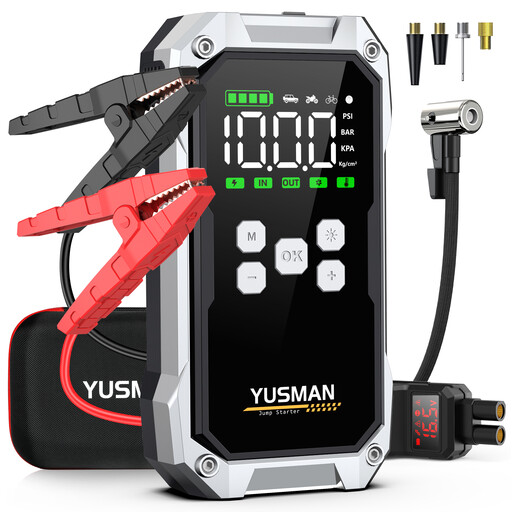
Why it suits this profile: According to the product listing, this model combines a car battery booster with a built-in compressor rated up to 150 PSI. That makes it a good choice for travellers, campers and drivers who want extra emergency features to hand.
According to the description, the LCD display shows the status and tyre pressure. Smart clamps alert you if they’re connected incorrectly, but you should still follow the safety instructions.
5000A peak current according to the product listing, 21800mAh capacity, compressor, LCD display and four LED modes.
We’ve put together a complete, up-to-date list of products that meet these strict selection criteria and the applicable European safety regulations.
Don’t use the jump starter if the battery is leaking, swollen or visibly damaged. If in doubt, roadside assistance or a garage is the safer option.
No. Check 12V compatibility, the recommended engine size and whether the model supports petrol, diesel or both. Electric cars and vehicles with a non-standard battery system aren’t automatically covered by the conditions of use.
It varies by model. Some product listings recommend charging the device after use and carrying out periodic maintenance if it won’t be used for a while. Check the manual, for example every two to six months, and charge the booster before a long journey.
That depends on how you use it, your subscriptions and the purchase price. A jump starter is a one-off purchase that can also be used as a power bank or LED light. However, it doesn’t replace a diagnosis of a faulty battery or an electrical problem.
