
Vandaag of morgen in huis

Kwaliteit gegarandeerd

Welkomstaanbiedingen ontgrendelen: GRATIS bezorging | Tot 80% korting | Gratis 30 dagen JoyPlus-proefperiode
Download de app
A flat 12V battery often strikes at the worst possible moment: just before you leave for work, while you’re travelling with a caravan or in a dark car park. A car jump starter can provide a practical emergency boost, without relying on another car. But not every model is suitable for every engine or situation.
When comparing models, don’t focus only on the highest amp rating. A jump starter’s suitability also depends on the engine type, battery voltage, cables, safety features and extras such as a compressor.
A rating such as 3000A, 5500A or 8000A sounds impressive, but peak current alone doesn’t tell you how well a jump starter will perform in everyday use. Always check the stated compatibility with petrol and diesel engines. A model suitable for a large petrol engine won’t necessarily work for a diesel engine with a similar capacity.
Also check whether your vehicle uses a 12V lead-acid battery. This is common in many cars, SUVs, vans and motorbikes, but check your vehicle’s handbook to be sure.
A jump starter with an air compressor may sound appealing, but check that the display is easy to read, the air hose is long enough and the compressor switches off automatically. An inflator rated at 150 PSI may suit a range of uses, but speed and ease of use matter just as much.
A car power bank isn’t necessarily a fully fledged charger for laptops or larger devices, either. Check which USB and 12V ports it has, as well as its charging output.
Brands often list ten safety features. According to their product descriptions, these may include protection against reverse polarity, short circuits, overheating, overcharging and overloading. That’s useful information, but check whether the smart cable also has a clear status indicator or an audible alarm.
Safety features don’t replace correct connection. Connect red to the positive terminal and black to the negative terminal or a suitable unpainted metal earth point, depending on the manufacturer’s instructions.
A compact model is often enough for a small petrol car, while a diesel car, SUV or van may need more starting power in reserve. Check the following:
So, a jump starter for a diesel car or jump starter for an SUV or van shouldn’t be chosen on the basis of a high figure on the packaging alone. Peak current, cable quality and vehicle compatibility are more important together.
A jump starter with a compressor is useful if you want one device for several emergencies. Check:
A jump starter with an air compressor usually takes up more space than a simple car battery booster. For motorbike riders and campers, weight may therefore matter more than having a larger battery pack.
Capacity is sometimes given in mAh and sometimes in Wh. These figures aren’t directly comparable unless you take the battery voltage into account. Also check how often the manufacturer recommends recharging. Some models claim a long standby time, but it’s still sensible to top them up periodically.
Store a portable car jump starter in a dry place, out of direct sunlight and not in a very hot car for long periods. Check the casing, clamps and cables before use. Don’t use the device if its battery is swollen, leaking or damaged.
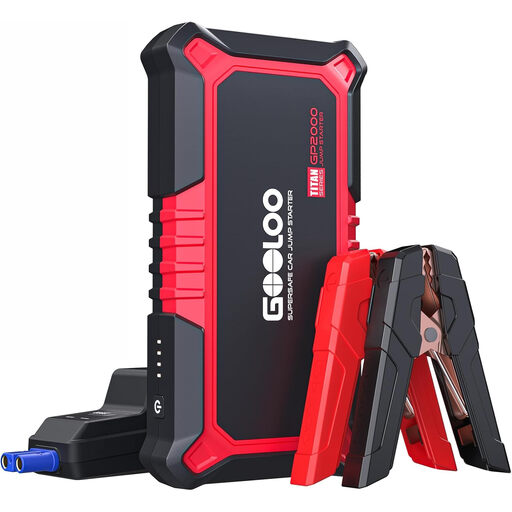
Why it suits this profile: This compact model is aimed at drivers looking for a straightforward battery starter for 12V vehicles, without a built-in compressor.
The product description gives separate compatibility figures of up to 8.0 litres for petrol engines and 6.0 litres for diesel engines. Be sure to check these against your own vehicle’s specifications.
Rated peak current of 2000A, two USB outputs, a 400-lumen light and a weight of around 545 grams.
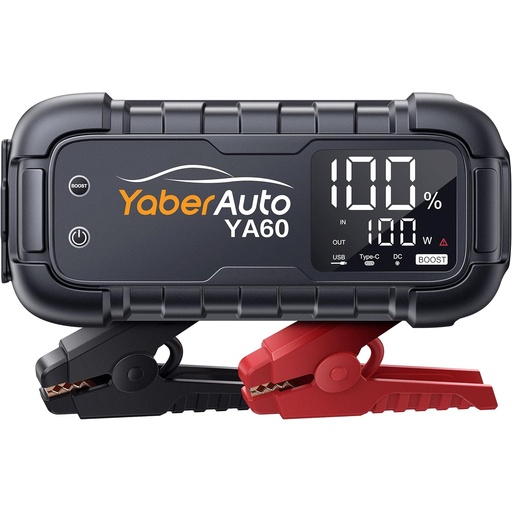
Why it suits this profile: For drivers of larger vehicles and anyone who also wants to charge phones, tablets or other 12V devices.
The stated compatibility covers 12V petrol engines and diesel engines up to 12.0 litres. According to the product information, the cables have an 8AWG construction and the unit offers ten intelligent safety protections.
8000A peak current, 65W USB-C, dual USB-A output, 150W DC output and 600-lumen lighting, according to the product description.
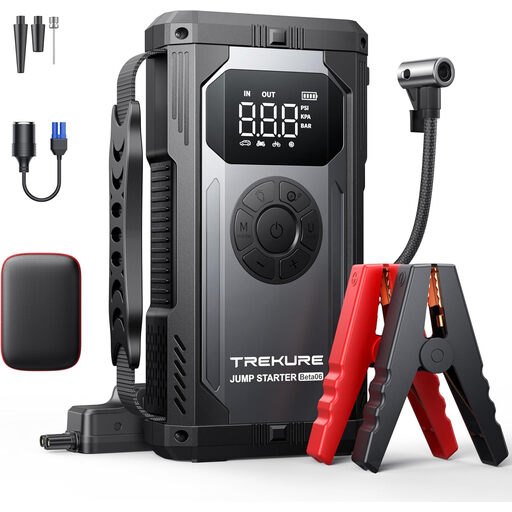
Why it suits this profile: A sensible choice for SUV and van owners, campers and drivers who want to carry a jump starter with an air compressor.
According to the product description, the compressor has an LCD display, adjustable pressure and an automatic shut-off. Check the current package contents before buying; the information provided lists different current ratings.
Rated peak current of 5500A, a 150 PSI compressor, 12V output, two USB-A ports and LED lighting with three modes.
We’ve put together a complete, up-to-date list of products that meet these strict selection criteria and current European safety regulations.
Don’t use an emergency jump starter with a damaged or leaking vehicle battery. If you’re unsure how to connect it, or the battery problem keeps coming back, it’s best to have a garage check it.
It depends on the battery type, charging cycles, storage temperature and maintenance. Top up the charge periodically if the device is not used for a long time. Follow the handbook; some models recommend recharging after a few months in storage.
Only if the manufacturer states that it’s compatible with diesel engines and gives a suitable maximum engine capacity. A powerful 12V jump starter won’t automatically be suitable for every diesel engine. Also check the condition of the vehicle battery and that the cables are connected correctly.
A model rated at 150 PSI with automatic shut-off can be handy for inflating car tyres, bicycle tyres and other inflatables. Always check your car’s recommended tyre pressure, and don’t use the maximum pressure as your standard setting.
