
Vandaag of morgen in huis

Kwaliteit gegarandeerd

Welkomstaanbiedingen ontgrendelen: GRATIS bezorging | Tot 80% korting | Gratis 30 dagen JoyPlus-proefperiode
Download de app
A flat 12V battery never happens at a convenient time. You might be in a car park, on the motorway or at a campsite with a campervan that won’t start. A car jump starter can be a practical emergency solution, but not every model is suitable for every car.
Look out for these three common pitfalls:
Below, you’ll find out which specifications matter and which portable jump starter suits different needs.
Most cars, motorbikes, SUVs, campervans and boats use a 12V battery system. That doesn’t mean every 12V jump starter is automatically suitable for every vehicle.
Before buying, check:
A car jump starter for a petrol engine may need a different capacity from one designed for a diesel. Diesel vehicles generally need more starting power. A product listing might, for example, state that it supports engines up to 8.0 litres petrol and 6.0 litres diesel. Use that limit to help you choose, rather than relying only on the eye-catching amp rating.
Also note that a jump starter for a standard 12V battery isn’t designed for an electric car’s high-voltage battery.
Peak current, such as 1,200 A, 2,000 A or 4,000 A, indicates the maximum starting power. In practice, battery charge, cable quality, temperature and engine size all play a part too.
A suitable high-power car jump starter should ideally have:
According to the product specifications for various models, safety features may include reverse polarity, overcurrent, overheating, overcharging and spark-free connection. Treat these as safety features, not a guarantee that an incorrect connection will never have consequences. Always follow the instructions.
A jump starter with a compressor combines a jump starter with a portable tyre inflator. It’s useful for a slow puncture, a motorbike, a campervan or a boat trailer. Check the following:
A stated maximum of 150 PSI doesn’t mean the pump will inflate every car tyre at the same speed. For everyday use, airflow and automatic shut-off are often more useful than maximum pressure alone.
The following selection is based on verifiable information in the product descriptions, such as peak current, engine compatibility, compressor functions and connections.
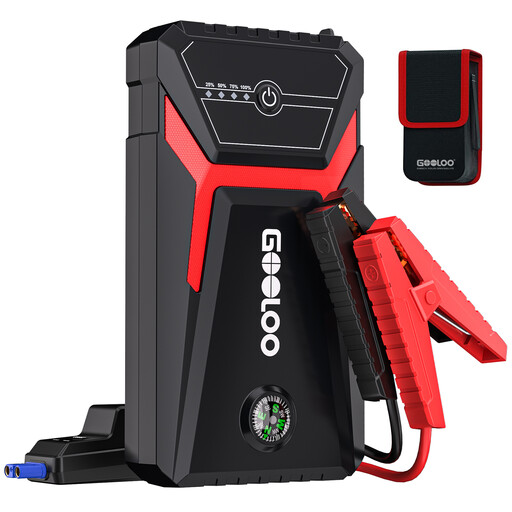
Why it suits this type of user: This 1,500 A car jump starter is designed for 12V vehicles with engines up to 6.0 litres petrol and 4.0 litres diesel. That makes it suitable for many everyday cars, motorbikes and smaller campervans.
The product specifications clearly state the engine limits and list ten safety features. So you don’t have to rely solely on a marketing claim about ‘power’.
Two USB outputs, a 400-lumen light with three modes and a weight of approximately 0.878 kg.
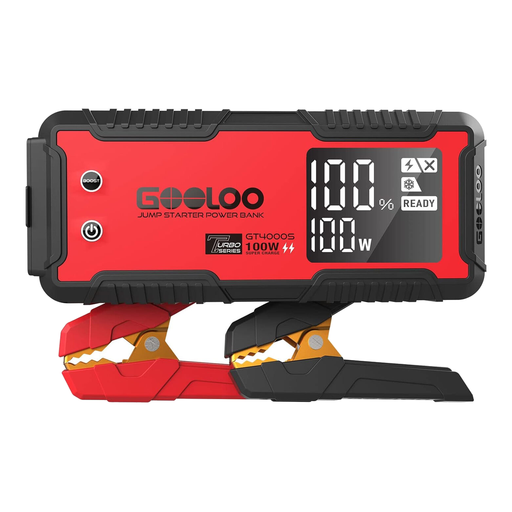
Why it suits this type of user: According to the product information, this model is suitable for 12V engines up to 12.0 litres petrol or 10.0 litres diesel. That makes it a good match for drivers of SUVs, campervans, pick-ups and larger vehicles.
The capacity, boost function and ten listed safety features are clearly described. Do check that your vehicle has a 12V system.
100W two-way charging, three USB ports, a 15V output and a 400-lumen light.
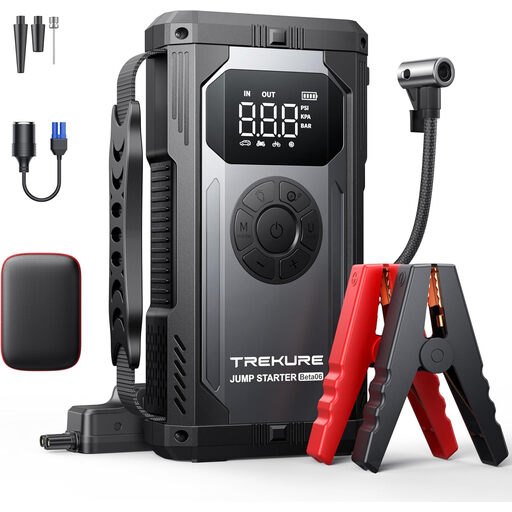
Why it suits this type of user: With a peak current of 5,500 A, a 150 PSI compressor and support for diesel engines up to 10.0 litres, this model is well suited to campervans, SUVs, vans and outdoor use.
The digital gauge, automatic shut-off and pre-set pressure make it easier to use the compressor accurately. Be sure to let the pump cool down as instructed.
23800 mAh battery, 35 l/min airflow, LCD screen, plus USB and 12V outputs.
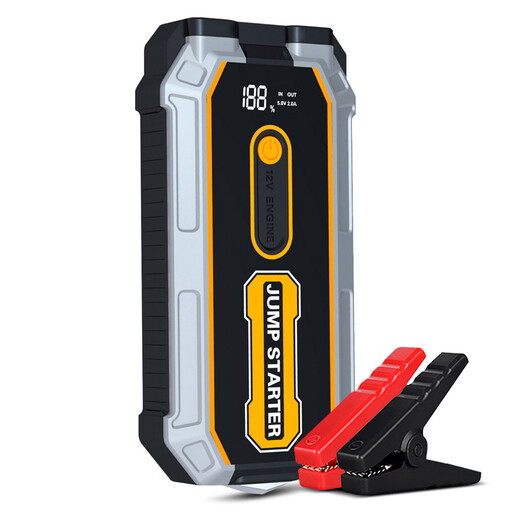
Why it suits this type of user: Weighing around 330 grams and measuring 165 × 84 × 30 mm, this portable power bank and car jump starter is ideal for a glove compartment, motorbike bag or compact emergency kit.
The product information lists both the peak current and the 600 A starting current. That gives you more context than a large peak-current figure alone.
12800 mAh battery, LCD display, USB output and LED light with three modes.
Don’t use the device if the battery is damaged or leaking, a cable is damaged or the casing is swollen. Store lithium products somewhere cool and dry, away from direct sunlight. Check the charge level every few months; the recommended maintenance interval varies by model.
We’ve put together a complete, up-to-date list of products that meet these strict selection criteria and the applicable European safety regulations.
Some models have a boost function for very low battery voltage. This doesn’t guarantee that they’ll work with every completely flat or damaged battery. Check the product specifications and only use the boost button as instructed.
Its lifespan depends on charging cycles, storage temperature and maintenance. Recharge the device regularly, even when you’re not using it. Don’t leave it in a hot car for long periods, and replace it if the casing, cables or battery show signs of damage.
It depends on how you’ll use it. For car drivers, motorcyclists and campervan owners, a built-in tyre inflator can save space. If you only need jump-starting, a more compact model without a compressor may be a simpler choice. So compare more than just the price: consider the weight, charging time, airflow and number of included accessories.
