
Vandaag of morgen in huis

Kwaliteit gegarandeerd

Welkomstaanbiedingen ontgrendelen: GRATIS bezorging | Tot 80% korting | Gratis 30 dagen JoyPlus-proefperiode
Download de app
A flat 12V battery often strikes at the worst possible moment: in a dark car park, during a caravan holiday or on your way to work. A car jump starter can be a practical solution, without relying on another driver. But not every portable jump starter is right for every vehicle or situation.
Look out for these three common pitfalls:
Most models in this category are designed for 12V lead-acid batteries. Check your vehicle’s manual to confirm. A car jump starter isn’t necessarily suitable for an electric car or a high-voltage system.
Next, check the stated compatibility:
Brands provide these figures themselves. For example, the GOOLOO GP2000 is claimed to support engines up to 8.0 litres petrol and 6.0 litres diesel. This is a manufacturer’s product specification, not a guarantee for every battery condition or vehicle model.
Peak current, for example 1500A, 2000A or 4000A, is a snapshot. Also check:
Useful safety features include reverse polarity, short-circuit, overheating, overload and spark protection. These features help reduce the risk of incorrect use, but they don’t replace careful connection according to the manual.
A basic car battery booster is compact and often easy to store. A more advanced model may also work as:
An air compressor is useful for motorists, motorhome owners and outdoor enthusiasts, but it makes the device heavier. Also check the maximum pressure in PSI, the air hose, the included valve adaptors and the automatic shut-off feature.
Read the full manual before using the device for the first time and charge it fully. The general procedure is:
Don’t let the clamps touch each other. Only use a forced-start function when you’re certain the polarity and connections are correct. If the cables are damaged, there’s a leak, the battery is swollen or you’re unsure what’s causing an electrical problem, it’s safer to call for roadside assistance.
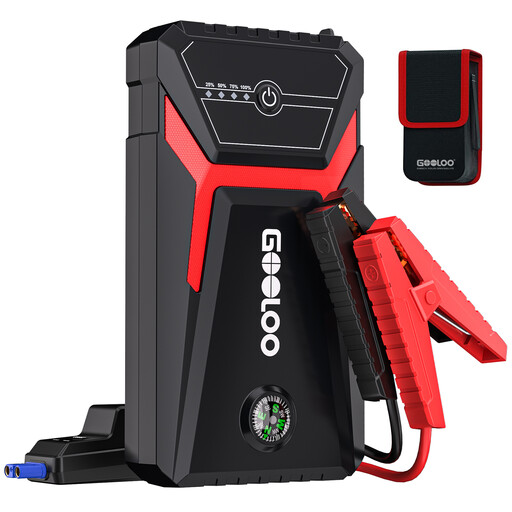
Why it suits this need: A compact option for drivers of a standard car, motorbike or small SUV who mainly want to carry a simple jump starter and power bank.
The product description states a peak current of 1500A, support for engines up to 6.0 litres petrol and 4.0 litres diesel, plus ten safety features. Check these details against your vehicle’s specifications.
Two USB ports, a 400-lumen lamp with three modes and a stated weight of around 0.878 kg, according to the product specifications.
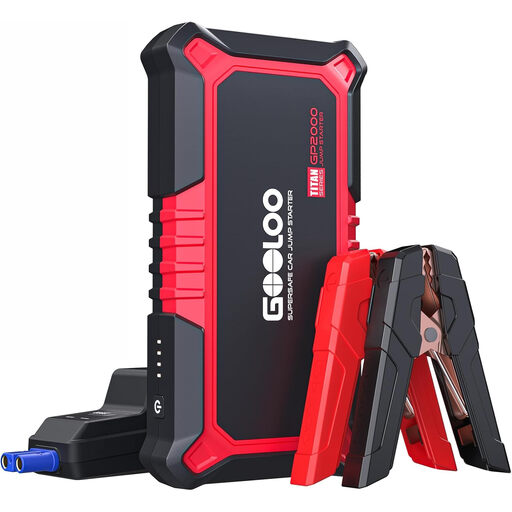
Why it suits this need: A good choice if you want a powerful 12V jump starter for a car, SUV, van, motorbike or recreational vehicle.
The smart cable is listed as having several safety features, and the casing is described as being designed for robust use. You’ll still need the right 12V battery.
2000A peak current, USB ports, a 400-lumen LED torch and stated support for engines up to 8.0 litres petrol and 6.0 litres diesel.
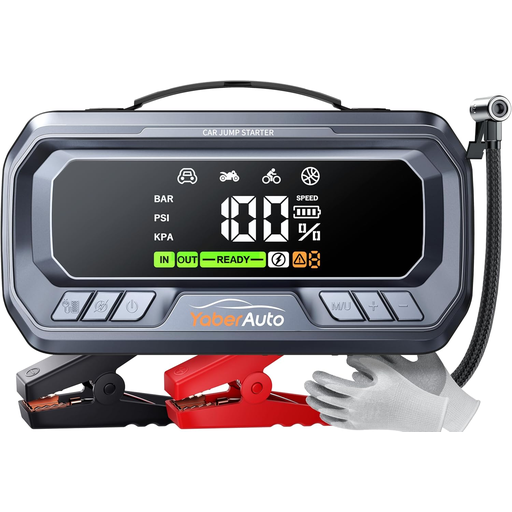
Why it suits this need: A practical combination for SUV and lorry drivers, campers and travellers who also want to manage tyre pressure and charge mobile devices on the go.
According to the product description, the LCD screen displays the set tyre pressure and the compressor switches off automatically when it reaches the set value. Don’t run the pump for long periods without a break.
A 160 PSI compressor, 65W two-way USB-C charging, a 3.3-inch LCD screen and a 600-lumen LED emergency light, according to the manufacturer.
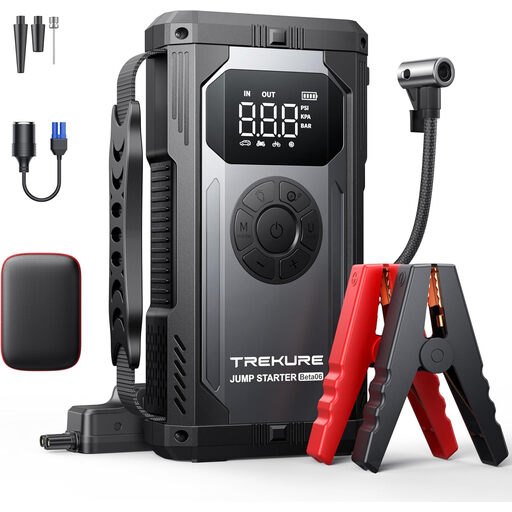
Why it suits this need: The combination of jump starter, compressor and power bank is well suited to larger vehicles, long journeys and outdoor use.
The manufacturer lists an LCD pressure display, automatic shut-off and safety features including short-circuit and reverse-polarity protection. Check whether the stated capacity for engines up to 10.0 litres petrol or 10.0 litres diesel applies to your vehicle.
5500A peak current, a 150 PSI air compressor, stated battery capacity of 23800mAh and three light modes.
We’ve put together a complete, up-to-date list of products that meet these strict selection criteria and the applicable European safety regulations.
A car jump starter needs little day-to-day maintenance, but it does need regular checks. Charge the device according to the manual and check its battery level before a long journey. Some manufacturers recommend topping it up every two to three months; follow the instructions for your chosen model.
Don’t store the jump starter in direct sunlight or in a very hot car for long periods. Lithium batteries may perform less well in cold and hot conditions. Also check the cables, clamps, USB ports and compressor accessories. The main running costs are usually the electricity used for charging and any replacement of the device or its internal battery after prolonged use.
No. Check whether your vehicle has a 12V lead-acid battery and compare its fuel type and engine size with the product specifications. A car jump starter isn’t automatically suitable for electric vehicles.
It varies by model and charger. A device with USB-C fast charging may charge more quickly than a basic model. Check the stated input, for example 18W, 65W or 100W, and only use suitable cables and adaptors.
Check the device regularly and charge it when the level is low. If you won’t be using it for a while, manufacturers often recommend checking or charging it every two to three months. It’s a good idea to recharge it after using it to jump-start a vehicle.
