
Vandaag of morgen in huis

Kwaliteit gegarandeerd

Welkomstaanbiedingen ontgrendelen: GRATIS bezorging | Tot 80% korting | Gratis 30 dagen JoyPlus-proefperiode
Download de app
A flat battery never happens at a convenient time. With a car jump starter, you can often try to start your vehicle yourself, without relying on another driver or roadside assistance. But not every portable jump starter is right for every car. And a high amp rating on the packaging doesn’t tell you everything.
For car, SUV and van owners, motorcyclists and campervan users, there are three pitfalls to watch out for: choosing a model that isn’t compatible with your vehicle, misinterpreting its stated peak current, and leaving the battery pack unused in the boot for months.
Brands often highlight peak current. It’s an important product specification, but it doesn’t guarantee that the jump starter will start your car. Always check:
In practice, a diesel engine generally needs more starting power than a comparable petrol engine. So a jump starter for a small city car won’t necessarily be suitable for a van, SUV or campervan.
Many models are described as universal, but this usually means they’re suitable for several vehicles with a 12V battery, within the stated limits. 24V systems, heavy commercial vehicles and the high-voltage batteries in electric cars aren’t necessarily covered.
Check your vehicle’s handbook and compare its engine capacity with the product specifications. A completely faulty, damaged or frozen battery may also be outside the scope of normal use. The boost function on some models may help when the voltage is very low, but the product information doesn’t guarantee a successful start.
A jump starter power bank isn’t an accessory you can buy once and then forget about. Lithium batteries gradually lose charge while in storage. Check the charge level regularly and recharge the jump starter after use. Some manufacturers recommend charging the device every two to three months.
Store your car battery booster somewhere dry, away from naked flames and extreme heat. If the manufacturer advises against it, don’t leave your jump starter in a hot car for long periods.
First, look at the combination of peak current, starting current and maximum engine capacity. A 1.200A model may be suitable for a small car or motorbike, while an SUV, diesel van or campervan may need more headroom.
Examples from product specifications:
These figures come from the relevant product information. Always compare them with your own vehicle instead of simply choosing the highest number.
Look for features such as reverse polarity protection, short-circuit protection, overheating protection and spark protection. These reduce the risk of connecting the clamps incorrectly, but they don’t replace careful use.
With a standard 12V jump starter, connect the red clamp to the positive terminal and the black clamp to the negative terminal or a suitable unpainted metal earth point, as instructed in the manual. Don’t crank for longer than the recommended three to five seconds at a time, and give the device time to cool down between attempts.
A battery booster with a compressor can come in handy if you need to top up a soft tyre as well as deal with a flat battery. Check the following:
A jump starter with an air compressor is especially practical for drivers, motorcyclists and campers. If you need to inflate several large tyres one after another, the maximum run time matters more than the maximum PSI alone.
An LCD or LED screen makes it easy to check the charge level and tyre pressure. A USB port also turns the jump starter into a portable battery charger for phones, tablets and other devices. If you also want to charge a laptop, check the USB voltage and charging standard.
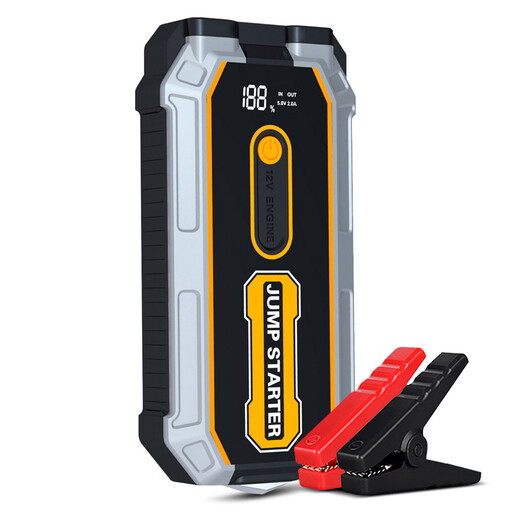
Why it suits this type of user: This compact model is for drivers looking for a straightforward emergency starter for a 12V car, motorbike, boat or snowmobile, without a compressor function.
The specifications clearly state a 1.200A peak current, a 12V system and the difference between peak current and nominal capacity. This makes it easier to compare the limits with those of your vehicle.
Around 330 grams, an LCD display, USB port and three-mode LED light, according to the product description.
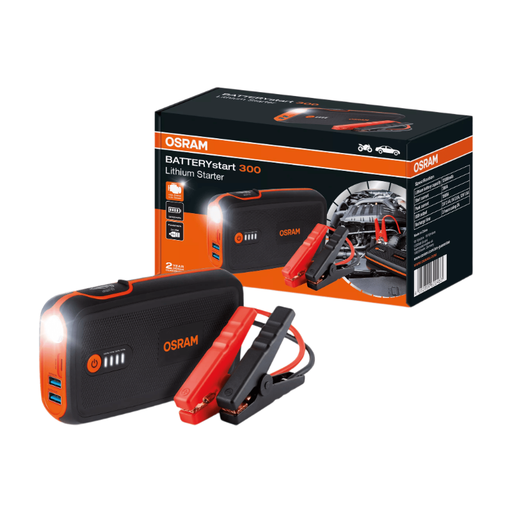
Why it suits this type of user: An option for anyone looking to combine a trusted brand, a 12V jump starter and extra power for accessories in one device.
The stated limit of up to 8 litres for petrol and 4 litres for diesel makes it easier to check whether it’s suitable before you buy. This model isn’t automatically designed for heavier diesel vehicles.
2.000A peak power, dual USB ports and an additional 12V output for items such as a tyre inflator or cool box, according to the product information.
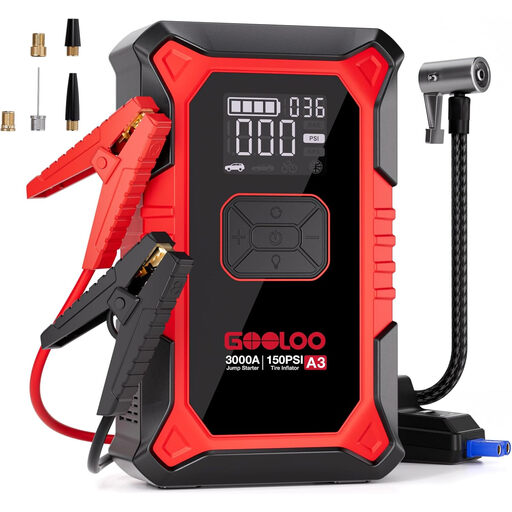
Why it suits this type of user: This model combines a jump starter, tyre inflator and power bank, giving drivers of SUVs, campervans, motorbikes or boats several emergency functions in one device.
Alongside vehicle compatibility, the product information lists the maximum pump pressure, airflow, automatic shut-off and five inflation modes. This makes it easier to assess the compressor function in detail.
3.000A peak current, a compressor rated up to 150 PSI, 35 litres per minute and a digital display with automatic shut-off, according to the product description.
We’ve put together a complete, up-to-date list of products that meet these strict selection criteria and current European safety regulations.
Don’t use a jump starter if the battery is visibly leaking, damaged or frozen. If in doubt, contact a garage or breakdown service.
No. Always check the voltage, engine capacity and fuel type. A 12V jump starter isn’t suitable for a 24V system or the high-voltage battery in an electric car. A completely faulty battery may also be outside the stated operating limits.
It depends on the battery type, how it’s used, storage temperature and maintenance. The product specifications may list, for example, a number of charge cycles or a standby period, but these are figures provided by the manufacturer. Charge the device regularly and store it somewhere dry and not too warm.
The compressor runs on the built-in battery, so there are no fuel costs, but you’ll use electricity when recharging it. Actual run time depends on the tyre size, the pressure you want, the outside temperature and the jump starter’s capacity. So don’t look at 150 PSI alone: check the airflow and maximum run time too.
