
Vandaag of morgen in huis

Kwaliteit gegarandeerd

Welkomstaanbiedingen ontgrendelen: GRATIS bezorging | Tot 80% korting | Gratis 30 dagen JoyPlus-proefperiode
Download de app
A flat battery often strikes at the worst possible time: in a car park, on a camping trip or just before you need to get to work. With a car jump starter, you can start a vehicle yourself in many situations, without needing another car or jump leads. Some models also work as a portable air compressor, a power bank for your car and an LED emergency light.
However, a high current rating isn’t the only thing to consider. Marketing claims can vary between brands and depending on conditions of use. Read on to find out which specifications matter in practice and which models suit different needs.
A figure such as 2000A, 4000A or 8000A sounds impressive, but peak current doesn’t guarantee that every vehicle will start in all conditions. Engine size, battery type, temperature and charge level also play a part.
So always check:
According to the manufacturer’s product information, for example, the GOOLOO GT4000S supports petrol engines up to 12,0 litres and diesel engines up to 10,0 litres. Treat this as a stated operating range, not a universal guarantee.
A jump starter with a compressor is handy for topping up a car tyre, bicycle tyre or air bed. Consider the combination of maximum pressure, airflow, hose length and automatic shut-off. A high PSI rating on its own tells you little about how quickly a tyre will inflate.
A digital pressure gauge is useful for car tyres. Also check that it offers the unit you need, such as PSI, bar or kPa. A separate tyre inflator may be a better choice if you mainly want to inflate tyres regularly and don’t need the jump-start function.
A car emergency jump starter only works if its internal lithium battery has enough charge. A model left in the boot for months without maintenance may not have enough capacity when you need it.
Good habits:
The stated peak current can help you compare models, but you should consider it alongside the engine size specified. A petrol jump starter generally needs less starting power than a diesel jump starter for an engine of a similar size. For an SUV, campervan, boat or van, it’s wise to allow for some extra headroom.
A 12V jump starter is designed for vehicles with a 12V battery system. Don’t use it with other voltages unless the manual expressly says it’s suitable.
Capacity is often listed in Wh or mAh. Wh is useful for comparing different models because it also takes voltage into account. USB-A and USB-C ports let you charge phones, tablets and other devices. A 12V or 15V output may be suitable for accessories, but check the required voltage and current beforehand.
Look for features such as:
These features reduce the risk of connecting the clamps incorrectly, but they don’t replace the manual. Usually, you should connect the red clamp to the positive terminal first, then the black clamp to the negative terminal or the designated earth point. Always follow your vehicle and manufacturer instructions.
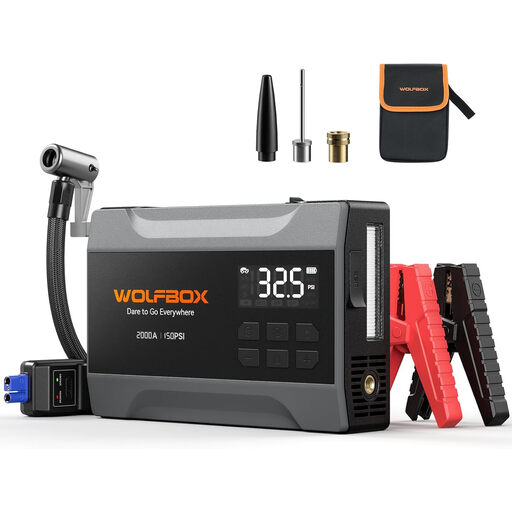
Why it suits this type of user: This model combines a jump starter with a compressor rated up to 150 PSI and LED lighting. According to the product information, it’s designed for petrol engines up to 5 litres and 12V vehicles.
The product specifications list both the maximum engine size and the compressor pressure. This makes it easier to check whether it’s suitable for your car than with a model that only makes an amperage claim.
2000A peak current, 150PSI compressor, 37Wh capacity and integrated LED light.
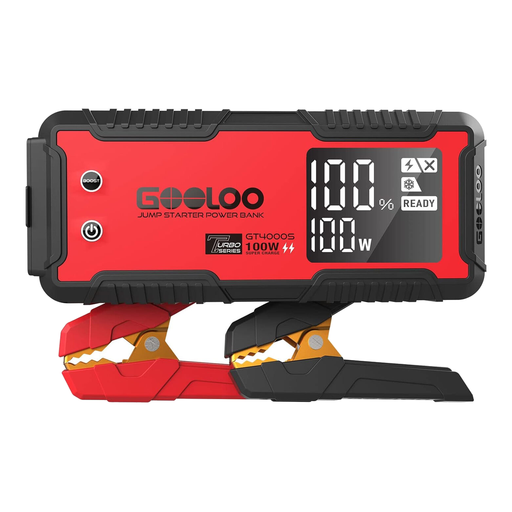
Why it suits this type of user: According to GOOLOO’s own product information, this model supports larger petrol and diesel engines and features 100W charging, multiple USB ports and a screen.
The stated engine ranges, connections and charging specifications are listed separately. So you don’t have to rely solely on the phrase “powerful jump starter”.
4000A peak current, supports diesel engines up to 10 litres according to the product information, 100W USB-C and LED emergency lighting.
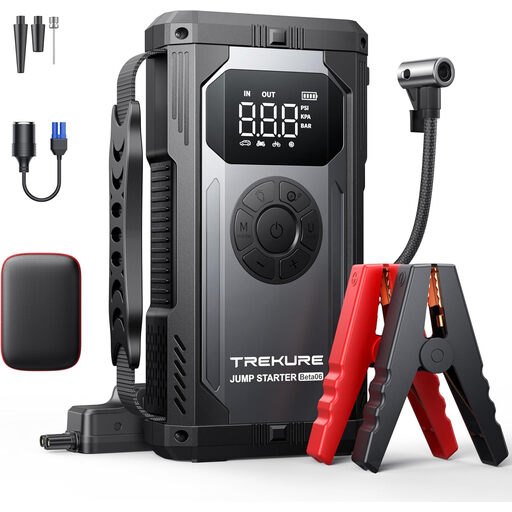
Why it suits this type of user: This model is aimed at larger vehicles and situations where you also need to inflate tyres. According to the product description, it supports petrol and diesel engines up to 10 litres and has a compressor with an LCD pressure display.
Alongside the peak current, the product information lists an airflow rate of 35 L/min, automatic shut-off and adjustable pressure. These are useful details if you use it regularly on the road.
5500A peak current, 150PSI compressor, LCD display, 12V output and three emergency light modes according to the product specifications.
We’ve put together a complete, up-to-date list of products that meet these strict selection criteria and the applicable European safety regulations.
That depends on the specifications. A diesel engine often needs more starting power than a petrol engine. So check the maximum diesel engine size specified and choose a model suitable for your 12V battery. For a large van, campervan or SUV, it’s wise to allow for some extra headroom.
Follow the brand’s instructions. As a practical check, look at the charge level every few months and fully charge the device before longer journeys. Some manufacturers recommend topping up the charge periodically, even if you haven’t used the jump starter.
A compressor is suitable for topping up a tyre with low pressure. If the tyre is genuinely leaking or damaged, don’t keep driving. Only use the tyre inflator within its stated pressure and usage limits, then have the tyre checked or repaired.
