
Vandaag of morgen in huis

Kwaliteit gegarandeerd

Welkomstaanbiedingen ontgrendelen: GRATIS bezorging | Tot 80% korting | Gratis 30 dagen JoyPlus-proefperiode
Download de app
A flat battery rarely happens at a convenient time. You might be in a car park, on the hard shoulder or about to set off for a campsite. A car jump starter can be a practical emergency starting aid, but not every model is right for every vehicle or situation.
Many buyers focus mainly on a high amp rating. That’s understandable, but it doesn’t tell the whole story. Check engine compatibility, battery voltage, cable safety, storage requirements and any extra features, such as a compressor. Read on to find out what to look for and which models suit different types of user.
A rating such as 2,000 A, 4,000 A or even 7,000 A sounds impressive. However, peak current is only one technical specification. In particular, check the petrol and diesel engine capacities the manufacturer says the device supports. A powerful jump starter for a compact car may not be suitable for an SUV, van or motorhome.
For example, according to the product description, the GOOLOO GP2000 supports engines up to 8.0 litres of petrol and 6.0 litres of diesel. The GOOLOO GE1500 is rated for up to 6.0 litres of petrol and 4.0 litres of diesel. Use these figures as a compatibility check, not as a guarantee that every car will start in all conditions.
Most portable car battery jump starters are designed for 12V vehicles. That doesn’t mean they’re suitable for the 24V systems found in some heavy goods vehicles, buses or commercial vehicles. Nor can a regular jump starter start an electric car’s high-voltage battery.
So, check your vehicle’s documentation to confirm:
A jump starter with a compressor is useful for a slowly deflating tyre or topping up tyre pressure. A model rated at, for example, 150 PSI may have a high maximum pressure, but that doesn’t automatically mean it will inflate a large car tyre quickly. Airflow, the hose, temperature and battery level all play a part.
Use the compressor for temporary roadside assistance, then have the tyre checked at a garage or service station. Always set the correct tyre pressure according to the sticker inside the door frame or your vehicle’s manual.
A model rated at 1,500 to 2,000 A may suit a small petrol car, provided the stated engine capacity is appropriate. For a diesel, SUV, motorhome or van, it’s useful to have more headroom. According to the product description, the GOOLOO GT4000S supports petrol engines up to 12.0 litres and diesel engines up to 10.0 litres.
Also check what to do if the battery voltage is very low. Some models have a BOOST or forced-start function. According to the product information for various models, this function is intended for emergencies when normal detection doesn’t work. Only use it when the clamps are connected correctly and the manual permits it.
A car battery booster with smart clamps may include:
These are useful features to check for, but they don’t replace correct connection. The red clamp should go on the positive terminal and the black clamp on the negative terminal or a suitable unpainted metal earth point, as directed in the manual. As a rule, don’t crank for longer than 3 to 5 seconds at a time, and let the starter cool down between attempts.
A model with a compressor may take up more space and weigh more than a basic 12V booster pack. So, compare:
A portable car power bank isn’t automatically an emergency jump starter. A regular power bank for a phone or laptop usually doesn’t have jump leads or supply the current needed by a car battery.
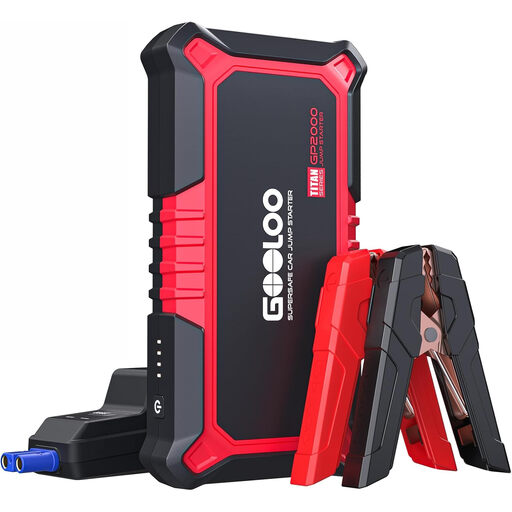
Why it suits this type of user: A compact option for drivers of standard 12V cars, motorbikes and smaller SUVs who mainly want to keep a jump starter handy in case of a flat battery.
The product description clearly states 12V support and limits of 8.0 litres of petrol and 6.0 litres of diesel, so you can check whether it’s compatible with your vehicle.
2,000 A peak current, 400-lumen LED torch, USB outputs and a stated standby time of up to 24 months.
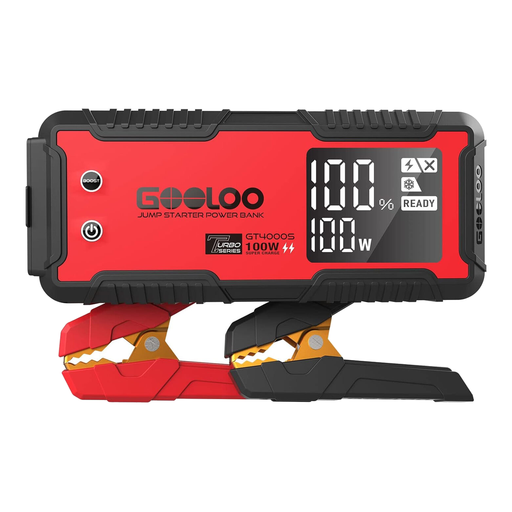
Why it suits this type of user: A good choice if you’re looking for broad engine compatibility, fast USB-C charging and extra ports.
The stated petrol and diesel limits make it easy to check whether it suits larger vehicles, while the status display helps you monitor the charge level.
4,000 A peak current, support for up to 12.0-litre petrol and 10.0-litre diesel engines, 100 W charging and a 400-lumen torch.
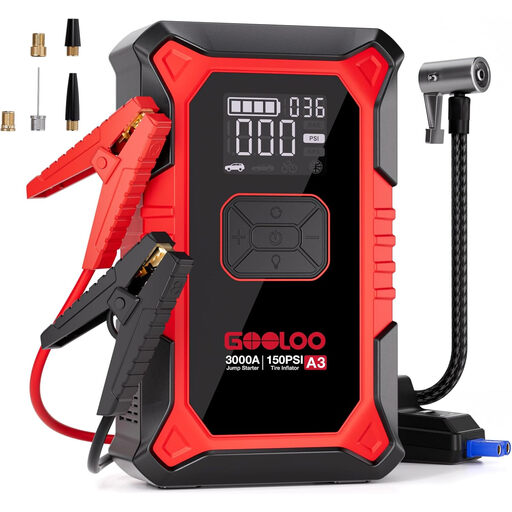
Why it suits this type of user: A handy option for motorists, cyclists and campers who want to take a tyre inflator and power bank along with an emergency jump starter.
The digital pressure gauge and automatic shut-off help prevent over-inflation; the product description lists five inflation modes.
3,000 A, compressor up to 150 PSI, airflow of 35 l/min, USB function, torch and ten listed safety features.
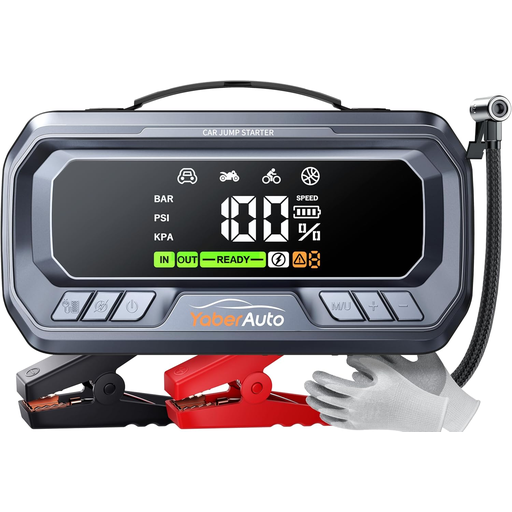
Why it suits this type of user: A good option for SUV, motorhome and van drivers who want a compressor, display and multiple power outputs in one device.
According to the product description, the 3.3-inch LCD screen shows settings and status, among other details. The manual emphasises connecting it correctly and using the forced-start function with care.
6,500 A peak current, 160 PSI compressor, 65 W bidirectional USB-C charging and a multi-mode torch.
We’ve put together a complete, up-to-date list of products that meet these strict selection criteria and the applicable European safety regulations.
Fully charge a new portable car battery jump starter before putting it in your car. Check the charge every two to three months and after each use. Don’t leave the device in direct sunlight or in a hot, enclosed car for long periods. Extreme heat can cause lithium batteries to deteriorate more quickly.
Read the manual before you find yourself in an emergency. Connect the red clamp to the positive terminal, attach the black clamp to the specified earth point and keep each starting attempt brief. Once the engine has started, disconnect the clamps in the order shown. A jump starter is for emergency assistance; if your battery problems keep coming back, have the vehicle battery checked.
Yes, many models are designed for both, but the permitted engine capacity varies. Check the limit for petrol and diesel separately. Diesel engines often need more power to start, especially in cold weather.
That depends on charging cycles, storage temperature, use and maintenance. Follow the charging interval in the manual and store the device somewhere dry. A stated standby time is a product specification, not a guarantee of the same performance in every situation.
Only if the model has a built-in compressor. Check the maximum pressure, airflow, hose and adaptors. Set the desired pressure and use the automatic shut-off if the feature is available. Then check the tyre again with a separate pressure gauge.
