
Vandaag of morgen in huis

Kwaliteit gegarandeerd

Welkomstaanbiedingen ontgrendelen: GRATIS bezorging | Tot 80% korting | Gratis 30 dagen JoyPlus-proefperiode
Download de app
A flat car battery rarely happens at a convenient time. You could be in a car park, on the motorway or at a campsite when you discover that your engine won’t start. A car jump starter can get you out of trouble, but only if it’s suitable for your vehicle and used correctly.
Many models look alike, but there are clear differences in starting current, engine compatibility, safety features and extra functions. Keep these points in mind to choose a powerful 12V jump starter that’s right for everyday use, holidays or emergencies.
A high peak current sounds appealing, but it doesn’t tell the whole story. Manufacturers often quote the maximum peak current, but whether a jump starter is suitable also depends on:
A 3,000A jump starter isn’t automatically suitable for every vehicle. Always check the stated limits for petrol and diesel engines.
Some small devices are primarily designed for charging a phone. They may have USB ports, but might not provide the starting power a car battery needs. So don’t just look at the capacity in mAh. Check that the product is explicitly described as a car emergency jump starter or a jump starter for 12V vehicles.
A jump starter with a compressor can be handy if you need to top up your tyre pressure on the road. However, a built-in portable tyre inflator isn’t the same as a workshop compressor. Check the maximum pressure, maximum operating time, supplied connectors and automatic shut-off.
A torch or power bank is useful too, but these features use battery capacity. So if a device is left unused in the boot for months, it needs to be recharged regularly.
Most cars, SUVs, motorhomes, boats and motorbikes use a 12V system. That doesn’t mean every 12V device is suitable for every vehicle. Pay particular attention to the maximum engine capacity:
A jump starter for petrol and diesel engines will usually state separate limits, for example, up to 9.0 litres for petrol and 8.0 litres for diesel. Treat these figures as the stated product specifications, not as a guarantee that every flat or faulty battery can be started.
Look for a clear polarity warning, plus protection against short circuits, overloading and overheating. A smart cable set can indicate whether the red clamp is connected to the positive terminal and the black clamp to the negative terminal.
Also check:
A CE mark indicates that the responsible party declares the product complies with the applicable European requirements. It isn’t a performance certification and, on its own, says nothing about starting power. Also check the seller’s information, product warnings and usage restrictions.
A lithium jump starter is usually compact and easy to carry. The stated mAh capacity gives you an indication of its energy reserve. Practical runtime also depends on starting current, temperature and use of the torch or USB ports.
Look for:
For example, the product information for the GOOLOO GP3000 lists a 15W USB-C port, a 15V DC socket for a tyre inflator and an LED light. The manufacturer recommends regular recharging to keep the device ready for use. Always follow the manufacturer’s instructions, and don’t use a jump starter with a damaged, leaking or frozen battery.
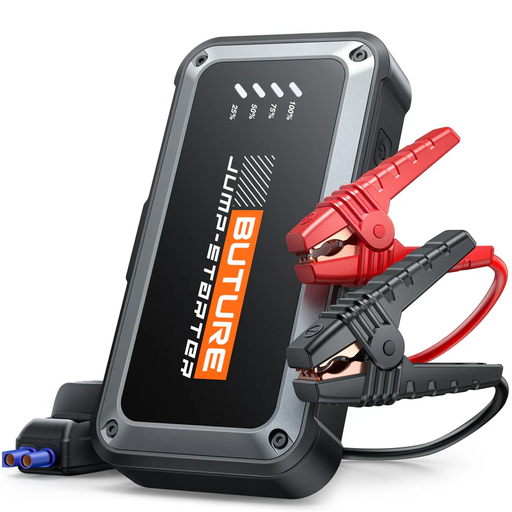
Why it suits this profile: The Beta08 combines a 3000A starting function with a power bank and four lighting modes. It’s a good fit for drivers looking for one compact device for roadside emergencies and camping.
The product information gives separate limits for petrol and diesel engines, so you can compare vehicle compatibility instead of focusing only on the amp rating.
3000A peak current according to the product listing, a 16800mAh power bank, two USB outputs and an LED light with four modes.
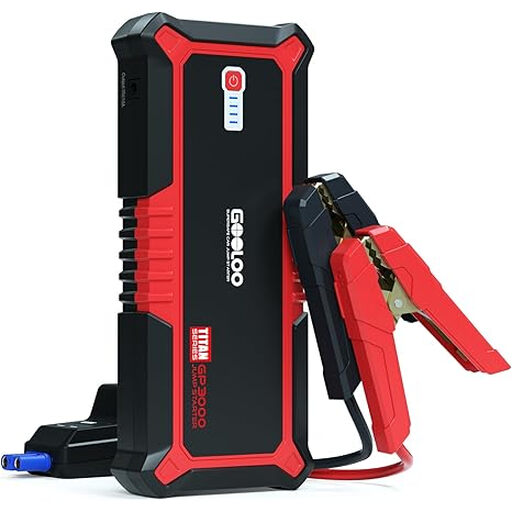
Why it suits this profile: This model is designed for drivers of cars, trucks, motorhomes and boats who want to carry a robust 12V booster with multiple connections.
The stated limit is up to 9 litres for petrol or 7 litres for diesel. The product description also mentions spark-proof clamps and protection against overloading, reverse polarity and other issues.
3000A peak current according to the manufacturer, a USB-C fast-charging port, a 15V DC socket and a 400-lumen LED light according to the product information.
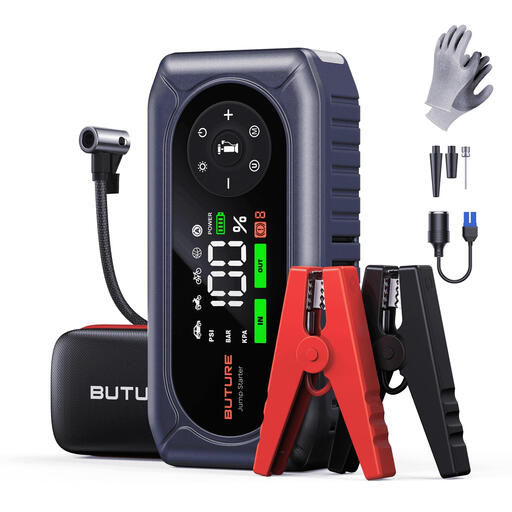
Why it suits this profile: The combination of a jump starter and compressor is a good fit for SUV owners, motorhome travellers and drivers who also want to carry a car tyre inflator.
The product information lists a digital compressor up to 150 PSI, five inflation modes, three pressure units and automatic shut-off. Do check the maximum operating time.
4500A peak current according to the product listing, a 150 PSI compressor, LCD screen, power bank and 500-lumen LED light.
We’ve put together a complete, up-to-date list of products that meet these strict selection criteria and the applicable European safety requirements.
First check that it’s designed for a 12V system, then check the stated engine capacity for petrol and diesel. A small city car won’t necessarily need the same specifications as an SUV, motorhome or boat. The stated peak current is only one part of the assessment.
A jump starter is primarily designed to provide temporary starting power. It won’t always fully recharge a vehicle battery in the way a battery charger does. If the battery goes flat often, have it checked after starting the vehicle.
Its lifespan depends on how often it’s charged, storage temperature, use and maintenance. Follow the charging intervals in the manual and avoid storing it in a hot car for long periods. Before any longer journey, check that the battery indicator shows a sufficient charge.
