
Vandaag of morgen in huis

Kwaliteit gegarandeerd

Welkomstaanbiedingen ontgrendelen: GRATIS bezorging | Tot 80% korting | Gratis 30 dagen JoyPlus-proefperiode
Download de app
A flat car battery rarely happens at a convenient time. You might be in a car park, at a campsite or on a dark country lane. A car jump starter can be a practical emergency aid, but not every model is right for every vehicle.
Marketing copy often focuses on a high amp rating, a large battery or a built-in compressor. Those figures don’t tell the whole story. Read on to find out which specifications matter, which pitfalls to avoid and what type of portable jump starter is right for you.
A peak current of, say, 6000A or 8000A sounds impressive. However, this isn’t the same as the normal starting current. Peak current is used for a short time, and it doesn’t tell you on its own how much power the device delivers in practice.
So always check:
A compact jump starter for a small petrol car has different requirements from a booster for a diesel SUV, van, motorhome or boat.
A high mAh figure mainly means there’s plenty of energy available for USB devices or multiple uses. It doesn’t automatically determine how well it can start a car. As well as capacity, check the stated peak current, starting current and engine compatibility.
A portable car power bank can be useful for a phone, tablet or GPS, but it should also come with suitable jump leads and safety features. Check whether a charging adapter is included, too. Some models only come with a USB cable.
A car jump starter with compressor can come in handy if a tyre is low, but maximum pressure is only one factor. Airflow, automatic shut-off, hose length and display are important, too.
A pump rated at 160 PSI may reach a high maximum pressure according to the product specifications, but the actual inflation time depends on the tyre size, its current pressure and how long the pump is used. Treat a built-in compressor as an emergency solution, then check the tyre pressure with a reliable pressure gauge.
Choose a car jump starter to suit your vehicle, not just the advert headline. For a standard car, a model that supports medium-sized petrol and diesel engines may be sufficient. If you own an SUV, motorhome, boat or van, it’s worth checking the stated engine capacity carefully.
Look out for conflicting information, too. The TREKURE Beta06 product title states a peak current of 5500A, while the accompanying information gives a figure of 4000A in one place. That’s exactly why you should check the product details, manual and compatibility information before ordering.
A good car battery booster should have clear connection instructions. Useful features include:
Connect the red clamp to the positive terminal and, following the manual, attach the black clamp to the negative terminal or a suitable unpainted metal earth point. Only use the cables supplied or recommended. Never let the red and black clamps touch.
Lithium batteries gradually lose charge in storage. So charge your jump starter periodically, even if you don’t use it. Follow the manual: some manufacturers recommend charging every few months, while others specify a longer maintenance interval.
Don’t leave the device in a hot, enclosed car for long periods. Check the stated operating temperature range, too. Even if the product description says it can work in low temperatures, performance still depends on the condition of your car battery and making the connections correctly.

Why it suits this type of user: According to the product description, this compact model is designed for 12V petrol and diesel vehicles, motorbikes, boats and snowmobiles. Its low weight and compact size make it handy for keeping in the glove compartment or a small emergency kit.
The product specifications give both a peak current of 1200A and a starting current of 600A. This makes it easier to compare with other products than if only one peak figure were listed.
330 grams, LCD display, 12800mAh battery, USB output and three LED modes, according to the product information.
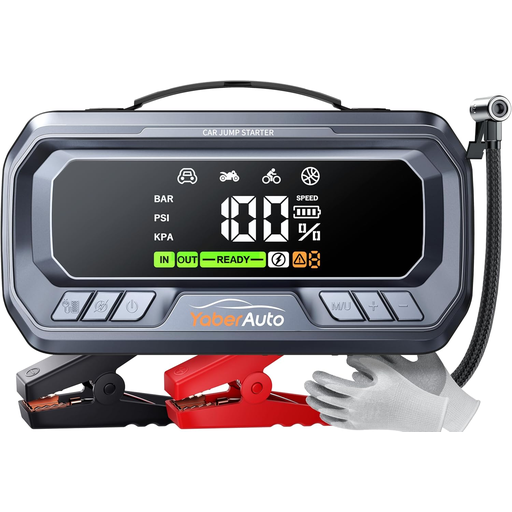
Why it suits this type of user: The combination of jump-starting function, compressor, display and 65W USB-C connection is ideal for drivers who want to use several devices and features on the go.
The product specifications list not only a peak current of 6500A, but also support for diesel engines up to 8,0 litres and a 160 PSI compressor. Even so, check that your vehicle falls within these limits.
65W bidirectional USB-C charging, 3,3-inch LCD display, 160 PSI air pump and four lighting modes, according to the product description.
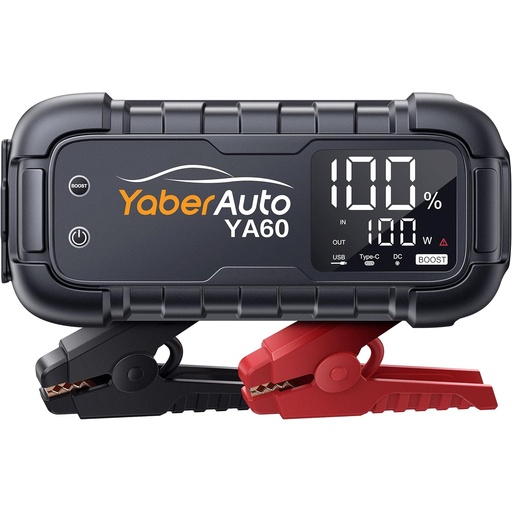
Why it suits this type of user: This model is designed for larger vehicles and for users who want to power laptops, phones, cool boxes or other 12V devices as well as jump-start their vehicle.
The product information specifically lists support for 12V petrol engines and diesel engines up to 12,0 litres, as well as guidance on charging intervals and the maximum number of starting attempts.
8000A peak current, 65W USB-C, 150W DC output, 26800mAh lithium-polymer battery and ten listed safety features.
We’ve put together a full, up-to-date list of products that meet these strict selection criteria and the applicable European safety regulations.
A jump starter won’t fix a faulty battery. If the car doesn’t start after several attempts, there may be a problem with the battery, starter motor, fuse or wiring.
You can, but exposing a lithium battery to high temperatures for long periods isn’t advisable. Store the device somewhere dry, out of direct sunlight and away from loose metal objects. Check its charge level regularly.
Its lifespan depends on how it’s used, storage temperature, charging habits and battery type. Follow the manufacturer’s care instructions and charge the device periodically. Don’t use it if the casing is damaged, swollen or leaking.
No. Always check 12V compatibility, the maximum engine capacity for petrol and diesel vehicles, and the stated starting and peak currents. A booster for a small car won’t necessarily be suitable for a large diesel motorhome or van.
