
Vandaag of morgen in huis

Kwaliteit gegarandeerd

Welkomstaanbiedingen ontgrendelen: GRATIS bezorging | Tot 80% korting | Gratis 30 dagen JoyPlus-proefperiode
Download de app
A flat battery often strikes at the worst possible moment: on a cold morning, at the roadside or just before setting off in your campervan. With a car jump starter, you can try to start a 12V battery yourself, without needing another car or jump leads. Some models also work as a power bank, torch and tyre inflator.
Yet many devices look much the same. A high amp rating on its own doesn’t tell you enough. Read on to find out which specifications matter, which marketing claims to treat with caution and what type of car battery jump starter best suits your needs.
A figure such as 3000A, 5500A or 8000A sounds impressive, but peak current is not the same as the normal starting current. Check which engine type and capacity the product information says the device is suitable for. A 12V jump starter for a small petrol engine isn’t automatically suitable for a large diesel engine.
A jump starter power bank might advertise a capacity of 20.000 mAh, while its stated rated capacity is lower. A lithium battery also loses charge if the device is left unused in your car for months. So check the charge level, recommended storage conditions and maintenance interval. A model you check regularly is more useful than a more powerful device that turns out to be flat.
A compressor, LCD screen, USB ports and emergency light can all come in handy, but they often make a device larger and heavier. A jump starter with compressor is useful for long journeys and campervans, but if you only need to deal with a flat battery, a more compact portable jump starter may be enough. Also check whether the air hose, cables and storage case are included.
Most car battery jump starters in this category are designed for 12V lead-acid batteries. Check your vehicle’s handbook to confirm. Then look at the maximum engine capacity stated:
The figures on the packaging are product specifications, not a guarantee that the device will start every vehicle in every situation.
A good car emergency jump starter should ideally have protection against reverse polarity, short circuits, overheating, overloading and overcharging. Smart cables can warn you if the clamps are connected the wrong way round. This helps reduce the risk of mistakes, but always check the positive and negative terminals yourself.
Strong metal clamps, cables long enough to reach and well-insulated handles are useful when the battery is difficult to access. Only use the cables supplied or recommended by the manufacturer.
Dutch winters can affect lithium batteries. Check the stated operating temperature range, and don’t leave a jump starter in direct sunlight for long periods or in a hot, closed car. Fully charge the device before using it for the first time, then check it as instructed in the manual, for example every two to six months.
A light with a steady beam, flashing mode or SOS function is useful if you break down in the dark. However, don’t use the light as a substitute for a warning triangle or a safe place to stop by the road.
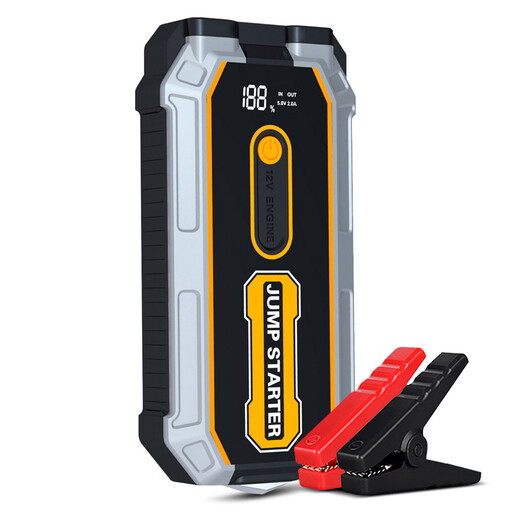
Why it suits this user: At around 330 grams, its compact design is ideal for motorists who want to keep a simple car jump starter in the glove compartment or an emergency kit.
The product information gives both a peak current of 1200A and the maximum application for 12V petrol and diesel vehicles. This lets you compare its suitability with your vehicle’s specifications instead of looking only at the biggest amp rating.
330 grams, LCD display, USB output and three-mode LED light.
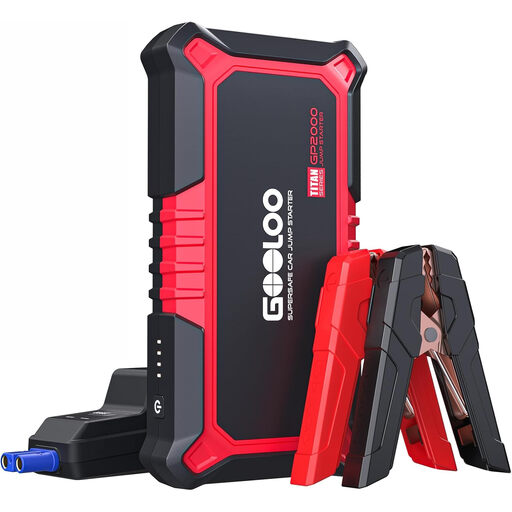
Why it suits this user: This portable jump starter combines a stated peak current of 2000A with smart jump leads, USB outputs and a compact design.
The product description specifies suitability for petrol engines up to 8,0 litres and diesel engines up to 6,0 litres, along with ten listed safety features. Always check these limits against your vehicle’s specifications.
Around 545 grams, 400-lumen light, USB outputs and a stated standby time of up to 24 months.
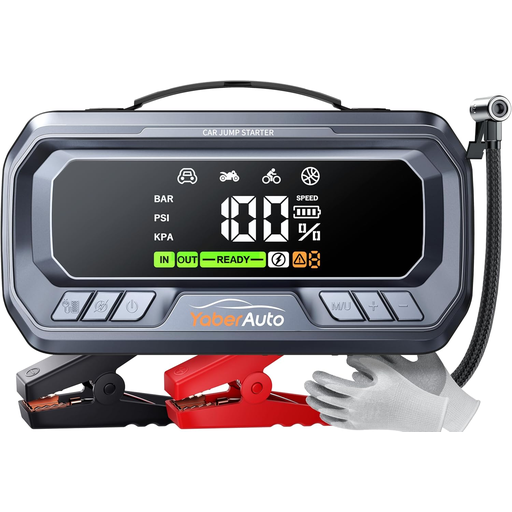
Why it suits this user: For SUV drivers, travellers and outdoor enthusiasts, this model offers an air pump and several connections for mobile devices as well as jump-starting support.
According to the product information, the built-in compressor has an LCD screen, an automatic stop function and a pressure range of up to 160 PSI. This means you can see the set pressure while inflating.
65W USB-C charging, 160 PSI compressor, 3,3-inch screen and 600-lumen light.
Don’t use a jump starter with a leaking, swollen or visibly damaged battery. If you’re unsure about the connections or the condition of the car, it’s safer to call for roadside assistance.
We’ve put together a complete, up-to-date list of products that meet these strict selection criteria and the relevant European safety regulations.
No. The battery generally needs to be in a condition where it can still accept a charge. Check the jump starter’s 12V specification, engine type and maximum engine capacity. A completely failed battery, a problem with the starter motor or an empty fuel tank won’t be fixed by a booster.
It varies by model and storage recommendations. Check the charge level every few months and recharge the device after use. Don’t store it for long periods in extreme heat or damp conditions. Its capacity may slowly decrease while in storage.
It depends on how you plan to use it. For long journeys, campervans, SUVs and outdoor activities, a built-in compressor can be useful if a tyre is under-inflated. If you only need to start a car with a flat battery, a lighter and simpler car battery jump starter may be a better choice.
